

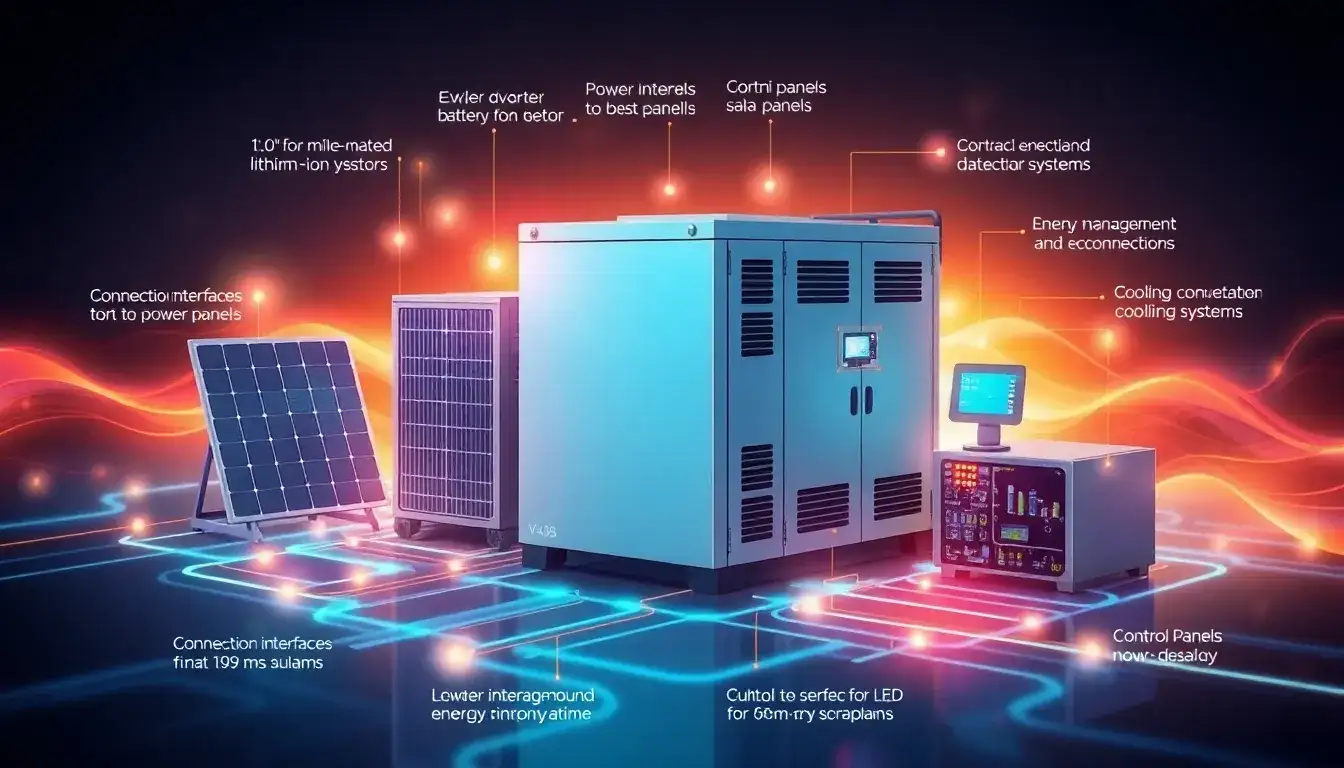
The main components of a Battery Energy Storage System (BESS)
A Battery Energy Storage System (BESS) includes several critical elements that work together to store, manage, convert, and safely deliver electrical energy. These components are:
1. Battery System
- The battery system is the core of the BESS, consisting of individual lithium cells wired together into modules.
- Modules are stacked and combined into battery racks; these racks can be connected in series or parallel to achieve the desired voltage and capacity.
- Lithium-ion chemistries like Lithium Iron Phosphate (LFP) or Lithium Nickel Manganese Cobalt Oxide (NMC) are commonly used due to their high energy density and efficiency.
- The battery stores energy chemically and delivers it as direct current (DC) when needed.
2. Battery Management System (BMS)
- The BMS acts as the brain of the battery system, continuously monitoring battery parameters such as state of charge (SoC), state of health (SoH), voltage, current, and temperature.
- It ensures safe operation by protecting the battery from overcharge, over-discharge, overheating, and other hazardous conditions.
- Advanced BMS architectures can monitor at cell, module, string, and system levels, enabling real-time protection, performance optimization, and thermal management to prevent failures like thermal runaway.
3. Power Conversion System (PCS) or Bidirectional Inverter
- Batteries store and provide electricity as DC, but electrical grids and loads typically use alternating current (AC).
- The PCS converts DC from the batteries to AC for grid or local use during discharge and converts AC to DC to charge the batteries.
- This bidirectional capability allows the BESS to both absorb power (charge) and deliver power (discharge).
- The PCS also supports various operational modes and integrates protection functions such as overload and reverse power protection.
4. Energy Management System (EMS)
- The EMS oversees the coordination and control of the entire BESS, optimizing energy flow and scheduling charging/discharging.
- It interfaces with the BMS, PCS, and external systems to ensure the BESS operates efficiently and aligns with grid demands or user needs.
- EMS can integrate with grid control systems like SCADA (Supervisory Control and Data Acquisition) for real-time monitoring and operation management.
5. Storage Enclosure and Thermal Management
- Batteries and electronics are housed in protective enclosures designed for safety, environmental protection, and compliance with standards.
- Thermal management systems, including HVAC (Heating, Ventilation, and Air Conditioning), maintain optimal operating temperatures to prolong battery life and prevent overheating.
- Enclosures may incorporate liquid cooling or chiller systems and include sensors to monitor environmental conditions.
6. Safety Systems
- Fire suppression and detection systems are integral to prevent and mitigate fire hazards.
- Additional safety features include temperature sensors, smoke detection, door and flooding sensors, and emergency shutdown capabilities.
- Restricted access, CCTV monitoring, and multiple protection layers ensure safe operation of the BESS.
7. Other Components
- Electrical components such as breakers, switches, and transformers ensure safe connection and integration with the electrical grid.
- Optional microgrid controllers can manage distributed energy resources and real-time dispatching.
Summary Table of Main BESS Components
| Component | Function |
|---|---|
| Battery System | Stores energy chemically and delivers DC power |
| Battery Management System (BMS) | Monitors and manages battery health and safety parameters |
| Power Conversion System (PCS) / Inverter | Converts DC to AC and vice versa, enabling charging and discharging |
| Energy Management System (EMS) | Controls and optimizes overall system operation and energy flow |
| Storage Enclosure & Thermal Management | Protects components and regulates internal temperature for safety and longevity |
| Safety Systems | Fire suppression, detection, and environmental safety sensors |
| Electrical Components | Breakers, switches, transformers for grid integration and system protection |
| Optional Controllers | Microgrid or system controllers for advanced dispatch and coordination |
These components collectively enable a BESS to store electricity from renewable or grid sources, maintain safe and efficient operation, and deliver power when required, supporting grid stability and energy reliability.
Original article by NenPower, If reposted, please credit the source: https://nenpower.com/blog/what-are-the-main-components-of-a-battery-energy-storage-system-2/

