

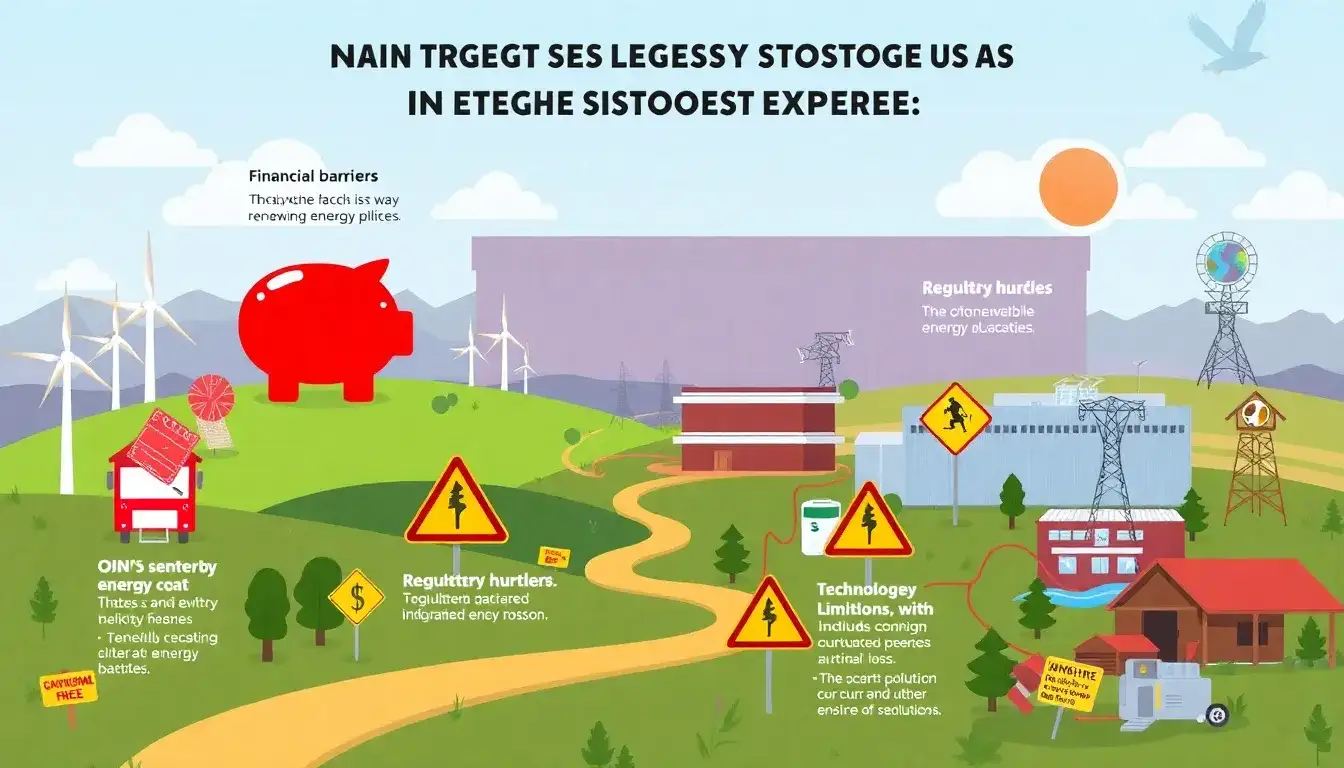
States face several main challenges in achieving their energy storage targets, which broadly fall into regulatory, technical, financial, and infrastructural categories:
Regulatory and Policy Challenges
- Limited agency capacity: Relevant state agencies often lack sufficient bandwidth to develop and manage comprehensive energy storage policies, slowing progress.
- Unclear or evolving regulations: There is uncertainty about utility ownership and control of large-scale storage in restructured electricity markets, complicating policy design and project implementation.
- Complex permitting and interconnection: Legacy interconnection standards and permitting processes create barriers to siting and deploying storage projects efficiently.
- Policy uncertainty: Crafting rules that apply across diverse storage technologies, applications, and nascent markets is difficult due to limited information and rapidly evolving technology.
- Challenges tracking renewables with storage: Difficulty in accounting for renewable generation when paired with storage complicates policy and market mechanisms.
Technical and Infrastructure Barriers
- Grid and hosting capacity constraints: Legacy grid infrastructure often lacks sufficient hosting capacity for large-scale storage, limiting integration.
- Site selection issues: Identifying optimal locations for large storage projects to maximize grid benefits remains a challenge.
- Integration with distributed energy resources: Decisions regarding co-location of storage with other distributed resources lead to technical and regulatory complexities.
Financial and Market Challenges
- High costs and supply chain issues: The perceived high upfront cost of storage technologies, worsened by supply chain disruptions, leads to procurement delays and financial hurdles.
- Market readiness concerns: Some storage technologies are not fully market-ready, creating uncertainty about their deployment viability and timing.
- Need for clear procurement targets: While procurement targets provide investor confidence and reduce regulatory uncertainty, variability in these targets (broad MW goals vs. technology-specific mandates) requires careful calibration to stimulate the right investment types.
Environmental and Long-Duration Storage Issues
- Environmental impacts: Potential environmental effects of storage projects need to be evaluated and mitigated, adding complexity to deployment.
- Focus on Long-Duration Energy Storage (LDES): States are increasingly focused on LDES to support deep decarbonization but face additional challenges related to technology maturity and regulatory frameworks.
In summary, states must navigate a complex mix of regulatory capacity, infrastructure limitations, financial viability, and evolving market designs to meet ambitious energy storage targets. Effective policymaking that addresses these multifaceted challenges is essential to accelerate energy storage adoption and support grid decarbonization goals.
Original article by NenPower, If reposted, please credit the source: https://nenpower.com/blog/what-are-the-main-challenges-states-face-in-achieving-their-energy-storage-targets/

