

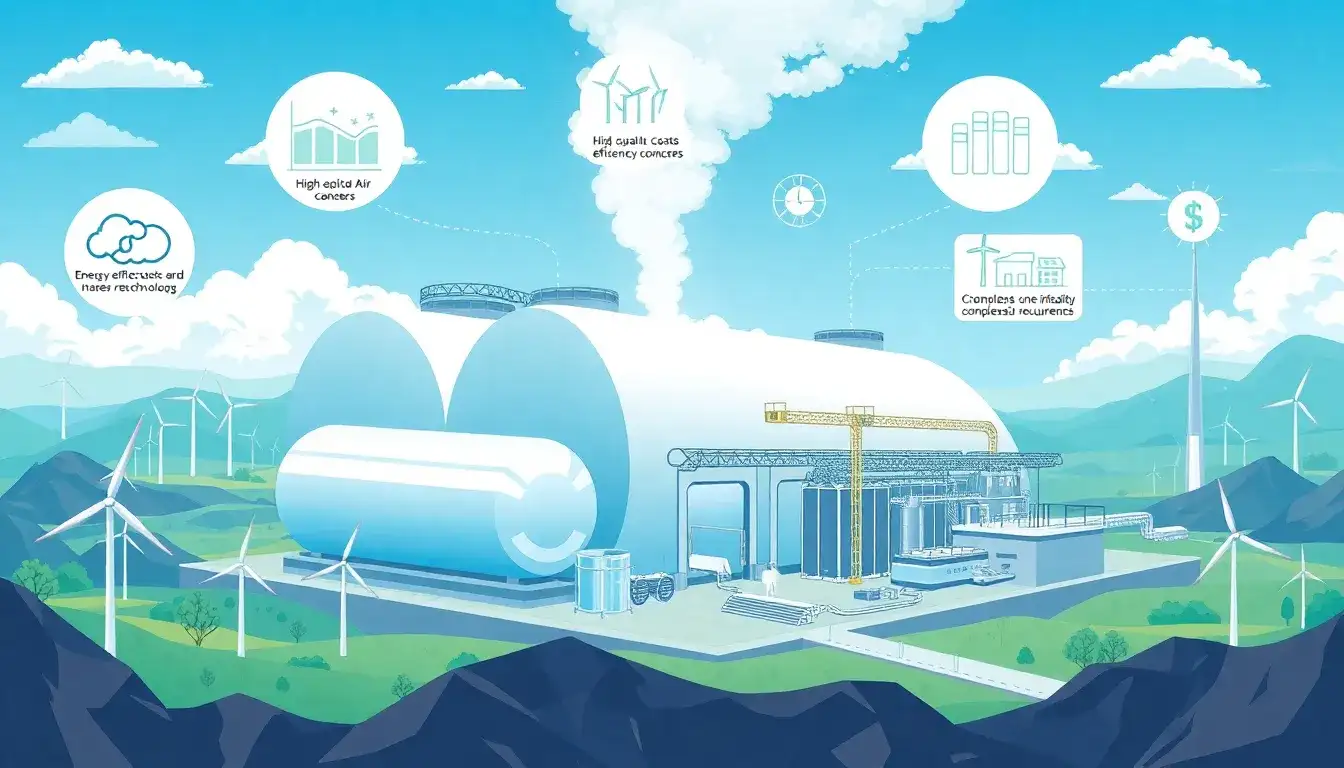
The main challenges preventing Liquid Air Energy Storage (LAES) from being economically viable are:
- High Capital Costs, Especially for Liquefaction Systems: LAES requires expensive liquefaction units, and at small scales, these costs are prohibitively high. Economies of scale are essential, with financial viability typically only achievable at large scales (around 200 MW) and production volumes (10 to 100 units per year). The lack of a competitive market for small-scale liquefaction systems keeps costs elevated and limits adoption.
- Need for Significant Cost Reductions: Despite promising technological performance, LAES systems must undergo further cost reductions in capital expenditures (CAPEX) and operating expenses (OPEX) to become competitive against other storage technologies and grid resources.
- Electricity Market Price Volatility and Revenue Uncertainty: LAES profitability relies heavily on the volatility of electricity prices, as it earns revenue by buying electricity at low prices to liquefy air and selling electricity at high prices during peak demand. Insufficient price volatility reduces the chances for LAES to capture enough value, hindering financial attractiveness to investors.
- Competition with Other Storage and Generation Technologies: Economic dispatch in electricity markets favors the lowest-cost available resource. LAES must compete against increasingly cheaper and more established technologies like batteries and pumped hydro, which can be more economically attractive depending on market conditions.
- Limited Financial Incentives and Market Support: Government incentives and policies that historically helped other renewable technologies (like feed-in tariffs) have yet to be established broadly for LAES. Without supportive policy frameworks and financial incentives, the economics remain challenging.
- Integration Challenges and Optimal Operation Scheduling: The complexity of hourly operation modeling and the ability to optimize charging and discharging cycles in real-world variable market conditions affect profitability and present operational challenges.
In summary, LAES is technically promising but currently limited by high capital costs at smaller scales, market and price uncertainties, and the need for supportive policies and economies of scale to improve financial viability.
Original article by NenPower, If reposted, please credit the source: https://nenpower.com/blog/what-are-the-main-challenges-preventing-laes-from-being-economically-viable/

