

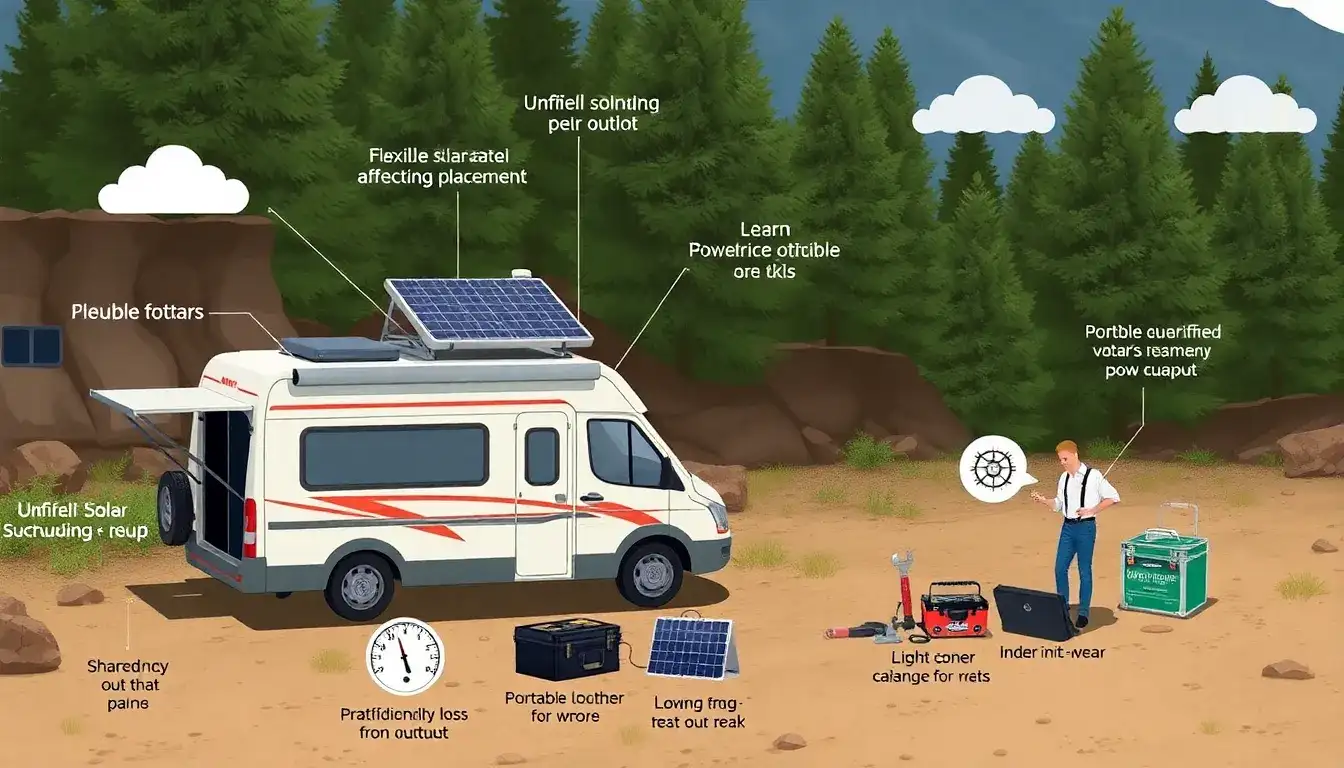
Flexible solar panels offer appealing advantages for off-grid applications, such as light weight, adaptability to curved or irregular surfaces, and ease of installation. However, they also present several significant challenges that can affect their performance, durability, and overall suitability for off-grid use.
Main Challenges of Using Flexible Solar Panels for Off-Grid Applications
1. Overheating and Heat Dissipation
Flexible solar panels tend to overheat more easily than rigid crystalline panels because their solar cells are sandwiched between layers that do not dissipate heat well. When mounted flush against surfaces (like RV roofs or boats) without adequate ventilation, heat can build up, reducing efficiency and accelerating the degradation of solar cells and the panel material itself. Prolonged overheating can also damage the surface beneath the panel, such as causing heat burns on RV roofs.
Practical solutions include elevating the panels slightly to allow airflow, using thermally conductive layers between the panel and mounting surface, or choosing panels with backsheet designs that minimize heat transfer.
2. Lower Efficiency Compared to Rigid Panels
Flexible solar panels generally have lower conversion efficiency, typically between 10% and 17%, while rigid crystalline panels achieve 16% to 24%. This is due to their thin semiconductor films having less material for photovoltaic reaction. For off-grid systems with limited space, this lower efficiency means less power generation per unit area, which can be a critical limitation.
A common workaround is to use multiple flexible panels in series or parallel (“daisy-chaining”) to boost overall output, though this increases cost and complexity.
3. Durability and Limited Flexibility
Despite their name, flexible solar panels have limited bending tolerance (often around a 30-degree bend radius). Excessive bending, twisting, or physical stress can crack the solar cells, causing permanent damage and voltage loss. This fragility reduces their lifespan compared to rigid panels designed with protective glass and aluminum frames. Flexible panels are also more prone to mechanical damage during handling and installation.
4. Delamination and UV Degradation
Flexible panels use fewer protective layers and often cheaper materials, making them susceptible to UV-induced degradation such as delamination—the peeling or yellowing of the plastic laminates that protect the solar cells. This not only reduces light transmission and efficiency but ultimately necessitates disposal and replacement of the panel.
5. Hot Spots and Partial Shading Sensitivity
Flexible panels are vulnerable to hot spot effects, where shaded or damaged cells cause localized overheating that can permanently damage the panel or pose safety risks. Their thin design and lack of robust protective layers make them especially prone to this phenomenon. Proper installation with bypass diodes and routine cleaning can mitigate this risk.
6. Suitability for Off-Grid System Design
Off-grid applications demand reliable, durable, and efficient power sources. Flexible panels’ lower efficiency and shorter lifespan compared to rigid panels create challenges in system sizing and maintenance. Careful system design and understanding of energy needs are essential to compensate for these limitations.
Summary Table of Flexible Solar Panel Challenges for Off-Grid Use
| Challenge | Cause/Detail | Impact on Off-Grid Use | Mitigation Strategies |
|---|---|---|---|
| Overheating | Poor heat dissipation; mounted flush without ventilation | Reduced efficiency, panel and surface damage | Elevate panels; add thermally conductive layer |
| Lower Efficiency | Thin semiconductor film | Requires more panels for same power output | Use multiple panels in parallel/series |
| Durability | Limited bend radius; fragile cells | Shorter lifespan; risk of breakage | Avoid excessive bending; careful handling |
| Delamination/UV Damage | UV exposure causes plastic laminates to peel/yellow | Efficiency loss; need for panel replacement | Use high-quality panels; proper disposal |
| Hot Spots | Partial shading causes localized overheating | Permanent damage, safety hazard | Install bypass diodes; regular cleaning |
| System Design Complexity | Need for understanding off-grid sizing and configuration | Potential for underperformance | Careful planning; professional advice |
Conclusion
Flexible solar panels provide valuable advantages in weight, installation ease, and adaptability for off-grid applications, especially on curved or mobile surfaces like boats, RVs, or tents. Nonetheless, their main challenges—overheating, lower efficiency, limited durability, and UV sensitivity—must be carefully managed through proper installation, system design, and maintenance practices to ensure reliable off-grid solar power. For users prioritizing longevity and maximum energy output, rigid solar panels usually remain the superior choice despite higher weight and installation complexity. However, for lightweight, portable, or curved surface applications, flexible panels are a cost-effective and practical solution when their limitations are acknowledged and addressed.
Original article by NenPower, If reposted, please credit the source: https://nenpower.com/blog/what-are-the-main-challenges-in-using-flexible-solar-panels-for-off-grid-applications/

