

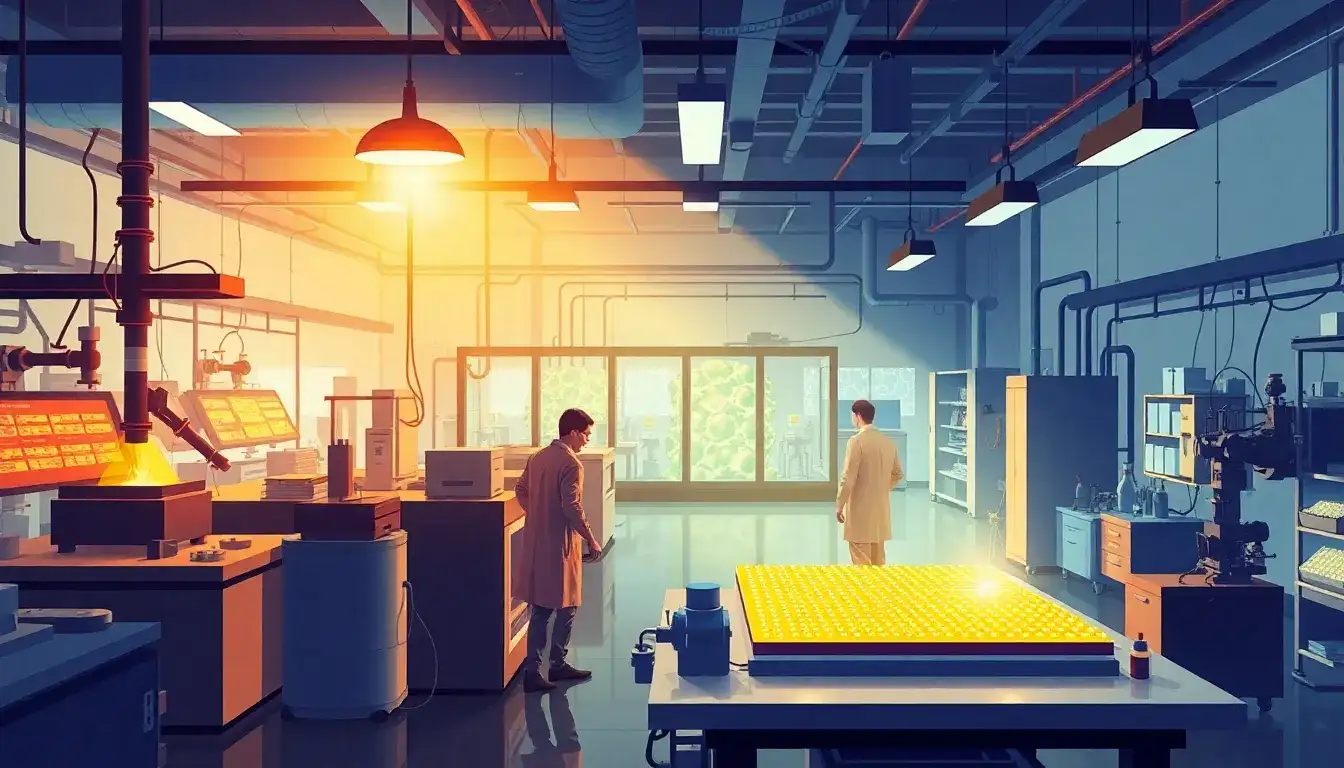
The main challenges in scaling up the production of high-efficiency perovskite solar cells (PSCs) revolve around several critical technical and industrial factors:
1. Large-Area Fabrication and Uniformity
- Uniformity and Morphology Control: Achieving uniform and defect-free perovskite layers over large areas is difficult. The performance and efficiency highly depend on the perovskite film’s morphology, which is sensitive to the deposition technique used. Scaling from small lab-scale cells to large-area modules requires precise control of film formation to maintain efficiency.
- Deposition Techniques: Laboratory-scale methods (e.g., spin coating) are not easily scalable. Transitioning to scalable deposition approaches such as slot-die coating or roll-to-roll processing faces challenges in maintaining film quality and uniform layer thickness during high-throughput production.
2. Stability and Durability
- Long-term Stability: Perovskite materials typically suffer from poor stability under environmental stressors like heat, moisture, and prolonged light exposure. This instability hinders commercialization and large-scale deployment, as device lifetimes must meet industry standards for solar modules.
- Encapsulation Technology: Effective encapsulation is needed to protect PSCs from degradation, but scalable encapsulation methods that maintain performance are still being optimized.
3. Efficiency Loss during Upscaling
When scaling up to large-area modules, efficiency often drops significantly compared to small-area lab devices. This performance loss is due to issues like non-uniform film coverage, defects, and increased electrical losses across larger areas.
4. Material and Environmental Considerations
- Reproducibility and Cost: Producing high-quality perovskite layers reproducibly at low cost over large areas remains a challenge. Consistent material quality is essential for industrial adoption.
- Sustainability: The use of toxic solvents and lead-containing materials raises environmental and health concerns. Efforts toward greener solvent use, recycling, and environmentally friendly processes are critical components for the sustainable industrial scale-up of PSCs.
Summary Table of Challenges
| Challenge | Details |
|---|---|
| Large-area film uniformity | Maintaining high-quality, uniform films with controlled morphology on large substrates |
| Scalable deposition | Adapting lab-scale deposition methods to scalable ones (e.g., slot-die, roll-to-roll) |
| Device stability | Ensuring long-term thermal, moisture, and light stability to meet commercial requirements |
| Efficiency retention | Minimizing performance loss when transitioning from small cells to large-area modules |
| Material reproducibility | Achieving consistent high-quality perovskite layers at low cost |
| Environmental impact | Developing green processing methods and recycling to reduce toxicity and environmental risks |
With ongoing research addressing these issues—improving deposition technologies, stabilizing materials, and enhancing encapsulation—perovskite solar cells hold strong potential for industrial-scale production and widespread renewable energy application.
Original article by NenPower, If reposted, please credit the source: https://nenpower.com/blog/what-are-the-main-challenges-in-scaling-up-the-production-of-high-efficiency-perovskite-solar-cells/

