

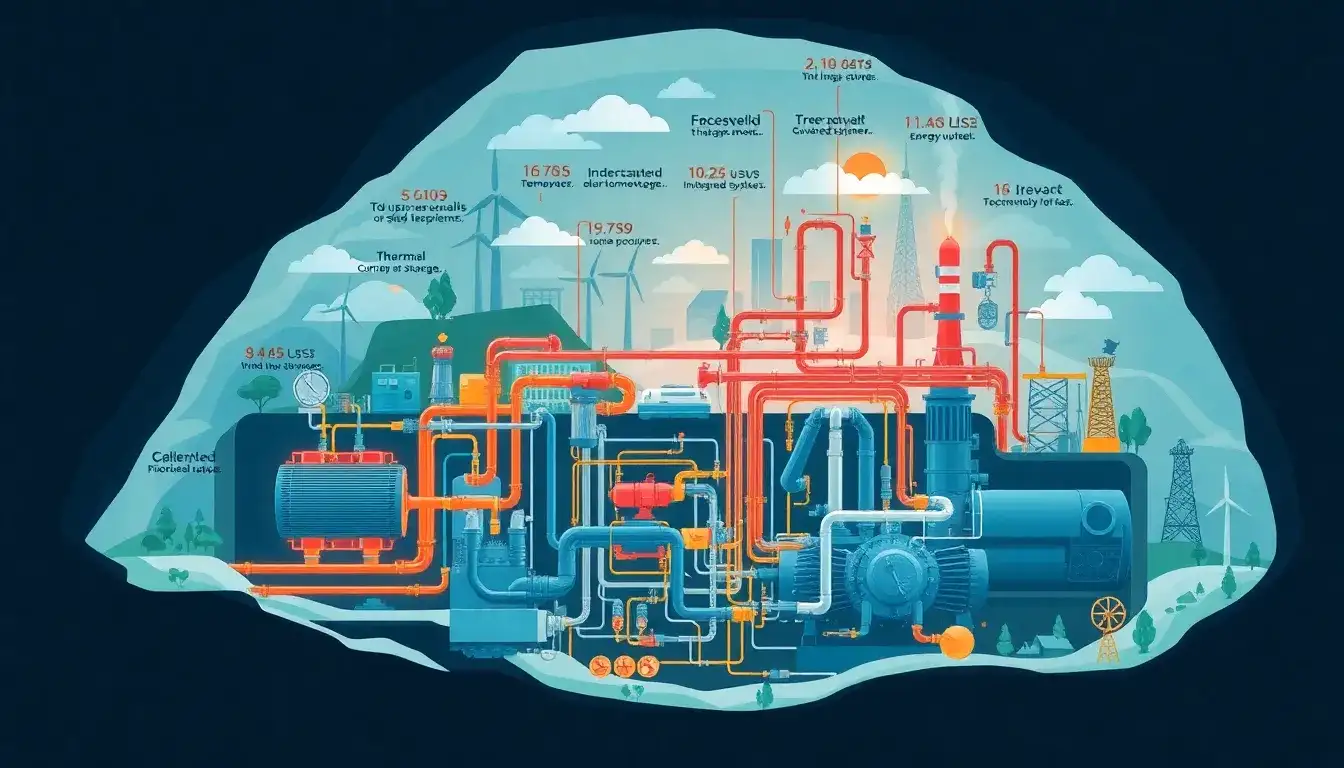
Thermal Energy Management and Efficiency
- Heat of Compression: When air is compressed for storage, it heats up significantly. Managing this thermal energy is challenging because the excess heat, if dissipated, reduces efficiency and can cause equipment damage. Diabatic CAES systems vent this heat during compression, losing valuable energy and requiring reheating of the air before expansion, often with natural gas combustion, which lowers overall efficiency (around 27% energy recovery) and compromises ecological benefits.
- Reheating Requirement: The need to reheat compressed air before expansion means fuel must be burned, especially when renewable sources are not generating, further lowering efficiency and increasing costs.
- Heat Recovery: Modern designs attempt to capture and reuse compression heat to improve efficiency, but this adds complexity and cost.
Economic and Technical Barriers
- High Capital Costs: Large-scale CAES projects demand significant upfront investment, which can be a barrier to adoption.
- Lower Round-Trip Efficiency: Compared to some other storage technologies, CAES systems typically have lower round-trip efficiencies, partly due to thermal losses and reheating requirements.
- Inconsistent Benchmarking: Variability in reporting and evaluating performance metrics complicates comparison and improvement across CAES systems.
- Resource Characterization: Identifying and characterizing suitable geological formations or other air storage options is a technical challenge that impacts feasibility and scalability.
Operational and Deployment Challenges
- Response Time and Energy Density: Improving how quickly CAES systems can respond to grid demands and increasing energy density are ongoing technical targets.
- Siting and Availability: Effective deployment depends on appropriate site selection for underground storage and ensuring high system availability.
- Sustainability and Reliability: Ensuring CAES systems can provide sustainable, reliable, and cost-effective long-duration energy storage remains a challenge that advanced CAES concepts aim to address.
In summary, large-scale CAES faces challenges primarily in managing the thermal energy associated with compression and expansion cycles, achieving high efficiency without fossil fuel input, overcoming high capital and operational costs, and identifying suitable storage resources and sites. These challenges shape ongoing research and development efforts to improve CAES viability as a long-duration energy storage solution.
Original article by NenPower, If reposted, please credit the source: https://nenpower.com/blog/what-are-the-main-challenges-in-large-scale-caes-systems/

