

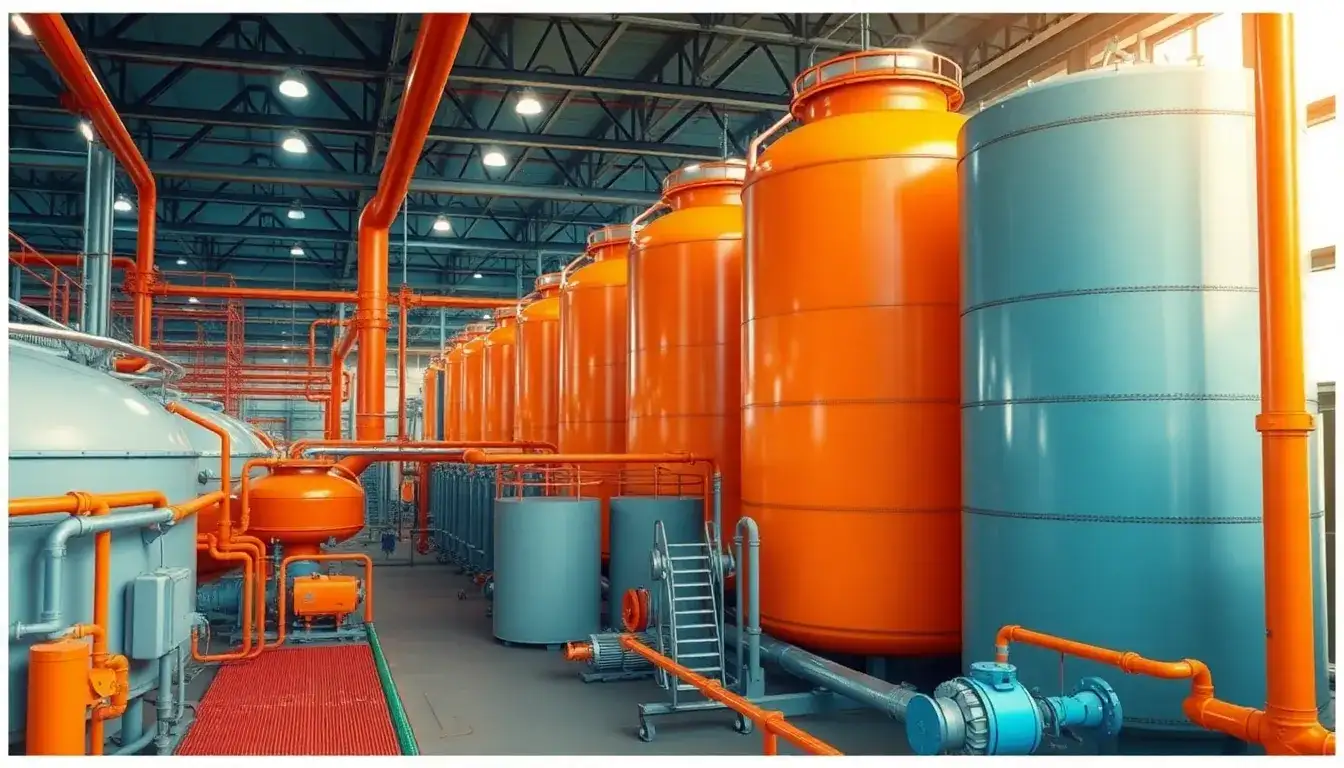
The main challenges in implementing thermal energy storage (TES) systems in industrial settings can be grouped into technological, economic, and integration-related issues as follows:
1. Material and Technological Challenges
- Low Energy Density and Large Volume Requirements: Sensible heat storage materials like water or rocks have relatively low energy density, leading to large storage volumes and footprints that can be impractical for some industrial locations.
- Material Degradation and Durability: Storage materials can degrade over time, especially water-based or salt-based media, reducing thermal storage capacity and lifespan.
- Thermal Conductivity and Efficiency Issues: Phase Change Materials (PCMs) used for latent heat storage suffer from low thermal conductivity, slowing charging/discharging rates, and phenomena like supercooling which reduce effectiveness. Encapsulation to improve their properties adds cost.
- High Temperature and Material Constraints for Thermochemical Storage: Thermochemical TES offers high energy density but requires materials that can withstand high temperatures, pressures, and repeated thermal cycling without degradation, posing significant material science challenges.
- Thermal Losses: All TES types face challenges with thermal losses through conduction, convection, and radiation, which decrease overall system efficiency.
- Complexity in Thermal Energy Conversion: Efficiently converting stored thermal energy back into usable energy or heat at industrial scale can be technologically difficult and expensive.
2. Economic and Financial Challenges
- High Upfront Costs: TES systems involve significant initial capital investment, especially for large-scale industrial applications. This can be a barrier despite falling costs in recent years.
- Financial Risk and Market Uncertainty: The lack of predictable, fixed-price power purchase agreements (PPAs) and limited market mechanisms to value flexibility increase financing risks for TES projects.
- Commercial Risks and Industry Immaturity: As TES technology is relatively new, it is perceived as risky by investors and users, slowing adoption and scaling.
- Cost of Advanced Materials and Technologies: Some advanced TES materials, particularly for latent and thermochemical storage, are costly or require expensive system components, impacting overall economics.
3. Integration and Scalability Challenges
- Scaling to Industrial Size: Scaling TES from lab or pilot scale to full industrial capacity requires overcoming engineering challenges related to maintaining uniform temperature distribution, heat transfer efficiency, and system control.
- Space and Site Constraints: Large storage volumes may not fit conveniently in urban or constrained industrial sites, posing a logistical barrier.
- Grid and System Integration: TES needs sophisticated control systems for managing charging/discharging cycles and to respond dynamically to grid demands. Integration with existing energy infrastructure requires coordination with grid operators and can be complex.
- Dependence on Renewable Energy Development: TES often relies on renewable electricity to charge storage mediums; delays in renewable generation capacity or grid upgrades can limit TES deployment.
- Regulatory and Standardization Gaps: Lack of clear regulation and standardization in TES systems poses challenges for project evolution, scalability, and replacement of components over time.
Summary Table
| Challenge Category | Specific Issues |
|---|---|
| Material & Technology | Low energy density, material degradation, thermal losses, efficiency, high-temperature material constraints, conversion inefficiency |
| Economic & Financial | High upfront costs, financing risks, industry immaturity, costly materials |
| Integration & Scalability | Large physical footprint, site and space constraints, grid integration complexity, dependency on renewable infrastructure, lack of standards/regulation |
Addressing these challenges involves ongoing research in advanced materials, better system designs for heat exchange, smart control integration using AI, financial mechanisms to reduce investment risk, and improved regulatory frameworks. Pilot projects and gradual scaling are key to demonstrating reliability and economic viability to the industrial sector.
In essence, while TES holds great promise for decarbonizing industrial heat and balancing energy supply-demand, overcoming the multifaceted challenges of materials, cost, scaling, and integration is critical for widespread industrial adoption.
Original article by NenPower, If reposted, please credit the source: https://nenpower.com/blog/what-are-the-main-challenges-in-implementing-thermal-energy-storage-systems-in-industrial-settings/

