

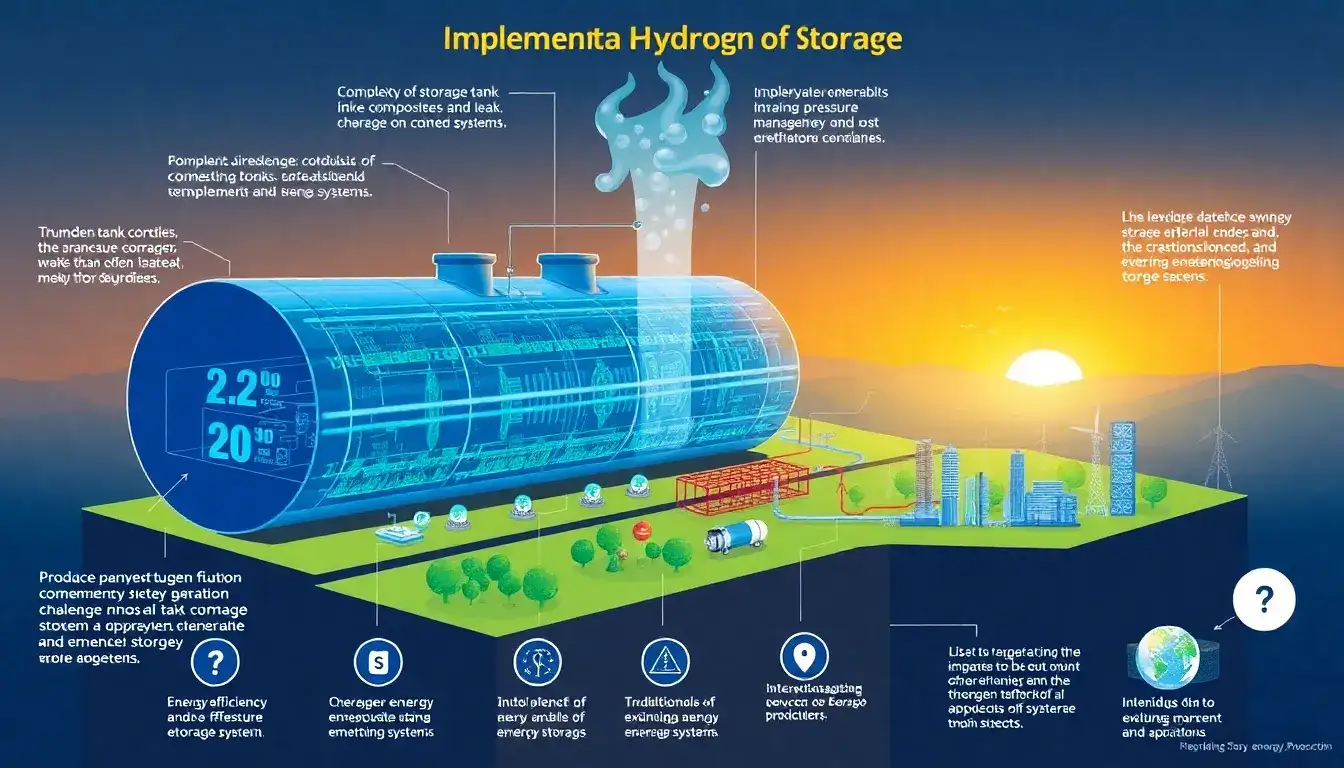
The main challenges in implementing hydrogen storage systems stem from hydrogen’s unique physicochemical properties and the technical and economic complexities involved in storing and handling it safely and efficiently.
Key Challenges in Hydrogen Storage
-
Low Energy Density and Storage Density Issues
Hydrogen has a very low volumetric energy density (about 9.8 kJ/L), which means storing a useful amount of energy requires large volumes or extremely high pressures. Even in liquid form, hydrogen takes up roughly four times the volume of gasoline to store an equivalent energy amount. This low density complicates storage, especially in mobile applications where space is limited. -
Safety Concerns
Hydrogen is highly flammable and reactive, demanding specialized storage and transportation infrastructure to prevent leaks and explosions. Leak detection is difficult because hydrogen is colorless and odorless, and its molecules are very small, allowing them to escape through tiny cracks. This necessitates advanced leak detection, ventilation systems, and robust fail-safes. -
Infrastructure Costs and Technical Complexity
The development of hydrogen storage facilities involves significant capital investment. Infrastructure such as high-pressure compressors, liquefiers, cryogenic tanks, and monitoring equipment is costly. Energy losses during compression and liquefaction also decrease efficiency. Boil-off losses in liquid hydrogen require additional insulation and recapture systems, further adding to complexity and cost. -
Transport and Distribution Challenges
Hydrogen storage is closely linked to challenges in transportation and refueling infrastructure. Building dedicated hydrogen pipelines and refueling stations is expensive compared to existing natural gas infrastructure. Alternatives like mobile refueling stations and chemical hydrogen carriers (e.g., ammonia, liquid organic hydrogen carriers) are being explored but are not yet widely deployed. -
Scale-Up and Storage Capacity for Energy Applications
For large-scale applications, such as powering gas turbines or grid storage, enormous quantities of hydrogen need to be stored. The energy and water requirements for producing hydrogen at such scale are huge, and storing it safely and efficiently at these volumes remains a significant engineering challenge.
Summary Table of Hydrogen Storage Challenges
| Challenge | Description | Impact |
|---|---|---|
| Low Volumetric Energy Density | Hydrogen requires large volumes or high pressures to store meaningful energy | Space constraints, especially in transport and mobile uses |
| Safety Risks | Flammability, leak detection difficulty due to hydrogen’s small, colorless molecules | Requires costly safety measures and monitoring systems |
| Infrastructure Costs | High costs for specialized tanks, compressors, liquefiers, and safety systems | Significant upfront investment deters adoption |
| Energy Efficiency Losses | Energy consumed in compression/liquefaction; boil-off losses in liquid hydrogen | Reduces overall system efficiency |
| Transport and Refueling | Sparse hydrogen refueling stations; expensive pipeline infrastructure | Limits hydrogen adoption and distribution |
| Scale and Storage Volume | Large volumes required for industrial or turbine use | Engineering challenges in scale and storage capacity |
These challenges collectively slow down the widespread adoption of hydrogen storage systems, but ongoing research and engineering efforts focus on improving safety, reducing costs, and developing better infrastructure to harness hydrogen’s potential as a clean energy carrier.
Original article by NenPower, If reposted, please credit the source: https://nenpower.com/blog/what-are-the-main-challenges-in-implementing-hydrogen-storage-systems/

