

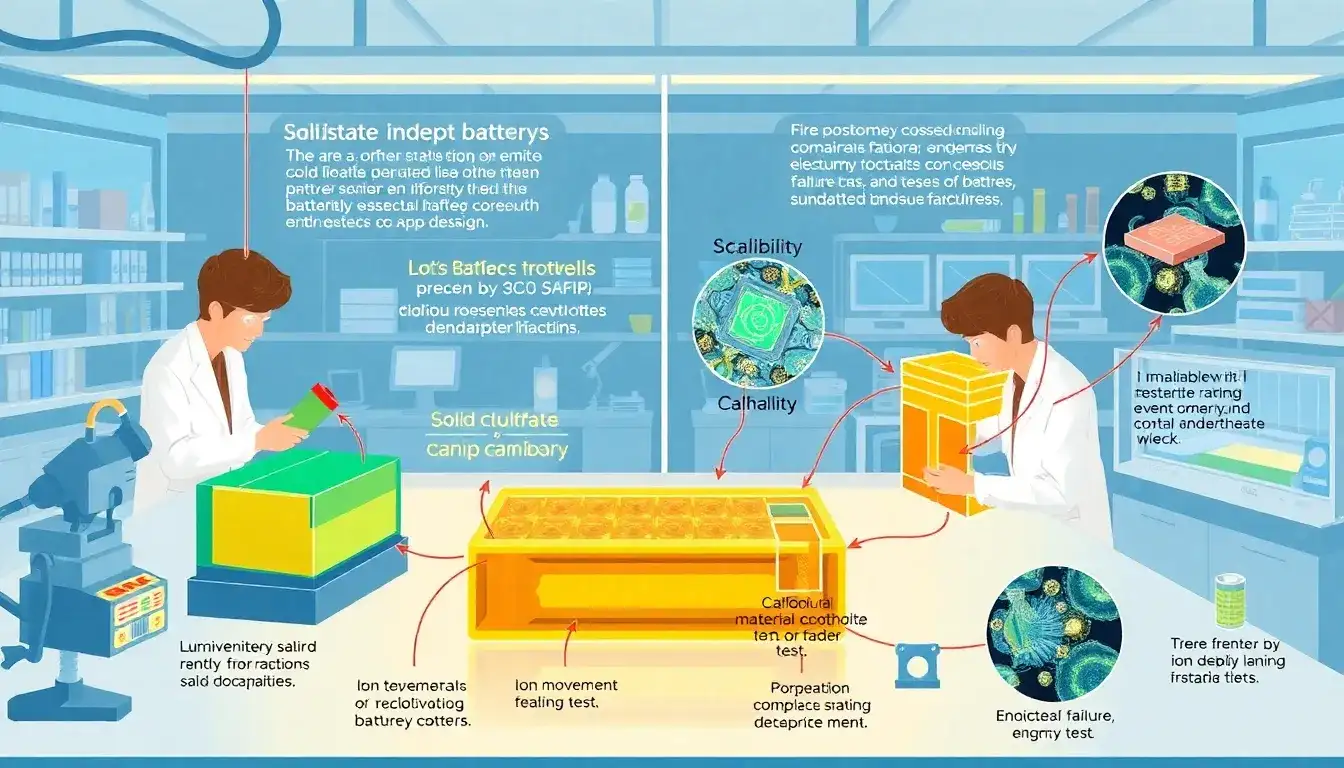
Key Challenges in Developing Solid-State Batteries
1. Dendrite Formation and Short Circuits
Despite using solid electrolytes, dendrite growth—needle-like lithium structures—can still occur during charging. These dendrites risk penetrating the solid electrolyte, causing internal short circuits and battery failure.
2. Solid Electrolyte Behavior and Interface Stability
- Lack of Comprehensive Characterization: Engineering teams often lack consistent, real-world feedback on how solid electrolytes behave under thermal and mechanical stresses in EV conditions. This gap limits performance optimization.
- Interfacial Contact and Resistance: Achieving stable, low-resistance interfaces between the solid electrolyte and electrodes is difficult. Poor contact leads to high interfacial resistance, reducing ion transport and degrading battery performance during charging/discharging cycles.
3. Mechanical Brittleness and Durability
Most solid electrolytes, especially ceramic-based types, are brittle. This brittleness complicates handling during manufacturing and renders the batteries susceptible to cracking and mechanical failure under vibrations and road stresses.
4. Material Selection and Volume Changes
- Selecting suitable materials for electrodes and electrolytes remains complex. Lithium metal is a promising anode for high energy density but is highly reactive, prone to unstable plating, dendrite growth, and safety risks.
- Silicon anodes, another option, suffer from significant volume expansion (~300%) on lithiation, which causes structural degradation.
5. Fabrication Complexity and Scalability
- Manufacturing involves complex and costly processes such as producing defect-free, ultra-thin solid electrolyte layers and ensuring precise electrode contact.
- Sensitive materials like sulfide-based electrolytes require moisture-free environments (dry rooms) to prevent degradation, adding to production challenges and costs.
6. Balancing Electrolyte Thickness and Mechanical Strength
Thicker solid electrolyte membranes offer better mechanical strength but impair ionic conductivity, while thinner membranes enhance conductivity but risk mechanical failure. Finding the optimal balance is a major materials science challenge.
7. Need for High Ionic Conductivity
Fast ion transport within composite cathodes and across interfaces is essential for high power and efficient operation. Achieving this with solid electrolytes remains difficult, limiting power density and overall battery performance.
8. System Integration and Thermal Management
- Solid electrolytes tend to have better thermal stability than liquid electrolytes, improving safety (higher decomposition temperature and lower fire risk). Nonetheless, effective battery management systems (BMS) and thermal management systems (TMS) specifically adapted to solid-state chemistry are still in development.
- Temperature fluctuations and mechanical stress during vehicle operation further complicate stable and reliable battery performance.
Summary Table of Challenges
| Challenge | Details |
|---|---|
| Dendrite Growth | Needle-like lithium dendrites cause internal short circuits despite solid electrolyte use |
| Interface Stability | High resistance and poor contact at electrolyte-electrode interfaces degrade performance |
| Mechanical Brittleness | Ceramic electrolytes brittle, prone to cracking under vibrations and stress |
| Material Selection | Reactive lithium metal and expanding silicon pose structural and safety risks |
| Fabrication Complexity | Complex, costly fabrication requiring moisture control and precision engineering |
| Electrolyte Thickness vs Strength | Trade-off between ionic conductivity and mechanical robustness |
| Ionic Conductivity | Achieving fast ion transport in solid electrolytes and composite electrodes |
| Thermal and System Integration | Need for specialized BMS, TMS, and stable operation under mechanical and thermal stresses |
These challenges collectively underline why solid-state battery technology, despite its promise for higher energy density and enhanced safety, still requires significant breakthroughs before widespread commercial adoption. Industry and research efforts continue focusing on novel materials, interface engineering, scalable manufacturing techniques, and comprehensive testing under real-world conditions to overcome these hurdles.
Original article by NenPower, If reposted, please credit the source: https://nenpower.com/blog/what-are-the-main-challenges-in-developing-solid-state-batteries/

