

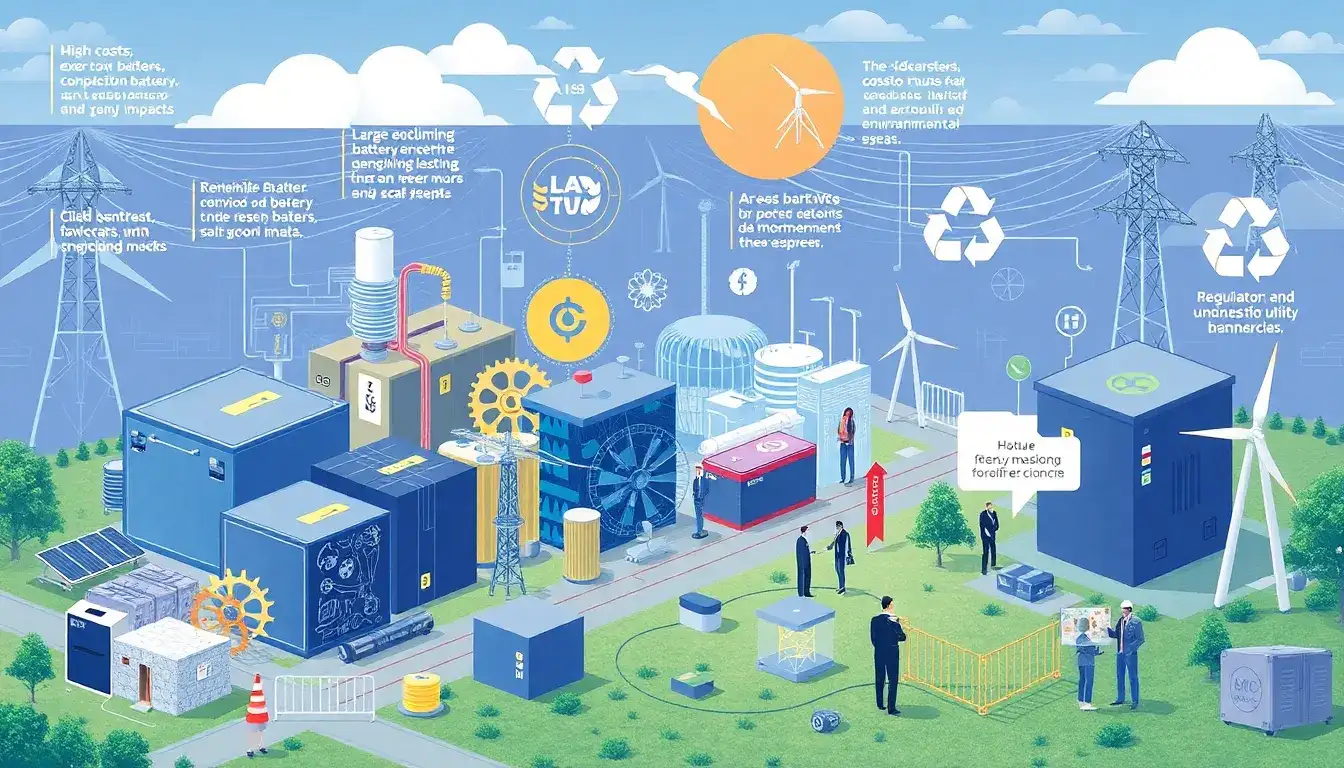
The main challenges in deploying utility-scale batteries revolve around regulatory, logistical, technical, and market factors:
1. Permitting and Regulatory Approvals
Securing all necessary permits and grid interconnection approvals is a critical and often time-consuming challenge. Utility-scale battery projects must comply with zoning, safety, testing, and multiple jurisdictional requirements imposed by local, state, and federal authorities. The involvement of several Authorities Having Jurisdiction (AHJs) can expand the approval timeline significantly, potentially delaying or even halting projects. Additionally, thermal runaway risks leading to fires or explosions require strict safety assessments and measures, complicating permitting processes further.
2. Supply Chain and Construction Logistics
Managing the logistics of construction, especially equipment delivery and site readiness, is a key difficulty. Projects in remote locations face longer timelines due to transportation challenges and communication issues at job sites. Ensuring job site safety is paramount as accidents can cause delays and damage public support, which could impact future projects in the area.
3. Battery Performance and Degradation Uncertainty
Battery degradation depends on factors such as depth and frequency of cycling, state of charge, ambient conditions, and specific operational use cases. New battery chemistries may have unknown degradation profiles, introducing risks for developers and utilities in designing and contracting for battery systems. Operating constraints on charge management and cycling affect how batteries can be used, potentially limiting their flexibility and economic viability.
4. Market and Profitability Challenges
The evolving energy markets and regulatory environment pose challenges to project profitability. Battery siting requires identifying grid locations that optimize returns without cannibalizing market opportunities. Efficient dispatch optimization is necessary to handle price volatility and maximize revenue from services like frequency regulation and energy arbitrage. Rapid changes in market conditions and rules add complexity to operational strategies and financial planning.
5. Limited Technical Maturity and Demonstrations
The grid-scale storage sector still faces challenges related to limited large-scale demonstrations and technical progress. Market structures are often deficient in fully supporting energy storage, which can hinder investment and development at scale.
In summary, deploying utility-scale battery energy storage systems is constrained by lengthy permitting processes, complex logistics, operational and degradation uncertainties, evolving market dynamics, and technical maturity barriers. Addressing these challenges requires coordinated efforts across regulatory bodies, technology providers, and market participants.
Original article by NenPower, If reposted, please credit the source: https://nenpower.com/blog/what-are-the-main-challenges-in-deploying-utility-scale-batteries/

