

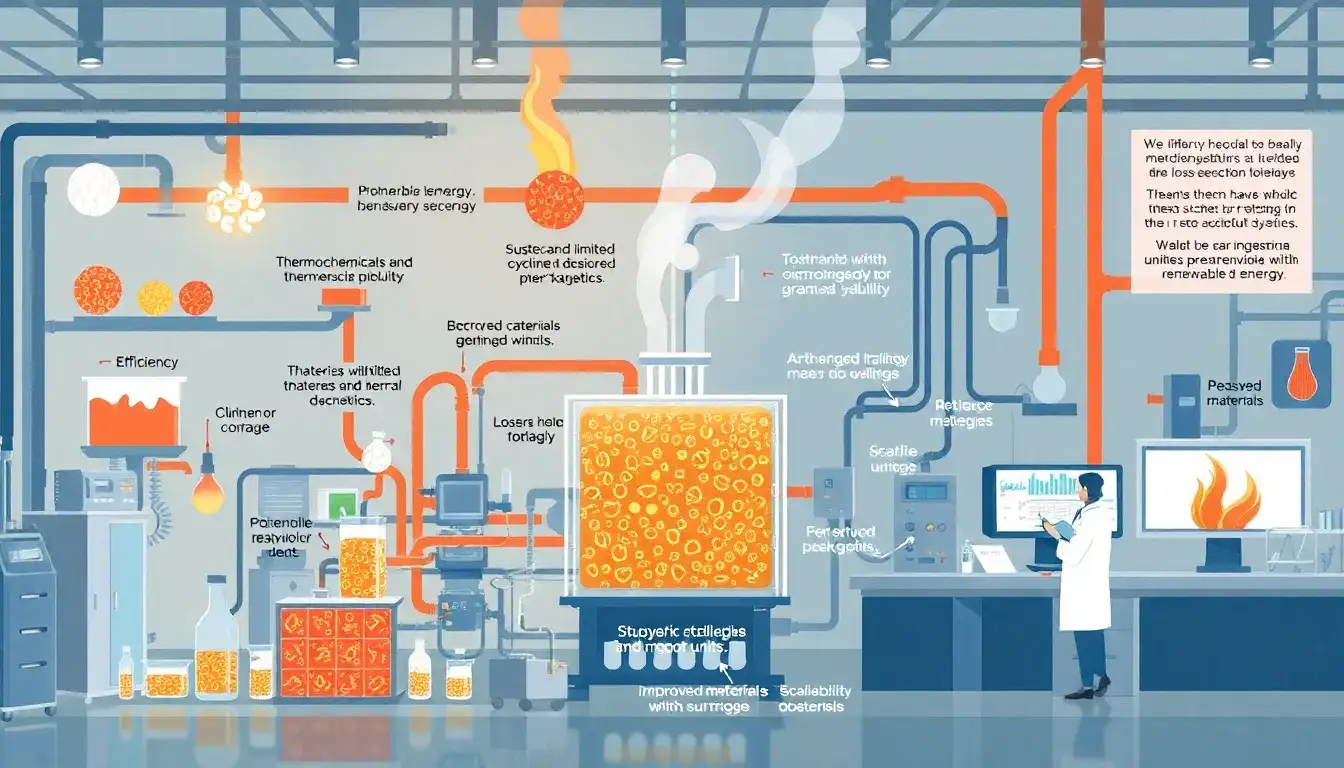
Material Challenges
- Finding suitable materials: TCES requires materials that can endure high temperatures, high pressures, and repeated thermal cycling without degradation. Materials must be stable and retain their chemical and physical properties over many charge-discharge cycles to maintain system efficiency and longevity.
- Material degradation: Some materials may degrade or lose their storage capacity over time, impacting the performance and reliability of the system.
- Reversibility and reaction kinetics: The chemical reactions used to store and release heat must be highly reversible and occur at practical rates to ensure efficient system operation. Slow kinetics or incomplete reactions reduce efficiency.
System Efficiency and Heat Transfer
- Heat transfer limitations: Efficient heat exchange between the storage material and the heat exchanger is critical. Poor heat transfer rates can reduce the charging and discharging efficiency of TCES systems.
- Heat losses: Although TCES can theoretically store energy for long durations with minimal loss, in practice, conduction, convection, and radiation losses still pose challenges to maintain high overall efficiency.
Operational and Practical Considerations
- High temperature and pressure operation: TCES systems often operate at elevated temperatures and pressures, requiring robust containment and safety measures for practical deployment.
- Energy source for charging: TCES materials must be “charged” with heat from a reliable, preferably low-carbon source such as concentrated solar power, nuclear heat, or industrial waste heat. Securing a cheap and abundant heat source is a challenge for commercial viability.
- Cost and scale-up: While TCES holds promise for high energy density and long-term storage, many materials and systems are still under research and not yet commercialized, with cost and scalability hurdles remaining.
Comparison to Other Thermal Storage Technologies
Unlike sensible heat storage (limited by low energy density and large volume) and latent heat storage (which has issues with phase change material stability and cost), TCES offers potentially higher energy densities but at the expense of more complex material and system requirements.
In summary, the primary challenges of thermochemical heat storage lie in the development of durable, efficient reversible chemical systems that can operate safely at high temperatures and pressures, ensuring good heat transfer and minimal losses, while being economically scalable with a reliable heat charging source.
Original article by NenPower, If reposted, please credit the source: https://nenpower.com/blog/what-are-the-main-challenges-associated-with-thermochemical-heat-storage/

