

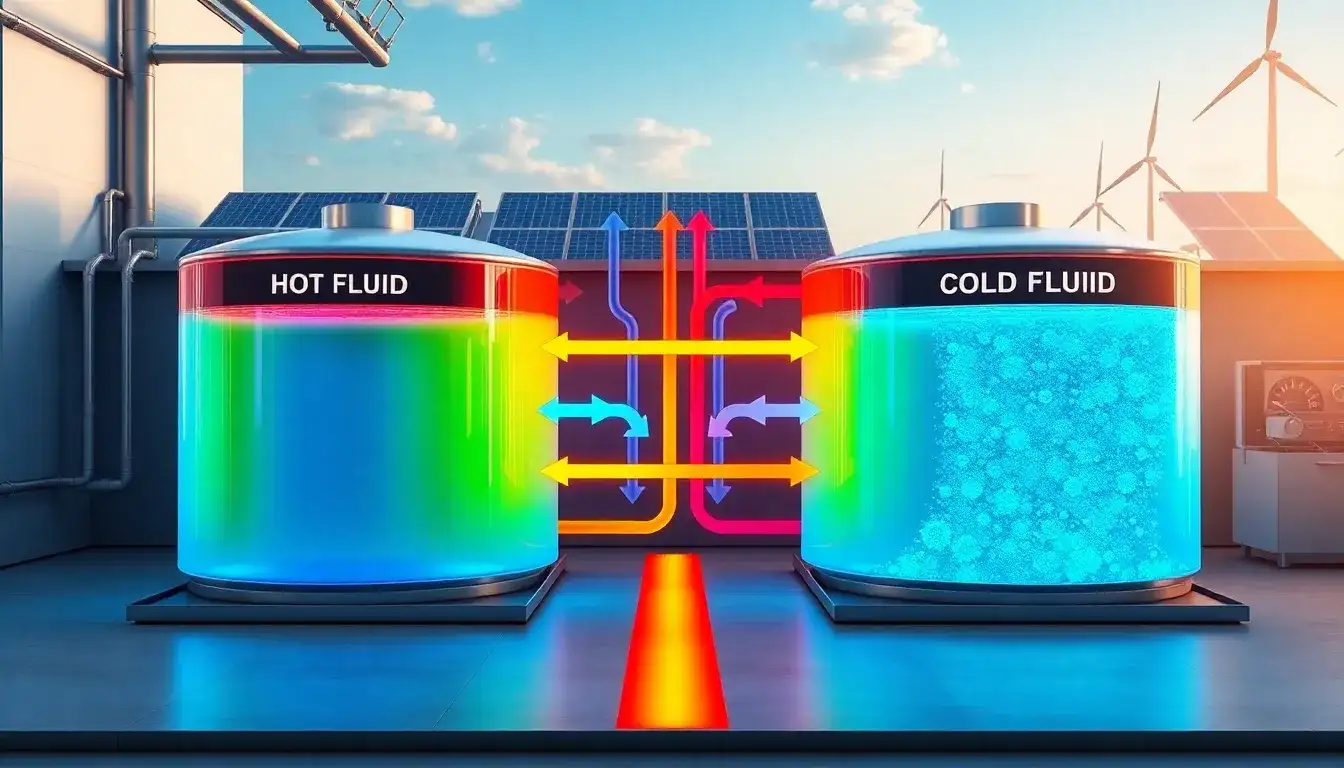
The two-tank direct thermal energy storage system offers specific advantages over other storage configurations, particularly in simplicity and thermal efficiency:
- Simplified design: Uses the same fluid for heat transfer and storage, eliminating the need for secondary heat exchangers. This reduces complexity compared to indirect systems, which require an additional heat exchanger between the heat-transfer fluid and storage medium.
- Higher operational efficiency: Direct heat transfer minimizes energy losses associated with intermediate heat exchangers, preserving thermal energy quality. Indirect systems inherently lose efficiency due to heat transfer between two fluids.
- Proven reliability: Early CSP plants like Solar Electric Generating Station I (parabolic trough) and Solar Two (power tower) successfully demonstrated this technology using mineral oil and molten salt respectively.
While thermocline systems (single-tank) offer cost savings through reduced tank infrastructure, they often struggle with thermal stratification and reduced ORC efficiency (e.g., 18.2% vs 19.7% in two-tank systems). Indirect systems are typically more expensive due to extra components but allow separate optimization of heat-transfer and storage fluids.
The two-tank direct system remains advantageous for applications prioritizing minimal heat loss and straightforward integration between solar collectors and power cycles.
Original article by NenPower, If reposted, please credit the source: https://nenpower.com/blog/what-are-the-main-advantages-of-using-a-two-tank-direct-system-over-other-thermal-energy-storage-systems/

