

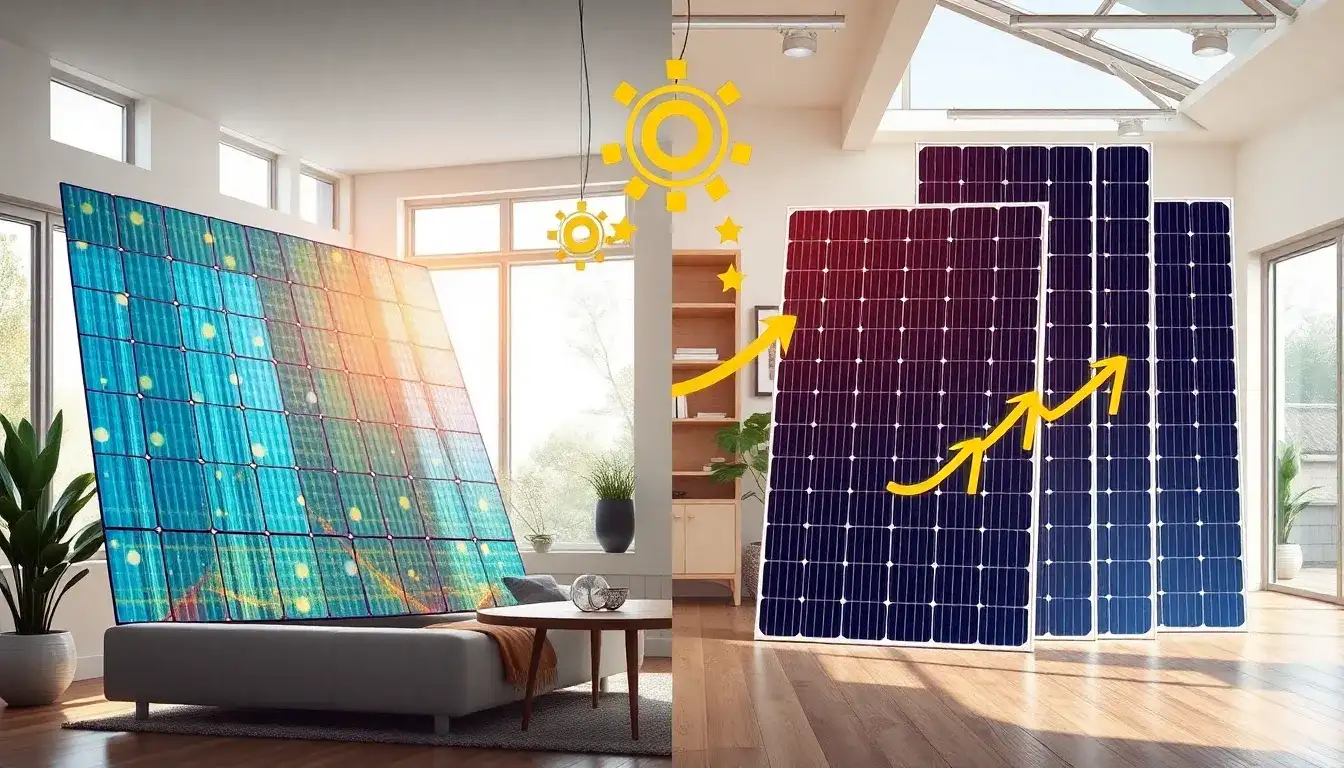
Perovskite solar panels offer several key advantages over traditional silicon-based solar panels specifically in indoor settings:
1. Higher Efficiency under Indoor Light:
Perovskite solar cells exhibit strong light absorption even under low-intensity indoor lighting, allowing them to generate electricity effectively indoors. Their theoretical maximum efficiency reaches around 31% for single-junction cells and up to 45% for multi-junction configurations, significantly higher than the approximately 29.4% limit of silicon cells. Studies show that perovskite cells outperform crystalline silicon under indoor conditions, producing roughly three times more energy per unit area over a year indoors.
2. Tunable Bandgap for Indoor Light Spectra:
The bandgap of perovskite materials can be precisely adjusted by changing their composition, enabling optimization to the specific wavelength ranges of indoor light sources such as LEDs or fluorescent lamps. This tunability enhances their performance compared to silicon cells which have a fixed bandgap and are less responsive to indoor light spectra.
3. Low-Cost and Simple Manufacturing:
Perovskite solar cells can be produced at lower cost due to less stringent material purity requirements (around 90% purity suffices versus 99.9999% for silicon) and simpler fabrication processes that require fewer production steps. They typically need only a single factory for manufacturing compared to multiple specialized factories for silicon solar panels. This makes perovskite technology more economically viable for indoor applications where large areas are not typically needed.
4. Flexibility and Lightweight Form Factors:
Perovskite solar cells can be made on flexible substrates, lightweight plastics, or even transparent surfaces. This flexibility allows integration into a variety of indoor environments and devices such as wearable electronics, sensors, portable chargers, or building-integrated photovoltaics (BIPV), where rigid silicon panels are impractical.
5. Stable Performance and Suitability for IoT Devices:
Long-term studies under realistic indoor conditions indicate that perovskite solar cells maintain most of their performance over extended periods with proper encapsulation. The energy harvested is sufficient to power low-power IoT devices year-round in most cases, making them ideal for indoor energy harvesting applications.
In summary, perovskite solar panels are well-suited for indoor use because of their high efficiency under low-light conditions, spectral tunability, cost-effectiveness, flexibility, and stable energy output suited for powering indoor electronics and IoT devices, providing a clear advantage over traditional silicon solar panels for these environments.
Original article by NenPower, If reposted, please credit the source: https://nenpower.com/blog/what-are-the-main-advantages-of-perovskite-solar-panels-over-traditional-ones-in-indoor-settings/

