

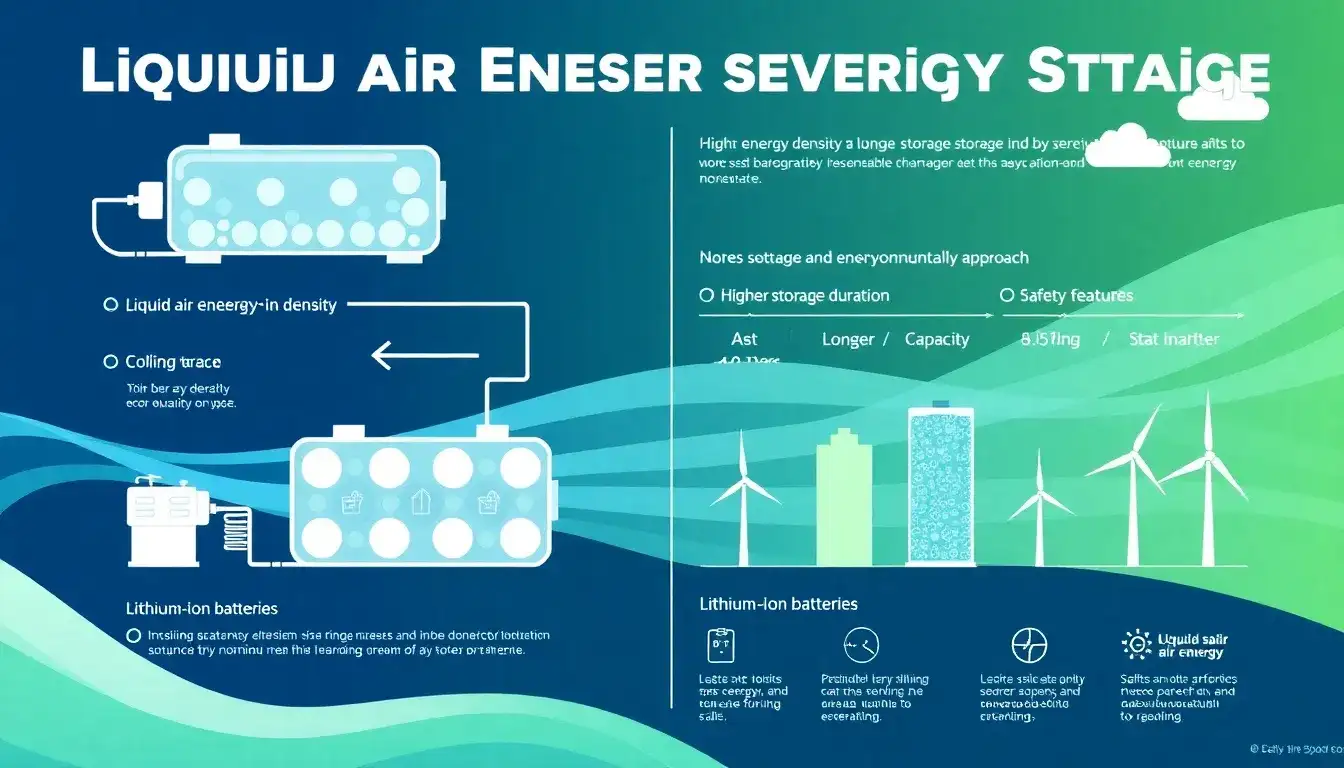
The main advantages of liquid air energy storage (LAES) over lithium-ion batteries are primarily related to cost, scalability, environmental impact, and long-duration storage capabilities:
- Lower Cost per Megawatt-hour: LAES can offer a levelized cost of storage (LCOS) around $60 per megawatt-hour, which is about one-third the cost of lithium-ion battery storage and roughly half the cost of pumped hydro storage. This significant cost advantage positions LAES as a potentially more economical solution for grid-scale energy storage in the future.
- Scalability: LAES systems can be designed to accommodate a wide range of energy storage capacities, from small-scale to large utility-scale installations. This adaptability allows LAES to meet diverse energy demands and grid requirements more flexibly than lithium-ion batteries, which can be limited by material and design constraints.
- Long-Duration Storage: Unlike lithium-ion batteries that generally excel at short to medium duration storage, LAES is well-suited for long-duration energy storage, capable of storing energy for several hours to days. This makes LAES especially valuable for balancing intermittent renewable power sources like wind and solar over extended periods.
- Environmental Benefits: LAES relies on air — an inexhaustible and non-toxic raw material — for energy storage, avoiding the use of hazardous materials or rare earth elements typical in lithium-ion batteries. It produces zero carbon emissions during operation and has a low environmental footprint, making it a more sustainable and environmentally friendly option.
- Flexibility and Location Versatility: LAES systems can be deployed in diverse environments including urban, remote, or industrial sites, offering flexible deployment options compared to lithium-ion systems that might face constraints due to safety, cooling, and space requirements.
- Efficiency Improvements and Waste Heat Utilization: While standalone LAES systems currently achieve up to about 57% efficiency, advances such as integrating waste heat recovery can improve this rate, potentially enhancing overall system economics and performance.
In summary, LAES offers a cost-effective, scalable, long-duration, and environmentally sustainable alternative to lithium-ion batteries for grid-scale energy storage, with particular advantages in applications requiring large capacity and extended discharge times.
Original article by NenPower, If reposted, please credit the source: https://nenpower.com/blog/what-are-the-main-advantages-of-liquid-air-energy-storage-over-lithium-ion-batteries/

