

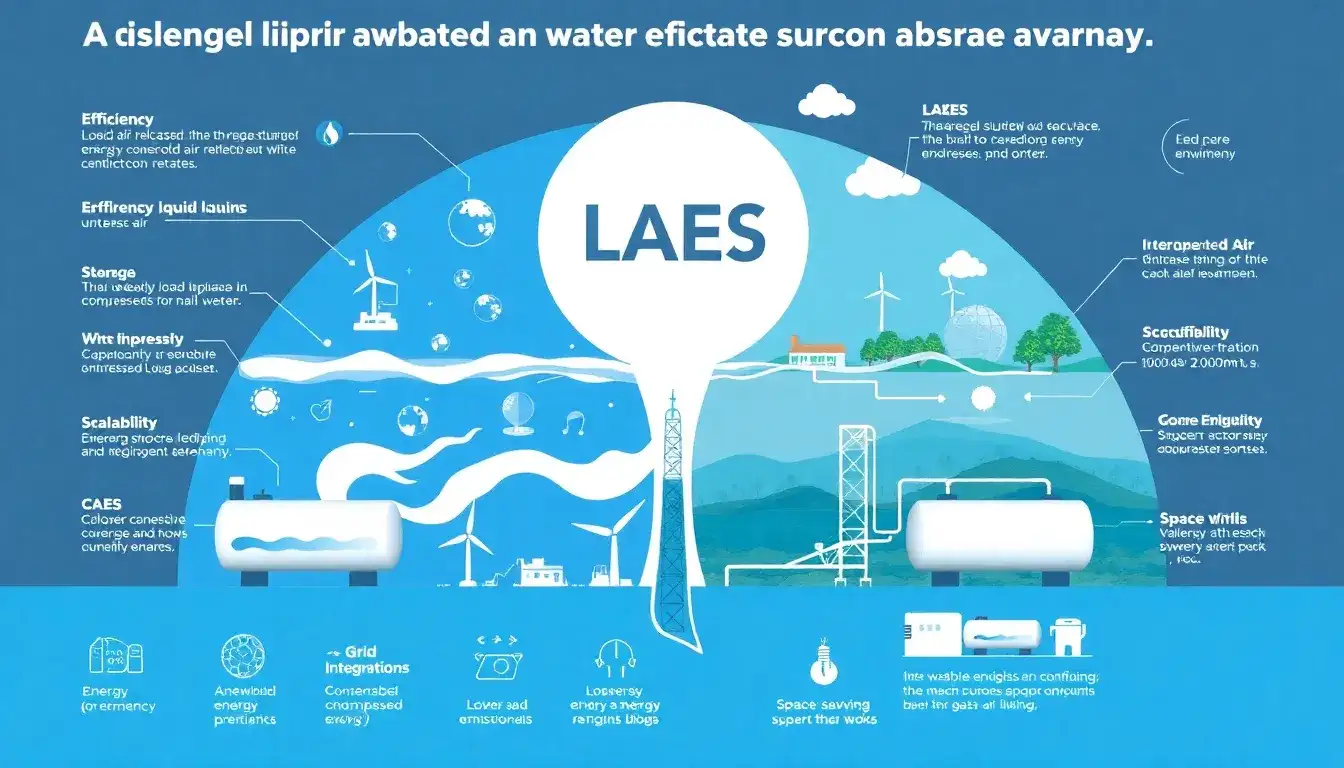
The main advantages of Liquid Air Energy Storage (LAES) over Compressed Air Energy Storage (CAES) are:
1. Scalability and Flexibility
- LAES systems can be designed and scaled to meet a wide range of energy storage capacities, from small-scale applications to large utility-scale installations, providing adaptability to different grid demands and settings.
- It can be deployed in various locations including urban, remote, and industrial sites, offering greater flexibility for integration into existing infrastructure.
2. Long-Duration Energy Storage Capability
- LAES systems are particularly suited for long-duration energy storage, capable of storing energy for several hours or even days. This makes them valuable for balancing the intermittency of renewable energy sources like wind and solar over extended periods.
3. Environmental Friendliness and Sustainability
- LAES uses only inexhaustible raw materials (ambient air) for storage, avoiding hazardous materials or expensive rare earth elements, making it more sustainable than CAES which often involves underground caverns or compressed air reservoirs.
- The process produces zero carbon emissions during operation, supporting a low-carbon energy future and minimizing environmental impact.
4. Lower Cost and Economic Viability Potential
- Recent studies have shown that LAES can achieve a lower levelized cost of storage (LCOS)—about $60 per megawatt-hour—which is roughly half the cost of pumped hydro and a third of lithium-ion batteries, indicating promising cost competitiveness for grid-scale storage.
- While CAES typically requires geological formations like salt caverns for storing compressed air, limiting siting options and increasing costs, LAES stores liquid air at low pressure in insulated tanks, which is simpler and potentially cheaper to site and expand.
5. Improved Efficiency and Operational Advantages
- LAES offers improved start-up times and efficiency compared to traditional CAES systems. It can also incorporate waste-heat-to-power integration, enhancing overall system efficiency.
- The process involves liquefaction of air to a dense liquid form, allowing large volumes of air to be stored in relatively small spaces at low pressure, enabling more compact and safer storage than high-pressure compressed air.
This comparison shows that Liquid Air Energy Storage offers significant advantages in scalability, environmental impact, cost, and long-duration storage potential compared to traditional Compressed Air Energy Storage, making it a promising alternative for future large-scale energy storage needs.
Original article by NenPower, If reposted, please credit the source: https://nenpower.com/blog/what-are-the-main-advantages-of-liquid-air-energy-storage-over-compressed-air-energy-storage/

