

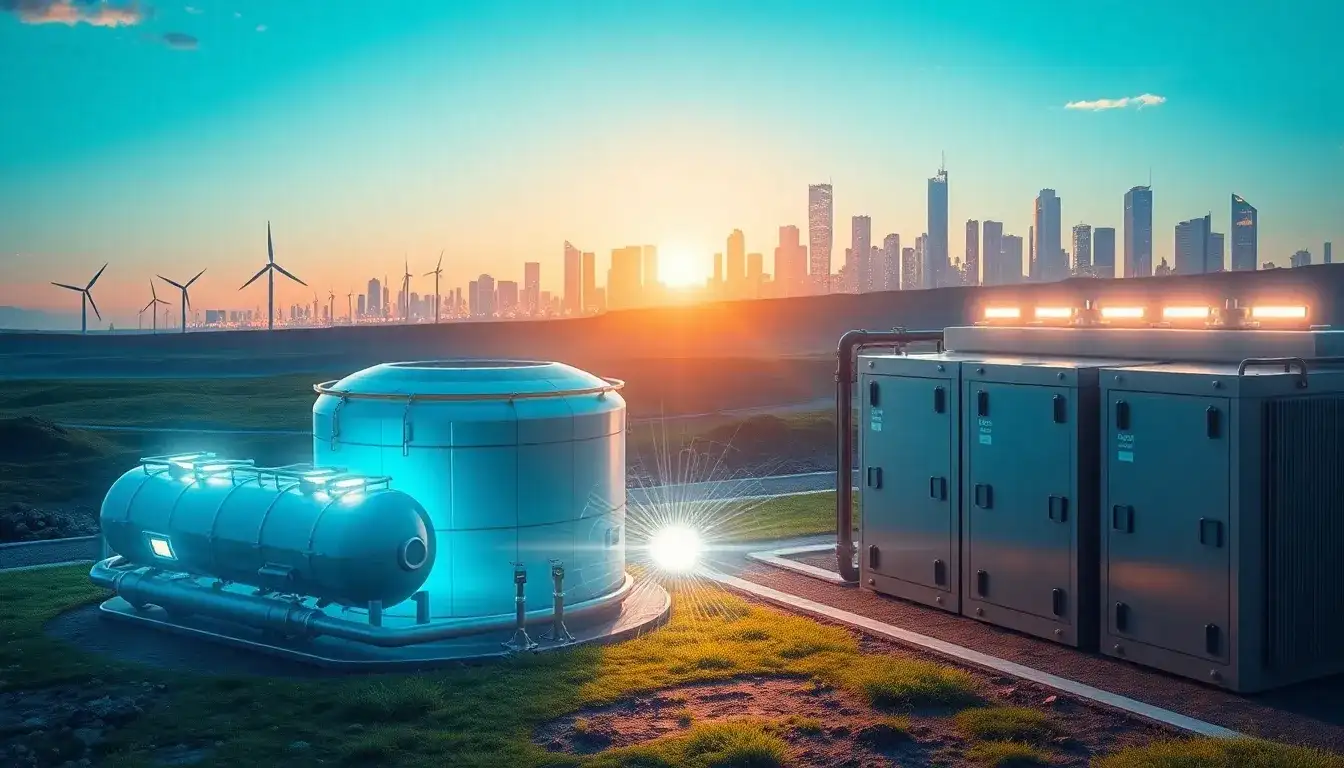
The main advantages of hydrogen storage systems over battery storage are as follows:
1. Higher Energy Density
Hydrogen has a significantly higher energy density by weight compared to batteries. It stores much more energy per unit mass — around 40 kWh/kg for hydrogen compared to about 0.25 kWh/kg for typical lithium-ion batteries. This makes hydrogen particularly advantageous for applications requiring large amounts of energy in a compact form, such as heavy transport or long-distance energy delivery.
2. Long-Term and Seasonal Energy Storage
Hydrogen is better suited for long-duration energy storage, capable of storing energy for weeks or even months without significant losses. Batteries, especially lithium-ion types, are more efficient for short-term storage ranging from hours to a day but face efficiency and economic challenges for long-term storage. This long-term storage capability makes hydrogen ideal for balancing seasonal supply and demand variations in renewable energy systems.
3. Scalability and Flexibility for Large-Scale Storage
Hydrogen storage systems can be scaled up relatively easily by increasing the size of storage tanks, without a drastic increase in complexity or cost. This scalability allows hydrogen to be used in large-scale applications like grid stabilization, industry, and transport where very large energy reservoirs are needed. Battery storage, while compact, becomes less practical and cost-effective at very large scales.
4. Renewable and Carbon-Free Potential
Hydrogen can be produced from various renewable resources via electrolysis using solar or wind power, resulting in a clean fuel with water vapor as the only byproduct when used in fuel cells. This renewable production pathway complements decarbonization goals and provides a versatile storage medium that can integrate with renewable energy generation.
Summary Table of Advantages
| Advantage | Hydrogen Storage | Battery Storage |
|---|---|---|
| Energy Density | High (~40 kWh/kg) | Low (~0.25 kWh/kg) |
| Storage Duration | Long-term (weeks to months) | Short to medium (hours to days) |
| Scalability | Easy to scale for large capacities | More complex and costly at large scale |
| Renewable Integration | Produced from renewables via electrolysis | Limited by battery materials and lifecycle |
| Byproduct | Water vapor (clean) | Chemical waste in batteries |
Considerations
While hydrogen storage has these advantages, current technology has lower round-trip efficiency (~30-50%) compared to batteries (~80-90%) and higher associated costs and infrastructure requirements. However, continued advances in electrolyzers, fuel cells, and storage methods are expected to improve these metrics over time.
In summary, hydrogen storage excels over batteries in energy density, long-term storage capability, scalability, and renewable integration—making it particularly advantageous for large-scale and seasonal energy storage needs. Batteries remain superior for short-term, high-efficiency, and compact energy storage applications.
Original article by NenPower, If reposted, please credit the source: https://nenpower.com/blog/what-are-the-main-advantages-of-hydrogen-storage-systems-over-battery-storage/

