

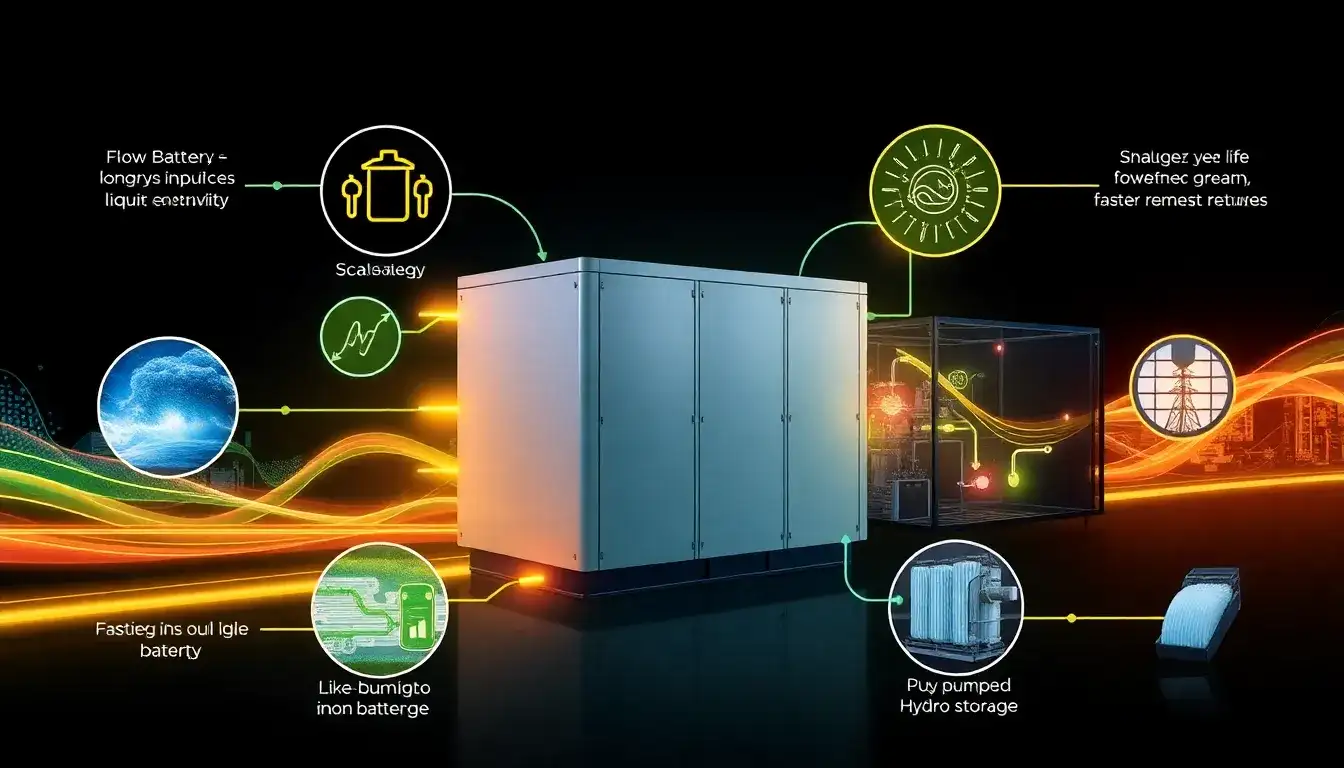
The main advantages of flow batteries over other long-duration energy storage solutions include:
1. Long Lifespan and High Cycle Durability
Flow batteries, particularly vanadium flow batteries, can last for decades with minimal degradation, often exceeding 20,000 charge-discharge cycles, equivalent to 15–25 years of operation. This is significantly longer than lithium-ion batteries, which typically last around 10,000 cycles (about 15 years), and lead-acid batteries with only about 1,000 cycles (5–15 years). The ability to maintain capacity over many deep discharge cycles reduces the need for frequent replacements and oversizing of systems.
2. Scalability and Flexible Energy Capacity
Unlike lithium-ion batteries that become increasingly expensive as they scale due to the cost of cathode materials, flow batteries scale cost-effectively by increasing the volume of electrolyte tanks. The energy capacity in flow batteries is limited primarily by the amount of electrolyte, which can be expanded easily and relatively cheaply, allowing for economical storage of large amounts of energy for extended durations.
3. Decoupling of Power and Energy Components
Flow batteries separate the power component (battery stacks) from the energy component (electrolyte tanks), enabling independent sizing of power output and energy capacity. This decoupling lowers the marginal cost of stored energy and allows optimization of system design based on specific application needs, improving asset utilization and cost-effectiveness in long-duration storage scenarios.
4. Stability and Safety
Flow batteries demonstrate stable performance over long periods with minimal self-discharge because the electrolytes are stored separately from the stacks. Additionally, they tend to be safer than lithium-ion batteries in stationary applications, reducing risks related to thermal runaway and fire hazards.
5. Cost-Effectiveness for Long-Duration Storage
Though flow batteries may not be competitive for short discharge times or small-scale applications, their costs decrease as the system size and discharge duration increase (typically more than 4 hours). This makes them particularly well-suited for grid-scale, long-duration energy storage, where they can store hundreds of megawatt-hours economically and reliably.
In summary, flow batteries offer long cycle life, scalability, flexible and independent sizing of power and energy, stable and safe operation, and cost advantages for large-scale, long-duration energy storage compared to other technologies like lithium-ion and lead-acid batteries. These features make flow batteries a promising solution for the challenges of renewable energy integration and grid-scale energy storage.
Original article by NenPower, If reposted, please credit the source: https://nenpower.com/blog/what-are-the-main-advantages-of-flow-batteries-over-other-long-duration-energy-storage-solutions/

