

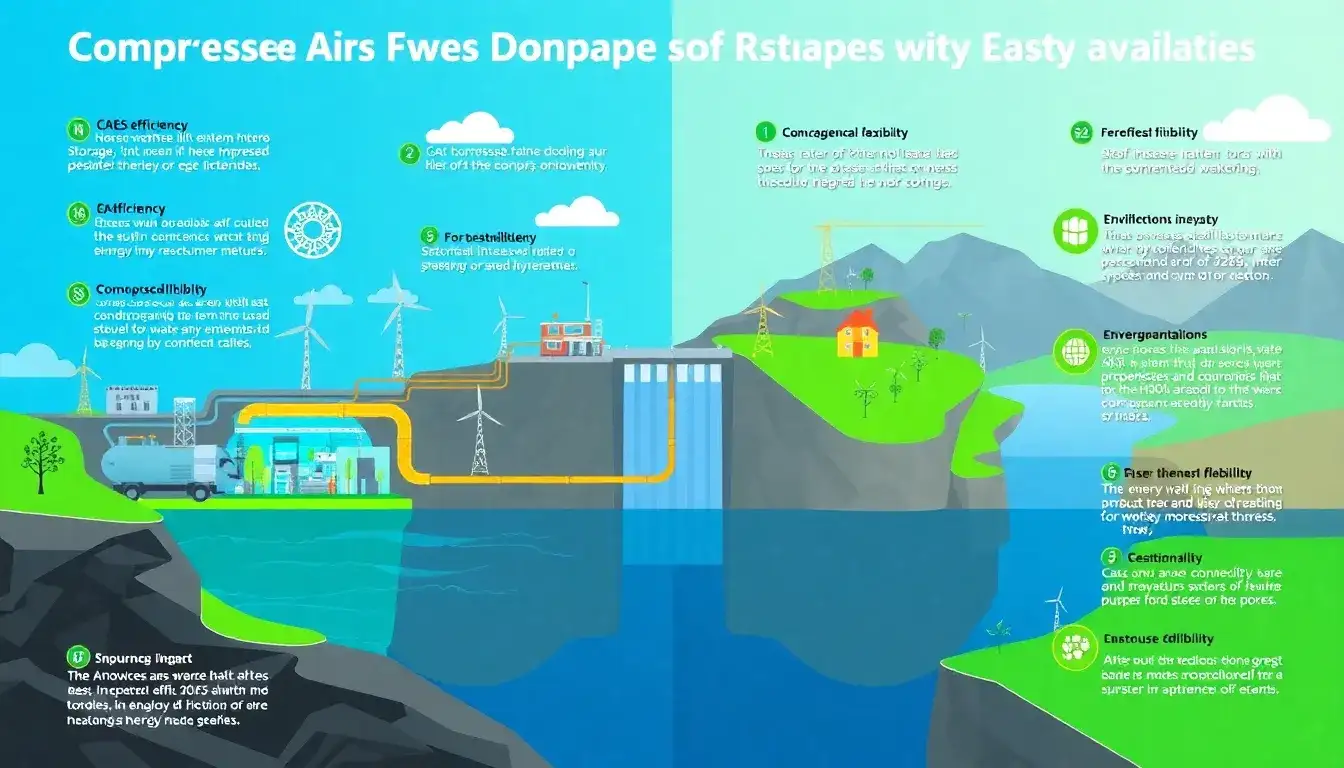
1. Greater Flexibility and Scalability
- CAES is suitable for both small-scale and large-scale energy storage applications, whereas PHS generally requires large geographical features like dams and reservoirs, limiting its siting flexibility.
- CAES systems can be implemented in a wider variety of locations because they do not depend on specific topography such as mountainous terrain or large water bodies.
2. Lower Environmental Impact and Sustainability
- CAES is more environmentally friendly, producing significantly lower CO2 emissions, especially with adiabatic processes that can nearly eliminate emissions.
- It does not rely on chemicals or toxic materials, unlike some battery technologies, making it more sustainable and less harmful to the environment than PHS, which can impact aquatic ecosystems and require large water storage areas.
3. Cost and Implementation Advantages
- CAES systems are generally more affordable and easier to implement than pumped hydro plants, saving on installation and infrastructure costs.
- They require less complex civil works compared to the massive dams and reservoirs needed for PHS.
4. Longer Energy Storage Duration
- CAES can store energy for extended durations (over 25 days), enabling long-term energy storage capabilities that can support grid stability over prolonged periods.
- PHS typically offers shorter duration storage tied to water availability and reservoir size.
5. Operational Benefits
- CAES offers improved grid stability by enhancing pressure stability and reducing load strain during peak demand.
- It also requires relatively low maintenance and has longer equipment lifetimes than electrochemical batteries.
- CAES can provide “black start” capabilities, allowing power generation to resume without external power supply after outages, a feature not typical for PHS.
6. Additional Utility in Small-Scale Applications
- Small-scale compressed air energy storage can utilize the heat produced during compression for residential heating, hot water production, and even space cooling through the cold expanding air, which PHS cannot provide.
| Feature | CAES | Pumped Hydro Storage (PHS) |
|---|---|---|
| Site Flexibility | High, can be implemented in varied locations | Low, requires specific geographic conditions |
| Environmental Impact | Low emissions, no toxic chemicals | Impacts aquatic ecosystems, large reservoirs |
| Cost and Implementation | Lower cost, easier to implement | Higher infrastructure and installation costs |
| Energy Storage Duration | Long storage (up to 25 days or more) | Generally shorter durations |
| Maintenance and Lifespan | Low maintenance, long lifespan | Moderate maintenance, long lifespan |
| Additional Benefits | Heat recovery for heating/cooling | Limited to electricity storage and generation |
In summary, CAES offers advantages in flexibility, environmental sustainability, cost-effectiveness, long-duration storage, and operational benefits such as grid stability and multifunctional heat/cooling use, making it a versatile alternative to pumped hydro storage in many contexts.
Original article by NenPower, If reposted, please credit the source: https://nenpower.com/blog/what-are-the-main-advantages-of-caes-over-pumped-hydro-storage/

