

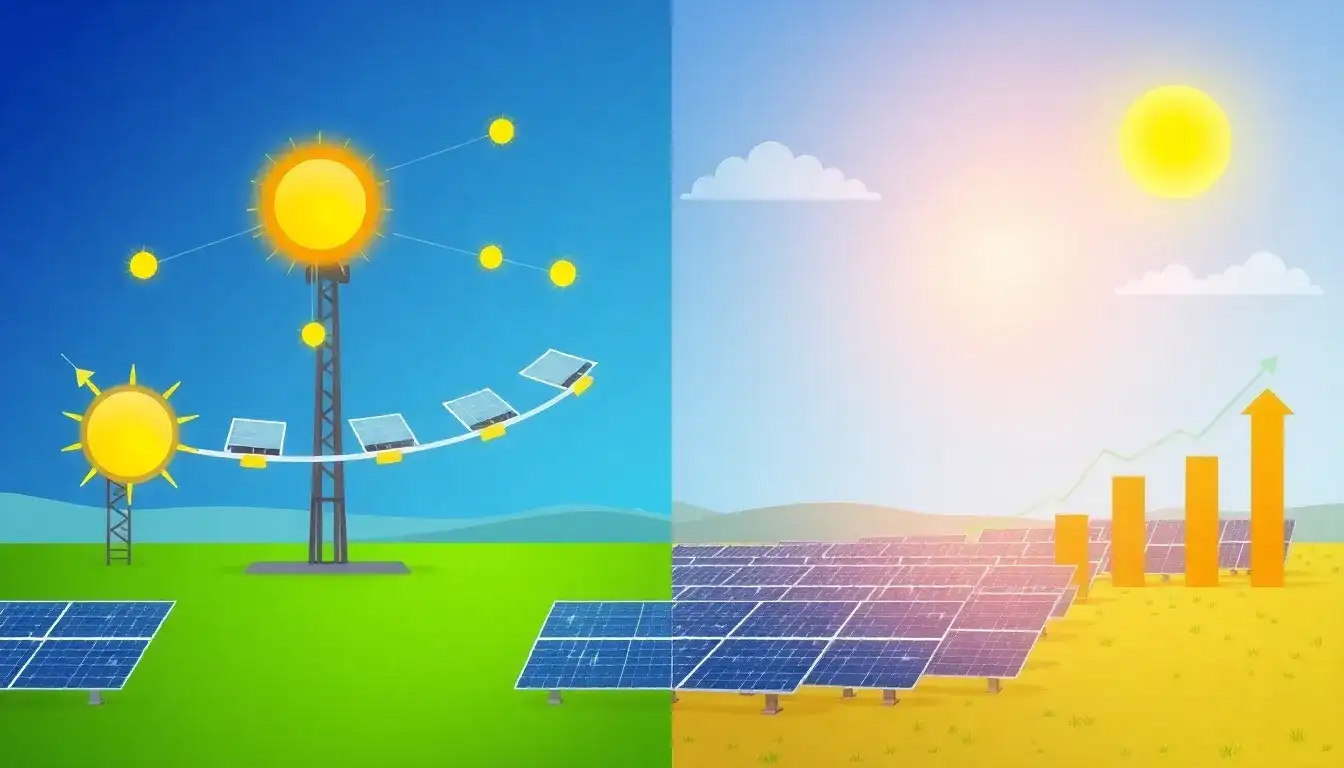
The long-term financial benefits of using solar trackers over fixed panels primarily derive from their significantly higher energy production, which can translate into greater cost savings and faster return on investment (ROI), despite their higher upfront and maintenance costs.
Increased Energy Production and Efficiency
- Higher Annual Energy Yield:
Solar trackers allow panels to follow the sun’s movement, maximizing sunlight exposure throughout the day and year. Single-axis trackers can generate about 15-20% more energy than fixed systems, while dual-axis trackers can increase energy output by 30-50%, and in some cases up to 60%, depending on location and system type. This greater energy harvest results in more electricity to offset utility bills or sell back to the grid, improving overall financial returns. - Smaller System Size for Equivalent Output:
Because trackers capture more sunlight, a smaller array capacity is needed to produce the same annual energy as a larger fixed system. For example, a tracked system can cost less overall despite higher per-watt costs because fewer panels and less infrastructure are required to meet power goals. This can reduce installation costs related to panels, foundations, wiring, and land use.
Cost Considerations and Payback
- Higher Initial and Maintenance Costs:
Trackers involve additional hardware (motors, sensors, control systems) and more complex mounting structures, leading to higher upfront investment—typically increasing system costs by roughly $1.33 to $2.24 per watt over fixed systems. Ongoing maintenance is also more intensive due to moving parts prone to wear and weather impact, resulting in higher operational expenses. - Faster Return on Investment:
Despite these costs, the increased energy production typically accelerates payback periods. Dual-axis trackers, while more expensive and less reliable, often achieve quicker ROI because of their superior energy gains, particularly in utility-scale or commercial projects where maximizing every kilowatt-hour per land area is critical. Single-axis trackers strike a balance by offering moderate efficiency gains with better reliability and lower maintenance.
Land Use Efficiency and Project Viability
- Better Land Utilization:
Trackers enable higher energy density per unit land area, which is financially advantageous in locations with limited space or high land costs. This efficiency reduces the need for larger land parcels or extensive groundwork, lowering project development expenses over time. - Expanded Viability in Less Ideal Sites:
Trackers can mitigate shading issues and perform better in partially cloudy areas or in locations with variable solar angles, allowing for more reliable and consistent energy production and enhancing long-term system value.
Summary of Long-Term Financial Benefits
| Benefit | Explanation |
|---|---|
| Increased Energy Production | 15-60% more annual power than fixed, leading to higher electricity value |
| Reduced Array Size Required | Smaller capacity installations can meet power needs, saving panel and installation costs |
| Improved Land Use Efficiency | More energy per land area lowers land acquisition and preparation costs |
| Accelerated Payback Period | Higher energy output can offset higher initial and maintenance costs more quickly |
| Enhanced Project Flexibility | Ability to deploy in sites less suitable for fixed panels expands potential applications |
Conclusion
Solar trackers offer clear long-term financial advantages through significantly increased energy generation and effective use of space, which can lower overall system costs per unit of energy produced and shorten payback periods. These benefits are most pronounced in large-scale commercial or utility projects where land and output per area are critical. However, higher upfront and maintenance costs as well as system complexity mean trackers may be less cost-effective or practical in small residential settings.
Choosing solar trackers over fixed panels is a financially sound strategy when project scale, site conditions, and budget align to leverage their higher efficiency and output gains.
Original article by NenPower, If reposted, please credit the source: https://nenpower.com/blog/what-are-the-long-term-financial-benefits-of-using-solar-trackers-over-fixed-panels/

