

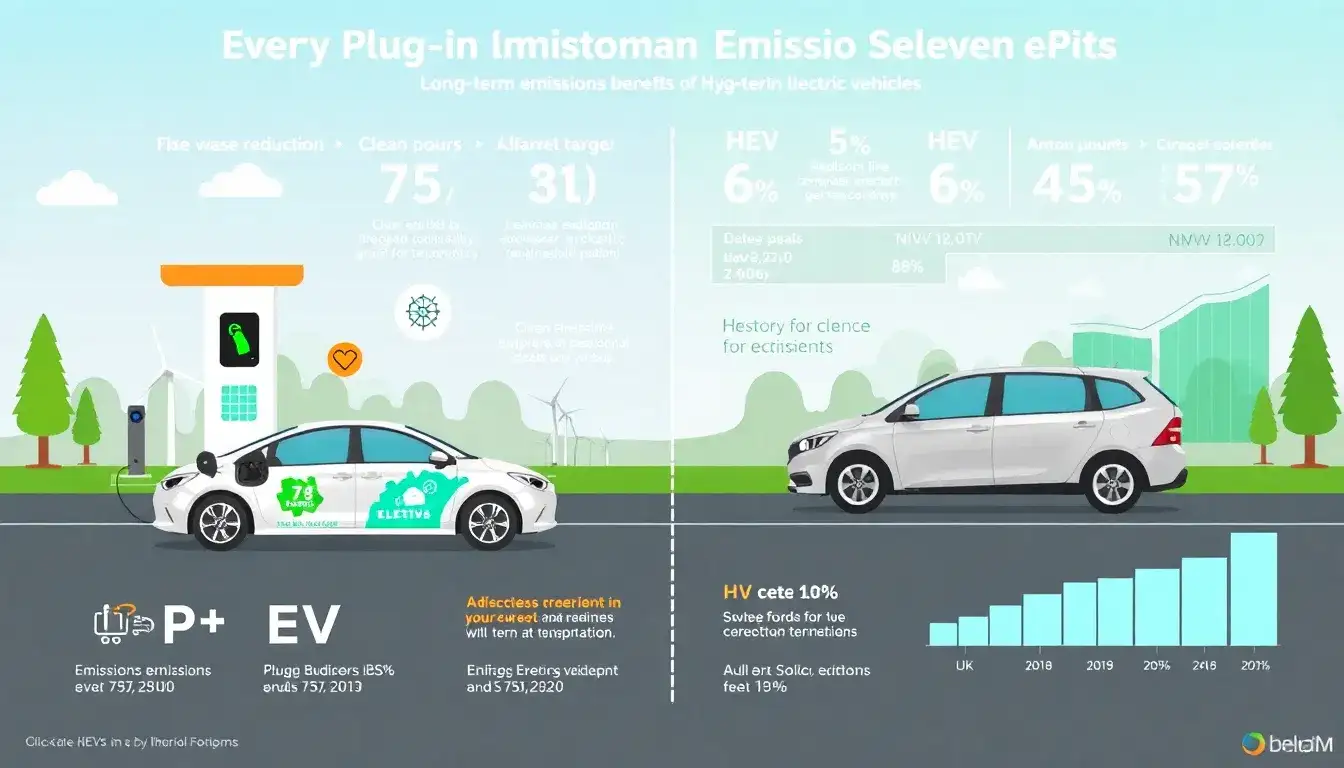
The long-term emissions benefits of Plug-in Hybrid Electric Vehicles (PHEVs) compared to Hybrid Electric Vehicles (HEVs) are significant, primarily because PHEVs can use electricity from the grid for a substantial portion of their miles, which typically has lower emissions than conventional gasoline use.
Key Points on Long-Term Emissions Benefits of PHEVs vs HEVs
- Emissions Reduction: PHEVs reduce lifetime greenhouse gas (GHG) emissions by approximately 46% on average in the U.S., which is a notable improvement over HEVs and internal combustion engine vehicles (ICEVs). This is largely because PHEVs can operate in all-electric mode for a portion of their driving, resulting in zero tailpipe emissions during those periods, unlike HEVs which always rely on some gasoline use combined with electric assistance.
- Battery Production Emissions: PHEVs have smaller batteries than full battery electric vehicles (BEVs), roughly one-sixth the size, which results in lower emissions associated with battery production. Compared to HEVs, PHEVs still have additional emissions from battery manufacturing but benefit from reduced use-phase emissions due to electric driving.
- Grid Electricity Role: The extent of emissions benefits depends on the carbon intensity of the electricity grid. In areas with cleaner electricity, PHEVs have a greater emissions advantage over HEVs. In regions with a high-carbon electricity grid, the benefit is smaller but still present, with PHEVs and HEVs performing comparably when the grid is very carbon-intensive.
- Break-even Mileage: The emissions reduction break-even point for PHEVs compared to ICE vehicles occurs relatively early, between 10,000 and 15,000 miles. Because PHEVs use less gasoline than HEVs, they generally achieve better emissions savings over their lifetime.
- Vehicle-to-Grid (V2G) Potential: Some studies suggest PHEVs can contribute further emissions reductions by providing grid services such as energy storage and ancillary grid balancing, which can help optimize electricity generation efficiency and reduce reliance on high-emission peaking power plants.
Summary
Compared to HEVs, PHEVs offer greater long-term emissions benefits because they can partially run on electricity, reducing tailpipe emissions and overall fuel cycle emissions. This advantage is more pronounced when the grid electricity is cleaner and when PHEVs are driven sufficient electric miles. While HEVs reduce fuel use and emissions compared to conventional vehicles by combining electric assist with gasoline, they cannot match the emissions reductions achievable by PHEVs’ ability to operate in all-electric mode for a significant share of driving.
Thus, PHEVs represent a more climate-friendly option than HEVs over their lifetime, cutting emissions roughly twice as much as HEVs in many cases, while also mitigating some environmental impacts through smaller batteries than BEVs.
Original article by NenPower, If reposted, please credit the source: https://nenpower.com/blog/what-are-the-long-term-emissions-benefits-of-phevs-compared-to-hevs/

