

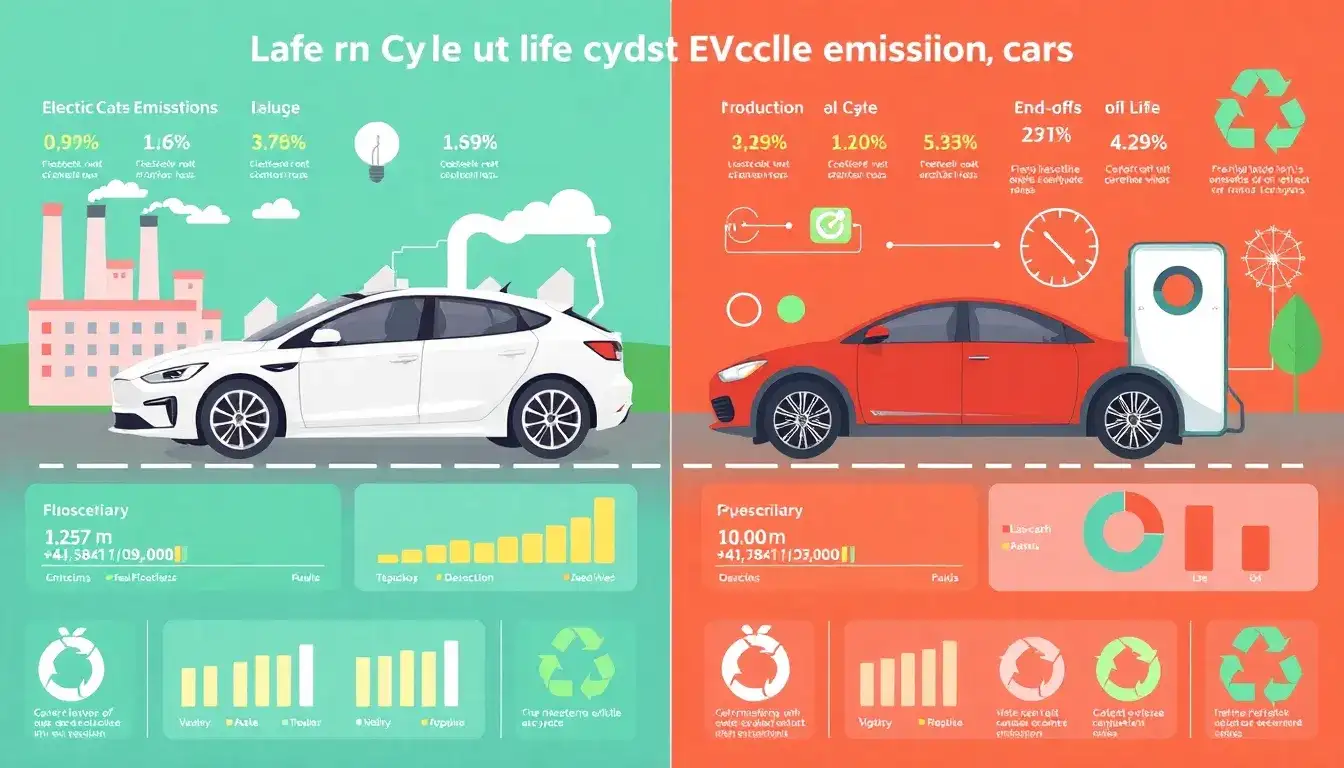
The life cycle emissions of electric vehicles (EVs) are significantly lower than those of gasoline cars when considering the entire lifespan—from manufacturing through operation to disposal.
Key Comparisons Between EVs and Gasoline Cars Lifecycle Emissions
- Overall Emissions Reduction: Electric cars produce about 52% fewer greenhouse gas (GHG) emissions over their lifetime compared to gasoline cars. For electric trucks, the reduction is even greater at 57% less than gas trucks.
- Manufacturing Emissions: Manufacturing emissions are roughly equivalent for both gasoline vehicles and EVs; however, EVs have additional emissions linked to battery production. Despite this, the higher initial manufacturing emissions of EVs are offset by much lower emissions during operation.
- Operational Emissions: Gasoline vehicles emit large amounts of CO2 throughout their use due to burning fossil fuel, while EVs run cleaner, producing zero tailpipe emissions and significantly less overall emissions during operation, especially when charged on cleaner electric grids.
- Break-even Point: EVs have a “break-even” mileage point where the emissions savings in driving outweigh the extra emissions from manufacturing the battery. This occurs at about 17,500 to 21,300 miles, which typically corresponds to 1.5 to 2 years of driving—after which EVs clearly become the lower-emission choice.
- Per Mile Emissions:
- Gasoline cars emit around 350-410 grams of CO2 per mile driven over their lifetime.
- Battery electric vehicles emit about 110-200 grams of CO2 per mile, factoring in manufacturing and electricity generation emissions averaged over the grid mix.
- Lifetime Emissions Example: A typical gasoline car produces around 13 metric tons of CO2 over its lifetime, whereas an electric car produces less than half of that—roughly 6 metric tons when considering the full life cycle.
Summary
| Aspect | Gasoline Cars | Electric Vehicles |
|---|---|---|
| Manufacturing Emissions | Moderate | Higher due to battery production |
| Operational Emissions | High (tailpipe emissions) | Low (zero tailpipe emissions) |
| Lifetime GHG Emissions | Baseline | Approximately 52% lower |
| Break-even Mileage | N/A | Around 17,500 – 21,300 miles |
| CO2 per Mile (grams) | 350 – 410 | 110 – 200 |
In conclusion, despite higher initial emissions during manufacturing, electric vehicles have substantially lower life cycle greenhouse gas emissions than gasoline cars, with the break-even point reached relatively quickly after starting use. Over their lifetime, EVs offer a meaningful reduction in carbon footprint, making them a more climate-friendly transport option.
Original article by NenPower, If reposted, please credit the source: https://nenpower.com/blog/what-are-the-life-cycle-emissions-of-electric-vehicles-compared-to-gasoline-cars/

