

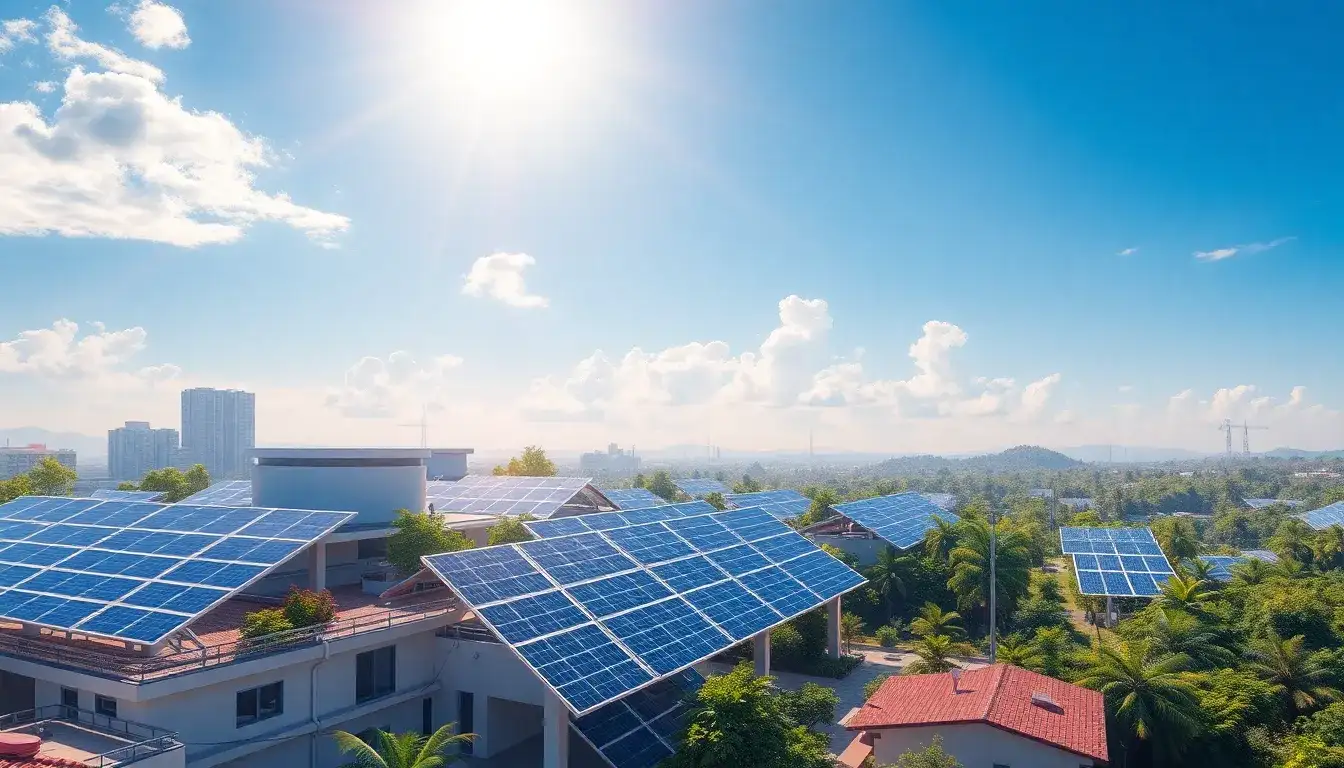
The latest advancements in solar panel efficiency for 2025 show significant progress driven by innovative technologies and materials:
Key Efficiency Improvements
- Current Efficiency Levels
Modern solar panels typically achieve efficiencies above 20%, with many top residential and commercial models exceeding 22% efficiency. The very best panels can reach efficiencies as high as approximately 25% or slightly more under laboratory conditions. - Leading Solar Panel Brands with High Efficiency
Companies like Maxeon, Jinko Solar, Longi Green Energy, Trina Solar, Canadian Solar, REC, Qcells, Panasonic, and Aiko Solar are producing panels with efficiency ratings in the 22%-25% range. For example, Maxeon’s Maxeon 7 panel achieves about 24.1%, Jinko’s Tiger Neo 3.0 reaches 24.8%, and Longi has demonstrated a hybrid passivated back contact module at 25.4% efficiency.
Technologies Driving Efficiency Gains
- Perovskite Tandem Cells
One of the most promising breakthroughs is the use of perovskite materials layered on top of traditional silicon cells to form tandem solar cells. These cells exploit different parts of the solar spectrum, allowing them to surpass the single-junction silicon cell efficiency limit. For instance, LONGi, a leading manufacturer, announced a certified perovskite-silicon tandem solar cell efficiency of 33.9% in lab-scale devices, a significant milestone that exceeds theoretical limits for single-junction cells. - Bifacial Solar Panels
Bifacial panels capture sunlight from both sides, utilizing reflected light from the ground or surrounding surfaces, which enhances electricity yield without additional panel area. This technology is gaining market share and can be combined with perovskite cells for further efficiency improvements. - Smart Solar Panels with IoT Integration
Integration of sensors and Internet of Things (IoT) technology allows for real-time monitoring, optimization, and adaptive alignment with sunlight, improving overall system efficiency and lifespan. - Advanced Cell Structures
The most efficient panels use Interdigitated Back Contact (IBC) cells, passivated back contact (TOPCon) cells, heterojunction (HJT) cells, and shingled or multi-busbar designs. These advancements reduce electron recombination losses and improve voltage and current output. - Larger Cell Sizes and Higher Power Ratings
Manufacturers are moving to larger wafer sizes (e.g., 166mm, 182mm, 210mm) and larger panel formats to increase power output and efficiency while reducing manufacturing costs. Panels with power ratings above 600W and efficiencies over 22% are becoming more common.
Additional Innovations
- Flexible and Transparent Solar Panels
Innovations include flexible, lightweight, and transparent solar panels that can be integrated into windows, building materials, or even fabrics, broadening the application scope of solar power. - AI and Quantum Computing
Artificial intelligence is used to optimize solar farm operations and energy harvesting. Quantum computing is being explored to design more efficient solar cell materials and structures.
Summary Table of Top Residential Solar Panel Efficiencies (2025)
| Manufacturer | Model | Efficiency (%) | Power Output (W) | Technology Highlights |
|---|---|---|---|---|
| Maxeon | Maxeon 7 | 24.1 | 445 | IBC cells, strong warranty |
| Jinko Solar | Tiger Neo 3.0 | 24.8 | 495 | TOPCon cells, high voltage output |
| Longi Green Energy | Hi-Mo 6 Scientist | 25.4 (lab) | Commercial use | Perovskite-silicon tandem cells |
| Aiko Solar | Neostar 2P | 24.3 | 485 | Emerging high-efficiency series |
| Panasonic | Evervolt 430 W | 22.2 | 430 | Low temperature coefficient |
| REC | Alpha Pure 410 W | 22.2 | 410 | Low temperature coefficient, affordable |
These advancements are driving solar panels towards higher conversion efficiencies, more power output per square meter, and lower costs per watt, making solar energy more competitive and widely deployable.
In conclusion, the solar industry’s latest efficiency advancements are mainly powered by perovskite tandem cells, bifacial panels, advanced cell designs (IBC, TOPCon, HJT), larger wafer sizes, and smart technologies. These developments push efficiencies beyond 25% for commercial products and hold promises of reaching even higher levels soon, with tandem cells already breaking the 33% efficiency barrier in lab environments.
Original article by NenPower, If reposted, please credit the source: https://nenpower.com/blog/what-are-the-latest-advancements-in-solar-panel-efficiency/

