

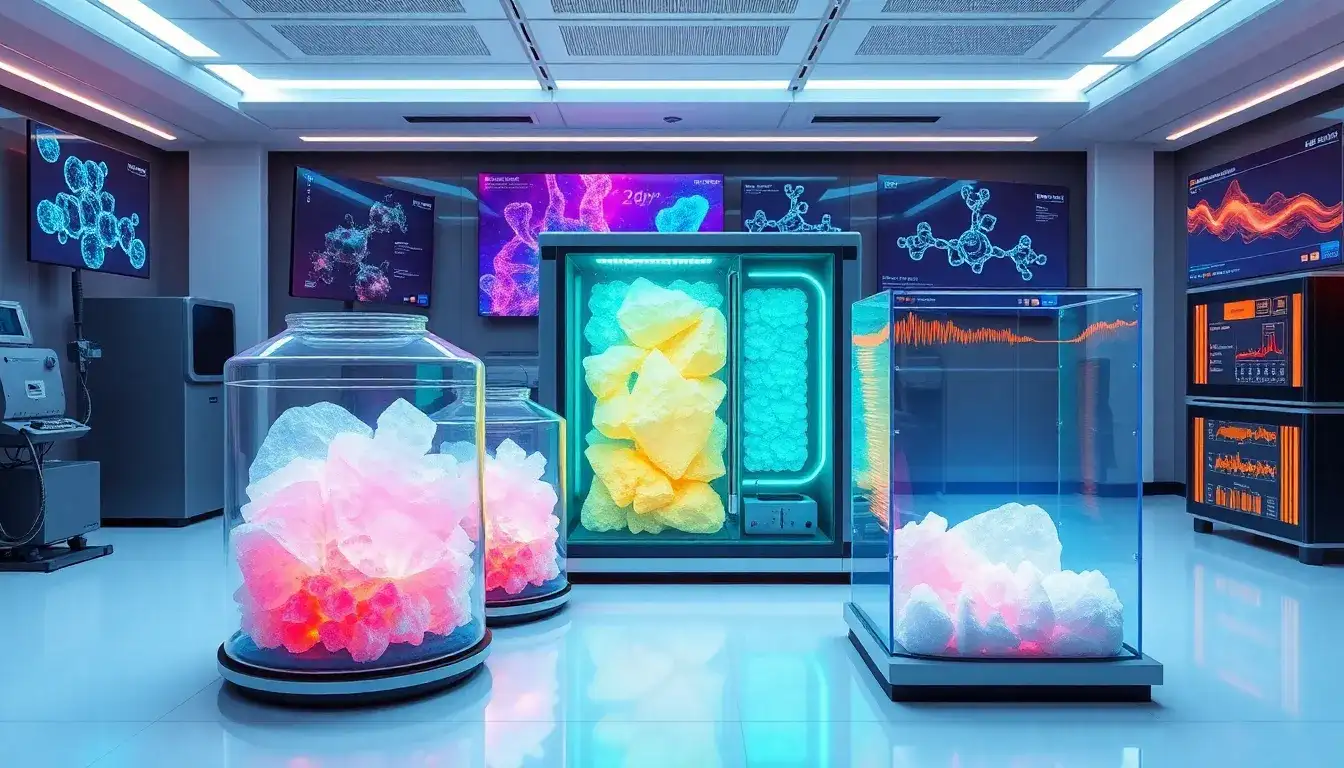
Latest Advancements in Materials for Thermal Energy Storage Systems
Thermal energy storage (TES) systems have seen significant advancements in recent years, driven by the need for more efficient and sustainable energy solutions. The development of new materials and technologies is central to these advancements.
Phase Change Materials (PCMs)
- Current Challenges: PCMs are widely used for their ability to store thermal energy efficiently, but they face challenges such as low thermal conductivity, thermal instability, and leakage.
- Improvements: Researchers are addressing these challenges by developing novel composite materials that combine PCMs with high-conductivity materials like nanoparticles. This can increase thermal conductivity by up to 30%.
- Applications: PCMs are crucial for building energy management and solar energy storage, offering effective heat storage solutions that reduce energy consumption and lower carbon emissions.
Composite Materials
- Development: Composite materials are being developed to integrate multiple functionalities, such as combining PCMs with other materials to enhance heat transfer and energy storage density.
- Advantages: These composites offer improved thermal management capabilities, making them ideal for various applications in thermal energy storage.
Thermochemical Materials
- Innovation: Thermochemical materials are emerging as a promising alternative to PCMs. They can store more thermal energy and utilize solar energy or excess grid electricity for charging.
- Potential Benefits: These materials could provide cost-effective and versatile energy storage solutions, reducing demand on electrochemical batteries and enhancing energy efficiency in buildings.
Novel Approaches and Materials
- Eutectic Mixtures and Nanomaterials: Recent investigations focus on linking molecular structures of organic molecules to their physical properties. Techniques such as freeze-cast matrices are being explored to improve thermal conductivity and form stability in PCMs.
- Economical Solutions: Research aims to develop very low-cost storage materials, such as salt hydrates, which could significantly lower the economic barrier to widespread adoption of TES systems.
Overall, these advancements are geared toward creating more efficient, cost-effective, and sustainable thermal energy storage systems that can support the transition to renewable energy sources.
Original article by NenPower, If reposted, please credit the source: https://nenpower.com/blog/what-are-the-latest-advancements-in-materials-for-thermal-energy-storage-systems/

