

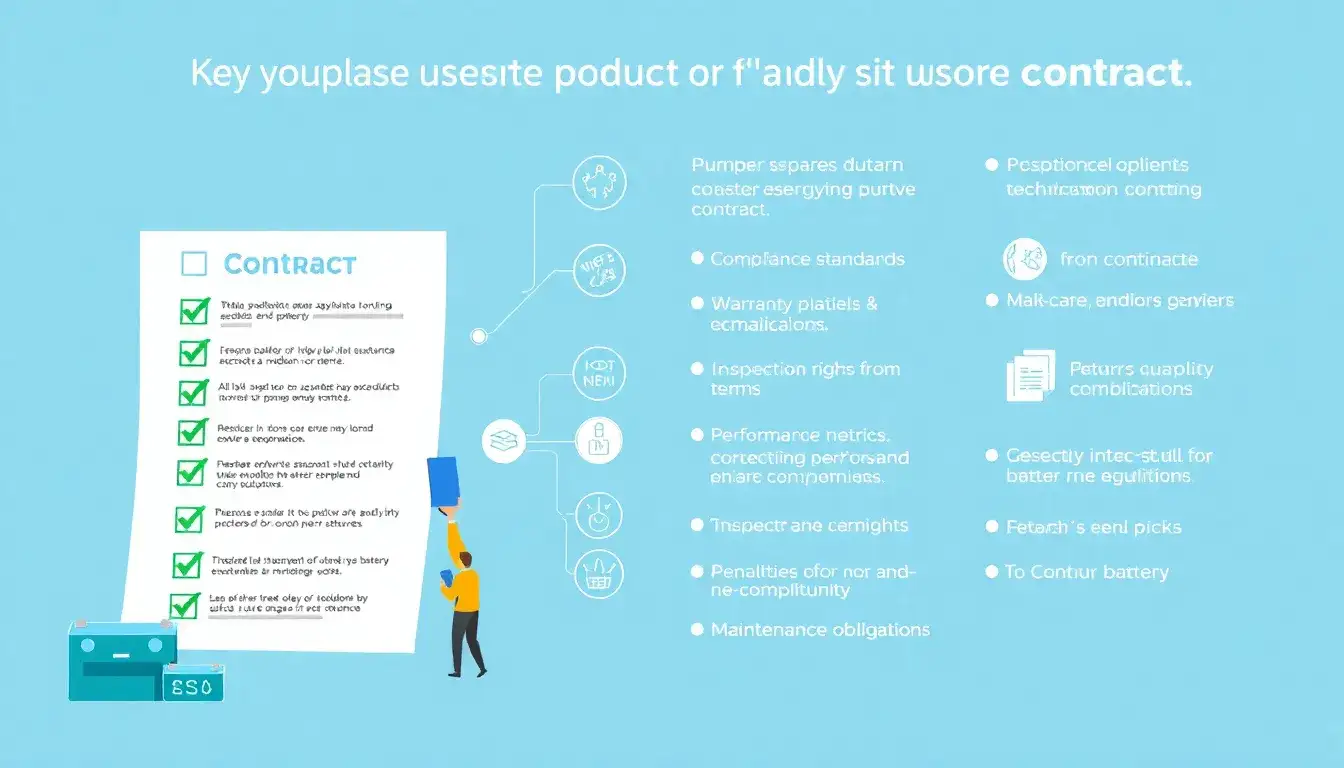
Key Terms to Ensure Product Quality for BESS
1. Comprehensive Product Warranty
- Include warranties that cover battery cell degradation, which is inevitable, but should be modeled and priced for in project ROI calculations.
- Warranty should address capacity and degradation guarantees, round-trip efficiency guarantees, and availability guarantees.
- Additional guarantees may cover response time, ramp rate, settling time, and signal-following accuracy depending on project needs.
- The supplier’s obligation for failure to meet performance thresholds should include repair, replacement, or make-whole payments.
- Developers may negotiate liquidated damages for underperformance or downtime, tied to critical milestones like commissioning completion.
2. Performance Testing and Commissioning
- Warranty testing should be done as part of commissioning and typically during annual maintenance.
- Contracts should allow for interim testing as needed to troubleshoot system issues.
- Clarify who (supplier or developer) is responsible for conducting warranty performance tests, often linked to the presence of a long-term services agreement (LTSA) with the supplier.
3. Technical Compliance and Review Rights
- The developer should have rights to review and comment on design drawings and documents to ensure compliance with technical specifications.
- The supplier should be responsible for coordination with other contractors without entitlement to price or schedule relief due to coordination issues.
- Interfacing requirements during design, delivery, and commissioning should be included in the purchase price without clauses shifting risk of delays to the developer.
4. Real-Time Efficiency and Operating Losses
- Include guarantees or allowances for round-trip efficiency (RTE) reflecting inevitable losses such as battery degradation, parasitic load (ventilation, cooling), and station load losses.
- Address how to meter and calculate losses separately, and specify who bears the cost of station load losses.
- Consider structuring RTE guarantees to reflect seasonal or operational variations in station loads to manage weather-related efficiency risks.
5. Price Adjustment and Liquidated Damages
- Include a fair price adjustment mechanism to protect the owner from supplier contingency pricing.
- Negotiate liquidated damages related to delays or underperformance to offset additional costs faced by the developer.
Including these terms in your BESS procurement or supply contract will help ensure product quality, operational reliability, and financial protection throughout the system’s lifecycle. The warranty and performance guarantees, combined with clear testing obligations and allowances for efficiency losses, are particularly critical in managing the technical and commercial risks associated with battery storage systems.
These recommendations are supported by industry practice and expert legal insights on BESS contracts.
Original article by NenPower, If reposted, please credit the source: https://nenpower.com/blog/what-are-the-key-terms-to-include-in-a-contract-to-ensure-product-quality-for-bess/

