

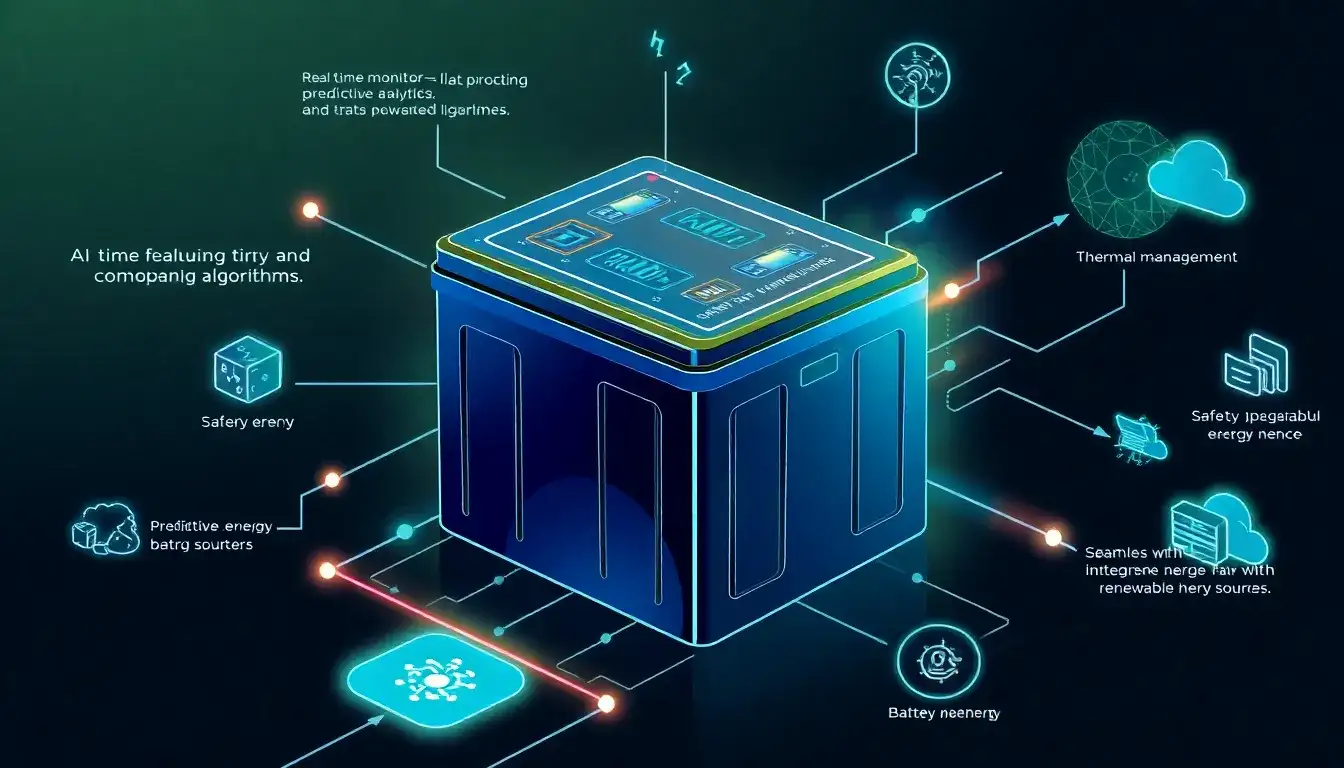
The Key Features of AI-driven Battery Management Systems (BMS)
The key features of AI-driven Battery Management Systems (BMS) revolve around enhancing accuracy, safety, efficiency, and battery lifespan through advanced data processing, predictive analytics, and real-time adaptability. Here are the main features:
1. Precise Battery State Estimation
- AI-driven BMS provides highly accurate estimations of critical battery metrics such as State of Charge (SoC), State of Health (SoH), and State of Power (SoP). For example, some systems achieve SoC estimation within 1% error and SoH within 3% error. This precision enables dependable range predictions and informed decision-making throughout the battery’s lifecycle.
2. Real-Time Adaptive Control
- These systems include a sophisticated software layer that processes vast amounts of battery and environmental data in real time. This allows for dynamic monitoring, prediction, and adjustment of battery operations, shifting from reactive to proactive battery management.
- AI-enabled edge computing processes data locally within the vehicle for low-latency, immediate responses critical for power adjustments during driving events such as rapid acceleration or regenerative braking.
3. Predictive Analytics and Fault Detection
- AI algorithms analyze trends in voltage, current, temperature, and other data to detect subtle anomalies that traditional threshold-based methods might miss. This early warning allows the system to predict battery failures, thermal runaway risks, and degradation, enabling preventive maintenance and fault mitigation before critical failures occur.
- AI-enhanced cell balancing optimizes charge distribution, reducing stress on individual cells and improving long-term battery health.
4. Optimized Charging and Energy Management
- AI adapts charging protocols based on factors such as battery chemistry, age, temperature, and usage patterns to minimize degradation. This includes dynamically adjusting voltage and current in real time to optimize energy flow without exceeding safety limits, enhancing fast charging capabilities while extending battery life.
- Charging strategies can also be personalized to individual vehicles using reinforcement learning based on historical driving and charging data.
5. Enhanced Safety and Thermal Management
- AI-driven BMS dynamically manages thermal conditions by regulating cooling and heating systems based on real-time sensor data, maintaining optimal battery temperatures to prevent overheating and energy waste.
- Advanced diagnostics enabled by AI detect risks early and help maintain safe battery operation under varying environmental and usage scenarios.
6. Integration of IoT and Connectivity
- Modern AI-driven BMS leverage IoT connectivity for granular monitoring of battery fleets, enabling cloud-based analytics and fleet-wide optimizations while maintaining vehicle data privacy through edge computing.
- Federated learning approaches allow AI models to improve collectively from distributed data sources without compromising individual vehicle data privacy.
7. Extended Battery Life and Reduced Maintenance Costs
- By optimizing charging and discharging cycles and preventing operations outside safe limits, AI-driven BMS reduce battery degradation, potentially extending battery life by up to 40% and lowering total cost of ownership.
- Predictive maintenance scheduling based on real-time battery health and usage patterns avoids unnecessary maintenance, minimizes downtime, and improves operational efficiency.
Summary Table of Key Features
| Feature | Description |
|---|---|
| Accurate State Estimation | Precise SoC, SoH, and SoP calculations with minimal error |
| Real-Time Adaptive Control | Dynamic monitoring and adjustment of battery parameters using onboard AI |
| Predictive Fault Detection | Early identification of anomalies to prevent failures |
| Optimized Charging Management | AI-based adaptive charging strategies minimizing degradation and improving fast charging |
| Thermal Management | AI-regulated cooling/heating to maintain safe battery temperatures |
| IoT and Connectivity Integration | Fleet monitoring and cloud analytics with edge computing for privacy and low latency |
| Extended Battery Life | Optimization to slow degradation, extending battery lifespan |
| Predictive Maintenance | Intelligent scheduling based on actual battery condition and predicted future health |
These features collectively make AI-driven battery management systems smarter, safer, more efficient, and more reliable than traditional BMS, ultimately supporting better performance and longer-lasting batteries in electric vehicles and energy storage applications.
Original article by NenPower, If reposted, please credit the source: https://nenpower.com/blog/what-are-the-key-features-of-ai-driven-battery-management-systems/

