

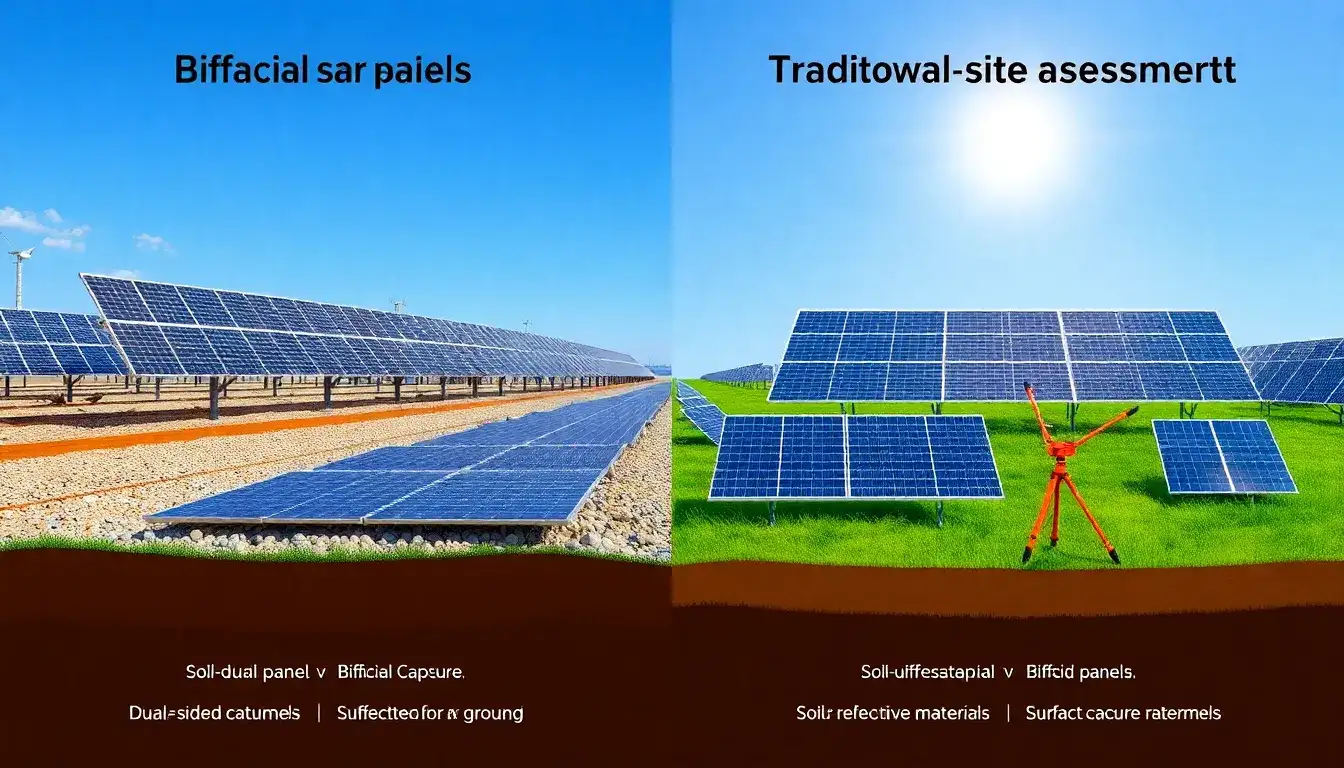
Key Differences in Site Assessment for Bifacial Solar Panels Compared to Traditional Ones
Bifacial solar panels require a more detailed and specific site assessment compared to traditional monofacial panels. Here are the key differences and considerations:
- Reflectivity and Albedo:
- Bifacial Panels: These panels benefit significantly from reflective surfaces like snow, sand, or light-colored roofs, which can enhance energy production through increased rear-side irradiance. The site assessment should include evaluating the albedo (reflectivity) of the ground or surrounding surfaces.
- Monofacial Panels: Traditional panels focus solely on direct sunlight from the front side, making ground reflectivity less crucial.
- Installation Height and Ground Clearance:
- Bifacial Panels: A height of at least 1 meter above the ground is recommended to ensure uniform rear-side irradiance and to maximize bifacial gain.
- Monofacial Panels: Ground clearance is less critical for monofacial panels, as they primarily rely on direct sunlight.
- Mounting and Orientation:
- Bifacial Panels: Require more sophisticated mounting systems to optimize tilt angles and elevations for maximum energy capture from both sides.
- Monofacial Panels: Generally simpler to install with standard rooftop setups and less emphasis on adjustments for surrounding reflectivity.
- Shading and Obstruction Analysis:
- Bifacial Panels: While bifacial panels are more efficient in low-light conditions, careful planning is still needed to avoid obstructions affecting both front and rear irradiance.
- Monofacial Panels: Primarily focus on minimizing obstructions to direct sunlight on the front side.
- Ground Cover Ratio (GCR) and Array Spacing:
- Bifacial Panels: Lower GCR (around 40-50%) can increase energy production by allowing more reflected light to reach the rear side.
- Monofacial Panels: GCR is less impactful since they primarily utilize direct sunlight.
In summary, while both types of panels need site assessment for optimal performance, bifacial panels require additional considerations to maximize their unique advantages in reflective environments and dual-sided energy capture.
Original article by NenPower, If reposted, please credit the source: https://nenpower.com/blog/what-are-the-key-differences-in-site-assessment-for-bifacial-solar-panels-compared-to-traditional-ones/

