

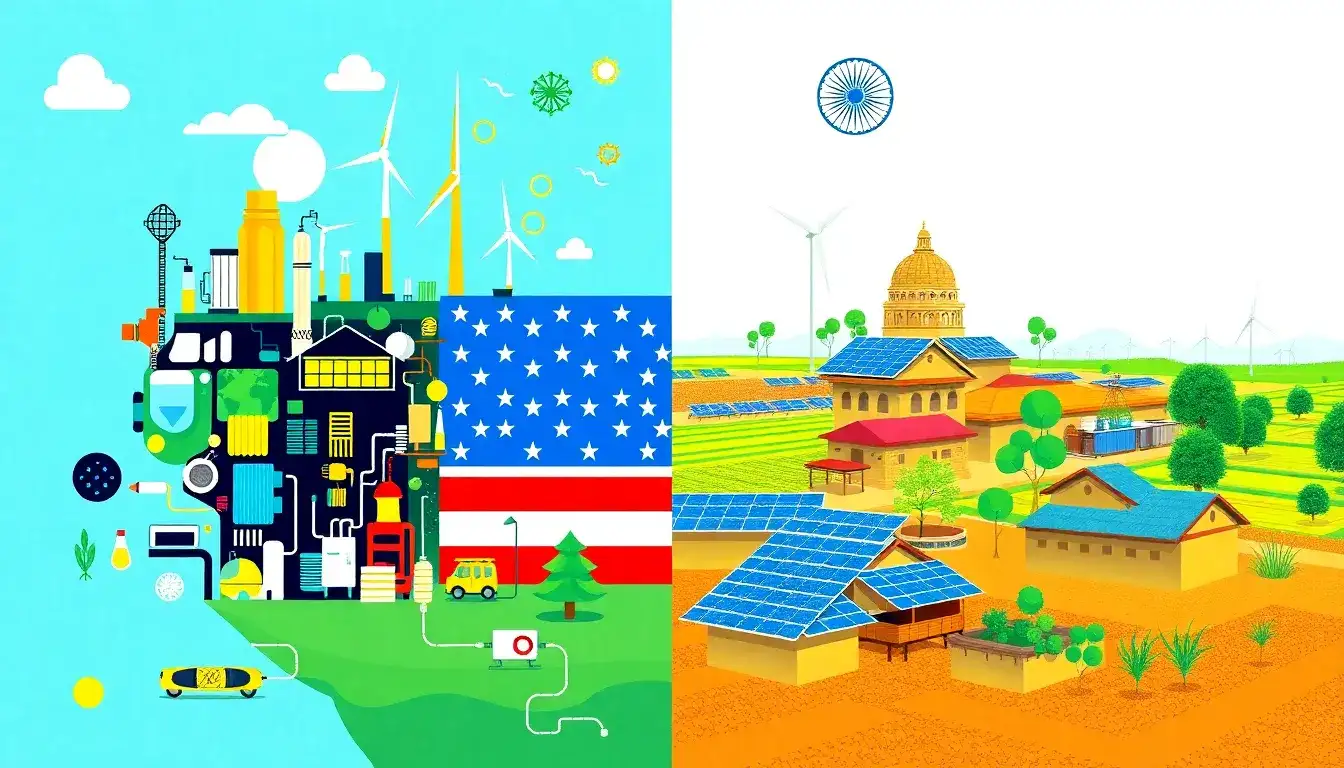
Comparing the green hydrogen policies of the U.S. and India reveals significant differences in their approaches, incentives, and implementation strategies. Here’s a summary of these differences:
U.S. Green Hydrogen Policies
- Legislation and Funding: The U.S. has introduced substantial legislative support through the Bipartisan Infrastructure Law and the Inflation Reduction Act (IRA). The IRA includes provisions like a production tax credit of up to $3 per kg for green hydrogen that meets stringent lifecycle emissions standards.
- Strategy and Roadmap: The U.S. has developed a comprehensive National Hydrogen Strategy and Roadmap, focusing on increasing high-impact uses, reducing costs, and deploying regional hubs.
- Eligibility for Tax Credits: To qualify for tax credits, green hydrogen must be produced using electricity from renewable sources. Draft rules emphasize three pillars: additionality, regionality, and temporality to ensure that fossil fuels are not indirectly used in production.
India’s Green Hydrogen Policies
- National Hydrogen Mission: India recently launched the National Hydrogen Mission aimed at achieving net-zero carbon emissions by 2070. It emphasizes the promotion of green hydrogen as a clean energy source.
- Targets and Incentives: India has set ambitious targets to achieve green hydrogen production but lacks specific tax incentives compared to the U.S. However, it has outlined plans for subsidies and financial assistance to support renewable energy and hydrogen infrastructure.
- Implementation Strategies: India focuses on developing comprehensive support structures, including government-backed research and subsidies to foster the green hydrogen market. It also seeks international collaborations to facilitate technology transfer and investment.
Key Differences
- Legislative Framework: The U.S. has a more detailed legislative framework with specific tax credits and funding allocations, whereas India’s approach is more focused on policy targets and subsidies.
- Renewable Energy Integration: Both countries emphasize the use of renewable energy for green hydrogen production. However, the U.S. has clearer rules defining the conditions under which hydrogen can qualify as “green.”
- Economic Incentives: The U.S. offers explicit tax credits for eligible green hydrogen production, while India relies on broader support mechanisms such as subsidies and government-supported infrastructure development.
Overall, while both the U.S. and India are committed to developing green hydrogen industries, their strategies differ in terms of policy specifics, incentives, and implementation timelines.
Original article by NenPower, If reposted, please credit the source: https://nenpower.com/blog/what-are-the-key-differences-in-green-hydrogen-policies-between-countries-like-the-u-s-and-india/

