

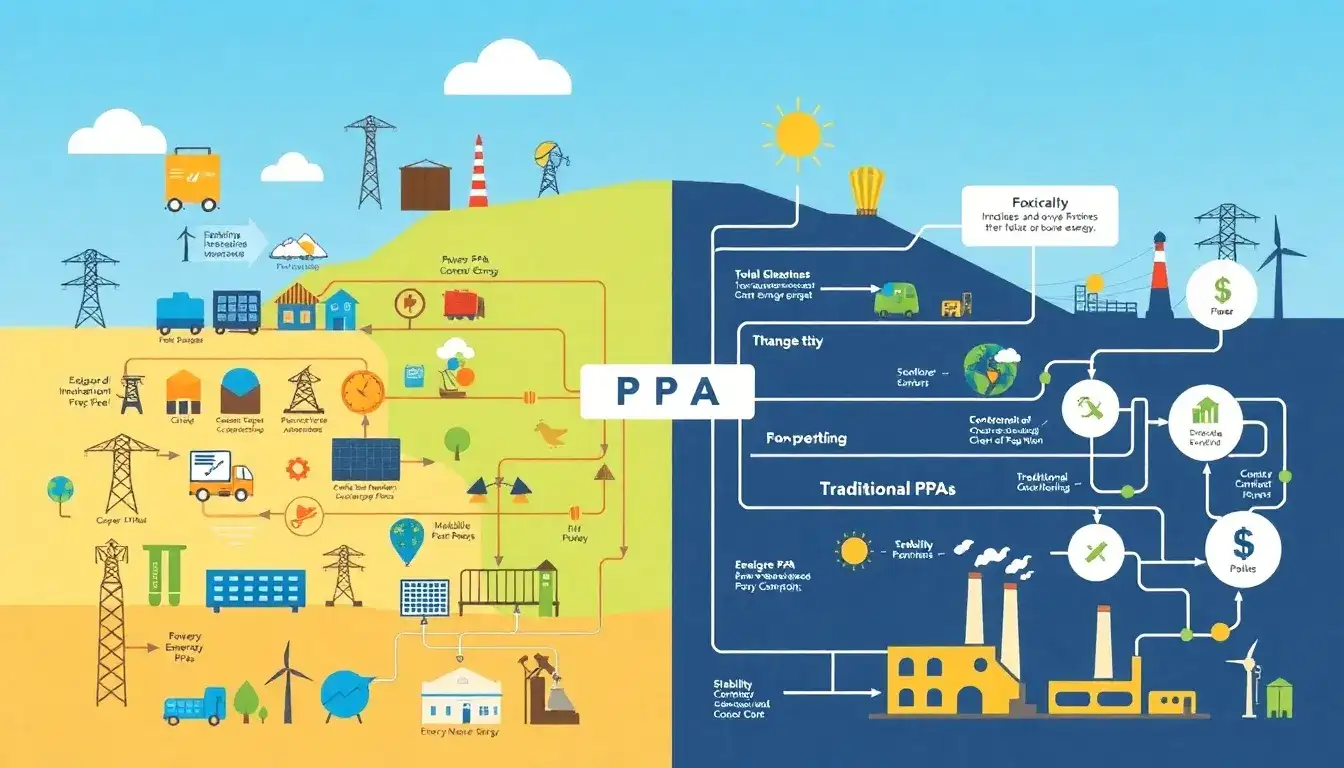
Key Differences
1. Nature of Services Provided
- Traditional PPAs: Primarily focus on the purchase of electricity generated from renewable or non-renewable sources. They involve contracts for energy output, often with terms that define the quantity of electricity to be supplied over a period.
- Storage PPAs: Involve the provision of storage services, including energy arbitrage, peak shaving, frequency regulation, and backup power. These PPAs often deal with complex arrangements for charging and discharging energy.
2. Pricing Models and Structures
- Traditional PPAs: Frequently use fixed-price or variable/index-based pricing for electricity, with common structures including annual escalators or price escalation rates. Renewable PPAs might offer below-market rates to secure project financing in exchange for guaranteed revenues.
- Storage PPAs: May involve more complex pricing, often including a combination of fixed capacity payments and variable costs per megawatt-hour (MWh) for throughput. They can also be structured as capacity-only contracts where the developer manages energy sales and costs.
3. Control Over Assets
- Traditional PPAs: Buyers typically do not control the generation asset; they purchase the output. In some onsite arrangements, physical delivery and ownership of assets are managed by the supplier.
- Storage PPAs: Can involve contracts that grant buyers control over the storage asset for operational purposes, such as tolling agreements, or they may use proxy structures that don’t give the buyer physical control over the asset but guarantee revenues based on virtual storage operations.
4. Risk Allocation and Complexity
- Traditional PPAs: Generally straightforward with well-established risks and benefits related to energy production and market prices.
- Storage PPAs: Involve more complex risk management due to the multiple functions of storage (generation, load, ancillary services), which necessitate clear definitions of services, pricing, and responsibilities.
5. Market Flexibility and Opening Up Opportunities
- Traditional PPAs: Mainly focused on providing cost savings and renewable energy credits (RECs) for sustainability goals.
- Storage PPAs: Offer additional benefits like flexibility in managing grid stability and allowing for arbitrage opportunities, which can enhance the economic viability of projects.
In summary, while traditional PPAs are primarily concerned with purchasing electricity, storage PPAs deal with a broader range of energy storage services, employing more complex pricing structures and operational agreements to manage these services.
Original article by NenPower, If reposted, please credit the source: https://nenpower.com/blog/what-are-the-key-differences-in-contractual-structures-between-storage-ppas-and-traditional-ppas/

