

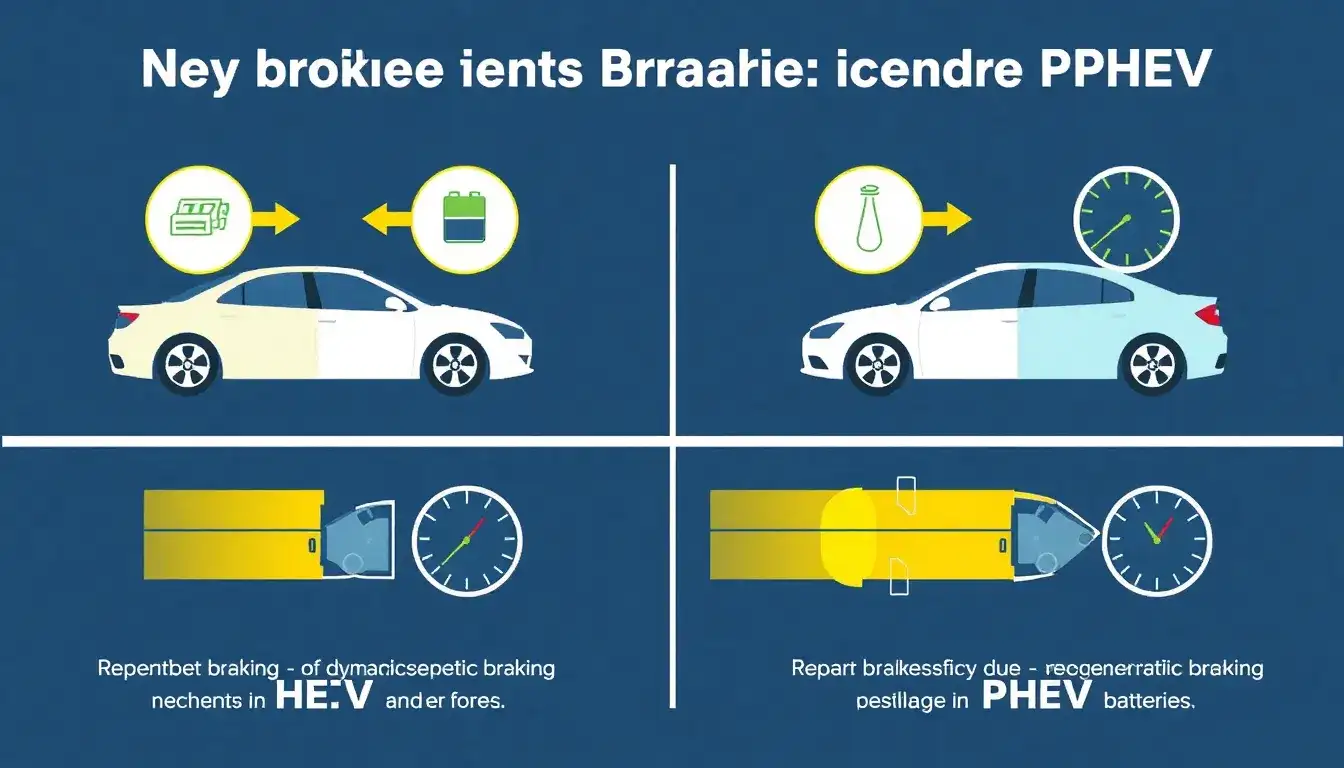
Key differences in braking performance between Hybrid Electric Vehicles (HEVs) and Plug-in Hybrid Electric Vehicles (PHEVs)
Key differences in braking performance between Hybrid Electric Vehicles (HEVs) and Plug-in Hybrid Electric Vehicles (PHEVs) primarily revolve around the nature of their regenerative braking systems and the impact on traditional friction braking.
Regenerative Braking in HEVs and PHEVs
- Both HEVs and PHEVs use regenerative braking, which captures and converts kinetic energy into electrical energy to recharge the battery during braking or deceleration, improving energy efficiency and reducing wear on conventional brakes.
- PHEVs typically have larger battery capacities and more powerful electric motors than HEVs, enabling greater use of electric driving and regenerative braking before the internal combustion engine (ICE) is needed. This can result in more frequent and stronger regenerative braking in PHEVs compared to HEVs.
Differences in Braking Performance and Brake Wear
- Because PHEVs rely more heavily on electric drive and have higher-capacity batteries, their regenerative braking systems can recover more energy during braking events. This means PHEVs potentially experience less friction brake wear than HEVs as they use brake pads and rotors less often.
- HEVs, with smaller batteries primarily assisting the ICE rather than powering the vehicle for long distances on electric power alone, may use regenerative braking less aggressively, leading to comparatively more reliance on friction brakes.
Practical Implications
- Brake components such as pads, rotors, and brake fluid require less frequent replacement on both HEVs and PHEVs due to regenerative braking, but this effect is more pronounced in PHEVs because of their ability to drive longer distances electrically and recover more braking energy.
- The braking architecture and control strategy may differ, with PHEVs possibly having more sophisticated regenerative braking calibrations to maximize battery recharge and braking feel, given their larger electric drive capacity.
Summary Table of Key Braking Differences
| Aspect | HEVs | PHEVs |
|---|---|---|
| Battery capacity | Smaller, assists ICE | Larger, supports longer electric range |
| Electric motor power | Moderate | Higher |
| Regenerative braking usage | Moderate, supplements friction braking | Greater, stronger regenerative braking |
| Friction brake wear | Higher relative to PHEVs | Lower, due to more energy recovery |
| Brake component maintenance | Required but less frequent | Even less frequent due to higher regen use |
In essence, while both HEVs and PHEVs benefit from regenerative braking that reduces friction brake wear and improves energy efficiency, PHEVs generally achieve superior braking performance through more powerful regenerative braking enabled by larger batteries and motors, resulting in less reliance on friction brakes compared to HEVs.
Original article by NenPower, If reposted, please credit the source: https://nenpower.com/blog/what-are-the-key-differences-in-braking-performance-between-hevs-and-phevs/

