

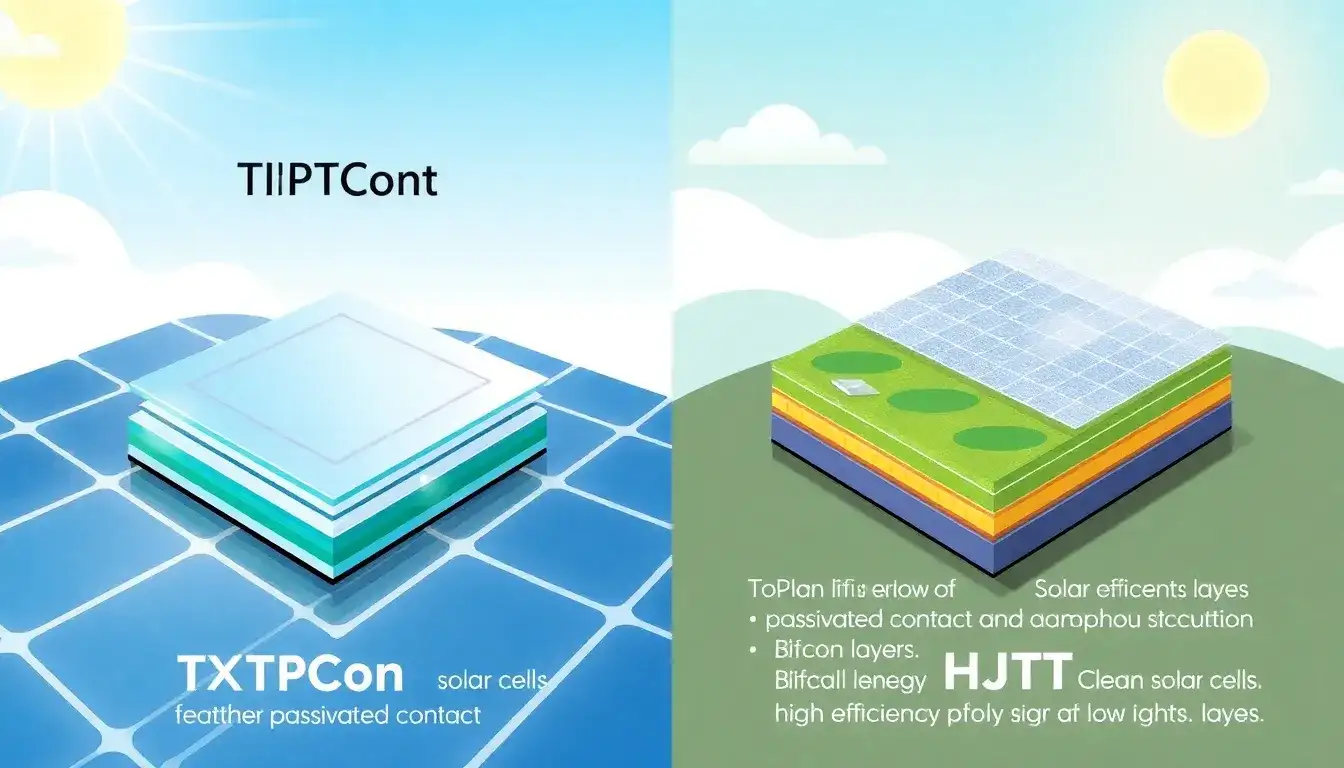
The key differences between TOPCon (Tunnel Oxide Passivated Contact) and HJT (Heterojunction) solar cells lie in their structure, materials, manufacturing complexity, efficiency, temperature performance, bifaciality, cost, and application suitability.
1. Technology and Structure
- TOPCon solar cells use a crystalline silicon wafer with a very thin tunnel oxide layer on the cell’s backside, combined with a passivated contact made of polycrystalline silicon. This design reduces recombination losses and improves charge carrier transport to enhance efficiency. The tunnel oxide layer is crucial for passivation and performance.
- HJT solar cells combine crystalline silicon wafers sandwiched between thin layers of amorphous silicon (a-Si:H). These layers form a heterojunction that improves passivation significantly and reduces recombination losses. The structure typically involves front and rear intrinsic and doped amorphous silicon layers, yielding a hybrid of crystalline and thin-film technologies.
2. Materials
- TOPCon uses n-type crystalline silicon wafers with a thin tunnel oxide and polycrystalline silicon layer on the rear side.
- HJT cells use monocrystalline silicon wafers coated on both sides with intrinsic and doped amorphous silicon layers, which form the heterojunction.
3. Efficiency
- HJT solar cells currently achieve very high efficiencies, typically around 25-26.7% for monofacial cells and can exceed 30% in bifacial configurations under optimal conditions.
- TOPCon cells also offer high efficiency, usually in the range of 24-28%, surpassing conventional PERC cells but generally slightly behind HJT in maximum achievable efficiency.
4. Temperature Performance
- TOPCon panels have an improved temperature coefficient, meaning they lose less efficiency at high temperatures compared to traditional PERC and even HJT cells. This makes them well-suited for hot climates.
- HJT cells also have a low temperature coefficient, maintaining good performance in both high and low-temperature environments, making them versatile across climates.
5. Bifaciality
- HJT solar panels are inherently bifacial, with excellent bifaciality (ability to generate power from light on both front and rear sides).
- TOPCon panels also offer bifaciality and often have a high bifaciality factor, sometimes reported as higher or comparable to HJT, enhancing energy generation especially in reflective environments.
6. Manufacturing Complexity and Cost
- HJT manufacturing is more complex and costly due to the need for specialized layers of amorphous silicon and transparent conductive oxides, as well as intricate interconnection processes. This complexity currently leads to higher upfront costs.
- TOPCon cells have a simpler manufacturing process relative to HJT. They can be produced by upgrading existing PERC production lines with additional steps like depositing the tunnel oxide layer and polycrystalline silicon passivation. This results in lower manufacturing costs and easier scalability, though the process remains more complex than for traditional cells.
7. Durability and Stability
- TOPCon cells benefit from a durable passivation layer that leads to enhanced long-term stability and reduced performance degradation, supporting extended service life.
- HJT cells exhibit low light-induced degradation (LID) and potential-induced degradation (PID), contributing to excellent long-term performance and minimal efficiency loss over time.
8. Application Suitability
- HJT technology excels in applications requiring the highest efficiency and bifacial energy yield, such as utility-scale solar farms in high irradiance areas, building-integrated photovoltaics (BIPV), and space-constrained installations.
- TOPCon technology is suitable for commercial rooftop installations and large-scale projects where a balance of efficiency, durability, and cost-effectiveness is desired. Its superior temperature stability makes it ideal for warm climates.
Summary Comparison Table
| Feature | TOPCon | HJT |
|---|---|---|
| Cell Structure | Crystalline Si + Tunnel oxide + poly-Si passivation | Crystalline Si wafer + amorphous Si layers (heterojunction) |
| Base Material | N-type crystalline Si | Monocrystalline Si + amorphous Si layers |
| Efficiency (%) | 24–28% | 25–26.7% (monofacial), >30% (bifacial) |
| Temperature Coefficient | Slightly better at high temps | Low, stable across temperatures |
| Bifaciality | High | Very high |
| Manufacturing Complexity | Moderate (PERC upgrade line) | High (complex thin-film deposition) |
| Cost | Lower | Higher |
| Durability & Stability | High, with durable passivation | Very high, low LID and PID |
| Best Applications | Commercial rooftops, warm climates | Utility-scale, BIPV, space-constrained installations |
In conclusion, TOPCon solar cells provide a cost-effective upgrade to traditional PERC cells with excellent temperature resilience and durability, while HJT cells achieve the highest efficiencies and superior bifacial performance at the cost of more complex and expensive manufacturing. The choice between them depends on project goals, budget, and site conditions.
Original article by NenPower, If reposted, please credit the source: https://nenpower.com/blog/what-are-the-key-differences-between-topcon-and-hjt-solar-cells/

