

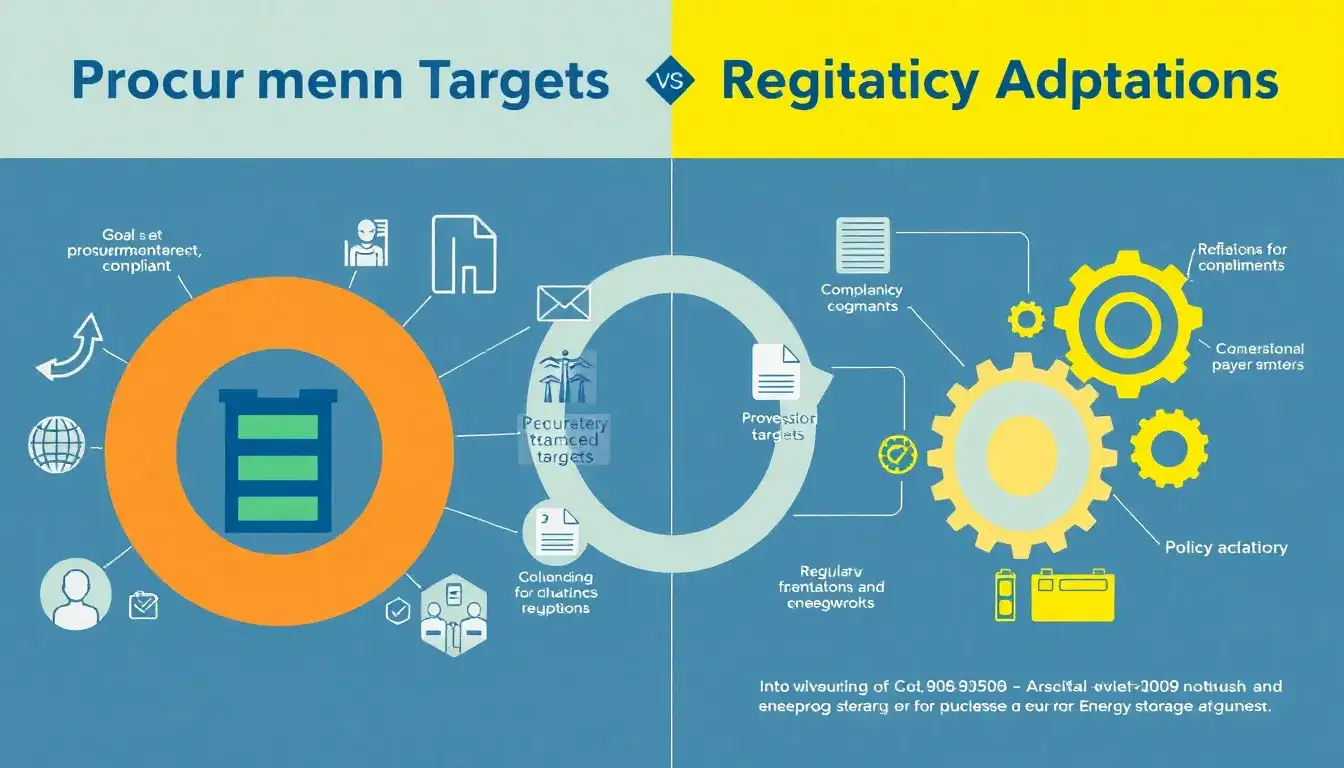
The key differences between procurement targets and regulatory adaptations in energy storage policies relate to their nature, purpose, and implementation focus:
Procurement Targets
- Definition and Purpose: Procurement targets are specific mandates requiring utilities to acquire a defined quantity of energy storage capacity by a certain deadline. They function as clear, quantitative goals to drive deployment of energy storage resources.
- Investor Signal and Market Certainty: Such targets provide supportive signals for investors by reducing regulatory uncertainty, thereby encouraging investment in energy storage technologies.
- Scope and Specificity: Procurement targets can be broad, focusing on megawatt (MW) capacity goals, or more specific, mandating adoption of particular storage technologies. For example, California’s target limited pumped storage to 50 MW within its overall storage procurement goals.
- Implementation Levels: These targets are set either by state utility commissions (e.g., California, Colorado, Massachusetts) or legislatures (e.g., Oregon, New Jersey).
- Role in Grid Process Evolution: Procurement targets help demonstrate commitment to utilizing energy storage, which facilitates learning and gradual updating of grid processes to better incorporate energy storage in planning, operations, and procurement.
Regulatory Adaptations
- Definition and Purpose: Regulatory adaptations refer to changes or updates in regulatory frameworks, rules, and grid procedures that enable and support the integration of energy storage technologies. This includes updating interconnection rules, tariffs, utility planning, valuation methodologies, and rate designs that historically did not contemplate energy storage.
- Focus on System Integration: Whereas procurement targets impose quantitative goals, regulatory adaptations are about modifying the underlying regulatory environment to unlock the full potential and functionality of energy storage on the grid.
- Process-Oriented: These adaptations address legacy barriers by ensuring that utility processes and regulatory frameworks systematically incorporate energy storage at all grid points—transmission, distribution, and customer-located systems.
Summary of Differences
| Aspect | Procurement Targets | Regulatory Adaptations |
|---|---|---|
| Nature | Quantitative mandates for storage acquisition | Qualitative changes in regulatory frameworks |
| Purpose | Drive deployment and investor confidence | Enable functional integration and grid modernization |
| Focus | Specified MW goals or technology-specific mandates | Updating rules, tariffs, and planning processes |
| Implementation | Set by utility commissions or legislatures | Modifications within regulatory and grid procedures |
| Impact | Guarantees a minimum storage capacity acquired | Facilitates smooth integration and utilization |
In essence, procurement targets set measurable goals for deploying energy storage capacity, signaling market demand and reducing uncertainty, while regulatory adaptations focus on evolving the regulatory and operational environment to effectively incorporate and optimize energy storage within the electricity system.
Original article by NenPower, If reposted, please credit the source: https://nenpower.com/blog/what-are-the-key-differences-between-procurement-targets-and-regulatory-adaptations-in-energy-storage-policies/

