

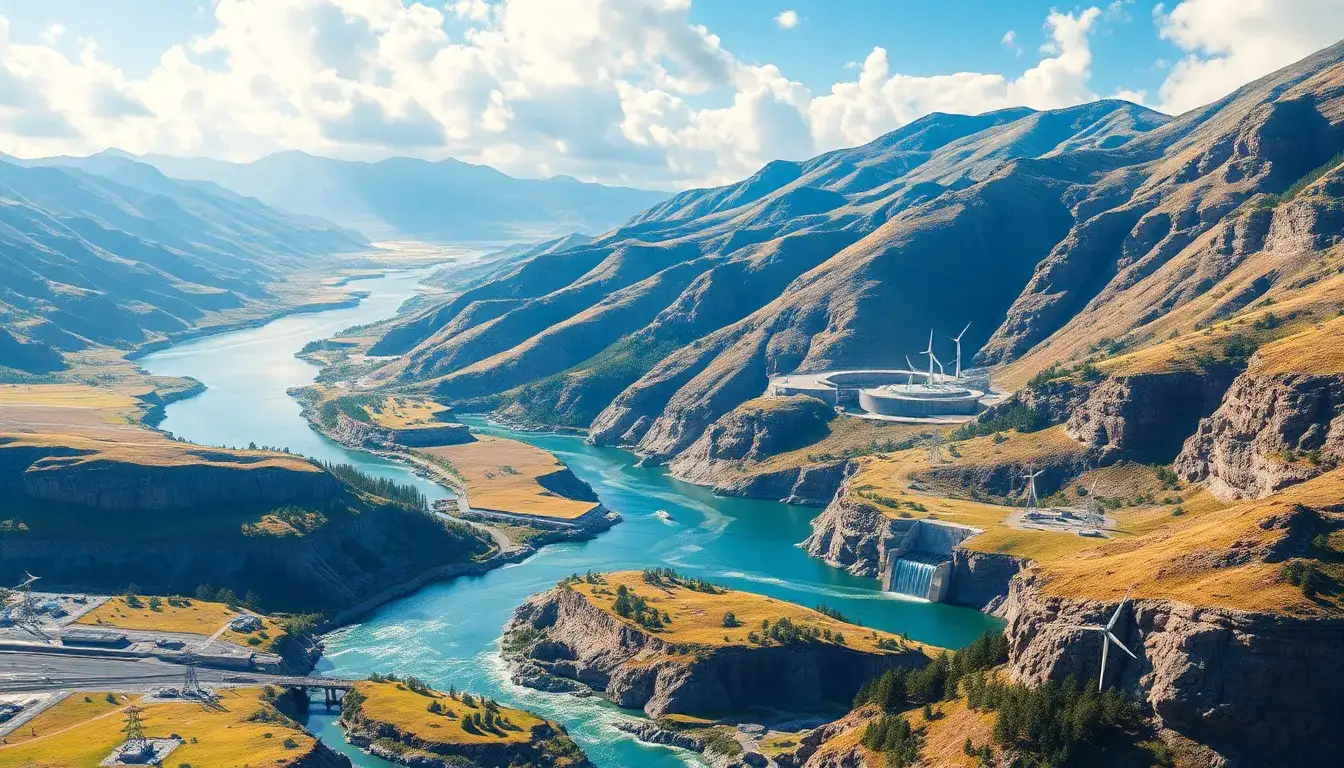
Pumped Storage Hydropower (PSH) facilities have several geographical limitations that affect their feasibility and siting:
Key Geographical Limitations for PSH Facilities
- Need for Suitable Reservoir Sites with Adequate Elevation Difference:
PSH requires two reservoirs at different elevations to enable water to be pumped uphill and released downhill to generate power. This means the location must have natural or constructible elevation differences that can support an upper and lower reservoir system. Without sufficient vertical “head,” the energy storage efficiency drops markedly. - Topological and Geological Constraints:
The site geology and topology must support dam and reservoir construction. Stable rock formations are needed to ensure the reservoirs and dams can be built safely. Areas prone to seismic activity, landslides, or unsuitable soil conditions limit feasibility. Also, topography must allow reservoirs to be close enough horizontally (usually within several kilometers) to minimize water conveyance tunnels or pipelines costs. - Water Availability and Hydrological Factors:
PSH systems require a reliable source of water to fill reservoirs initially and maintain levels through operation. Sites lacking sufficient water bodies or with competing water uses (agriculture, drinking water, ecosystems) may face limitations. The alteration of natural water flows can also create environmental constraints. - Environmental and Ecological Considerations:
Building reservoirs and dams significantly alters local ecosystems, potentially affecting wildlife, fish habitats, and river hydrology. Sensitive environments or protected areas may not be viable locations due to regulatory and environmental impact concerns. - Existing Infrastructure Considerations:
Some PSH projects make use of existing reservoirs or repurpose open-pit mines to overcome natural site limitations, but these options are limited and depend heavily on local conditions.
Summary Table of Geographical Limitations
| Limitation | Description |
|---|---|
| Elevation Difference | Requires significant height difference between reservoirs for energy storage efficiency |
| Geology and Topography | Stable ground and suitable landscape needed for dam and reservoir construction |
| Water Availability | Sufficient water supply needed, considering local hydrological and environmental factors |
| Environmental Impact | Ecosystem disruption limits siting in protected or sensitive areas |
| Proximity of Reservoirs | Horizontal distance constraints to limit conveyance infrastructure costs |
| Use of Existing Features | Sometimes can use existing reservoirs or mines, but availability is limited |
These factors collectively restrict PSH development to locations where natural geography and environmental regulations permit the appropriate infrastructure, making PSH siting more challenging than some other energy storage types.
Thus, while PSH offers significant grid-scale energy storage benefits, its geographical requirements remain the primary constraint on where new facilities can be built. Ongoing research uses geospatial data and mapping algorithms to identify new potential sites by evaluating topological and hydrological criteria systematically.
Original article by NenPower, If reposted, please credit the source: https://nenpower.com/blog/what-are-the-geographical-limitations-for-building-psh-facilities/

