

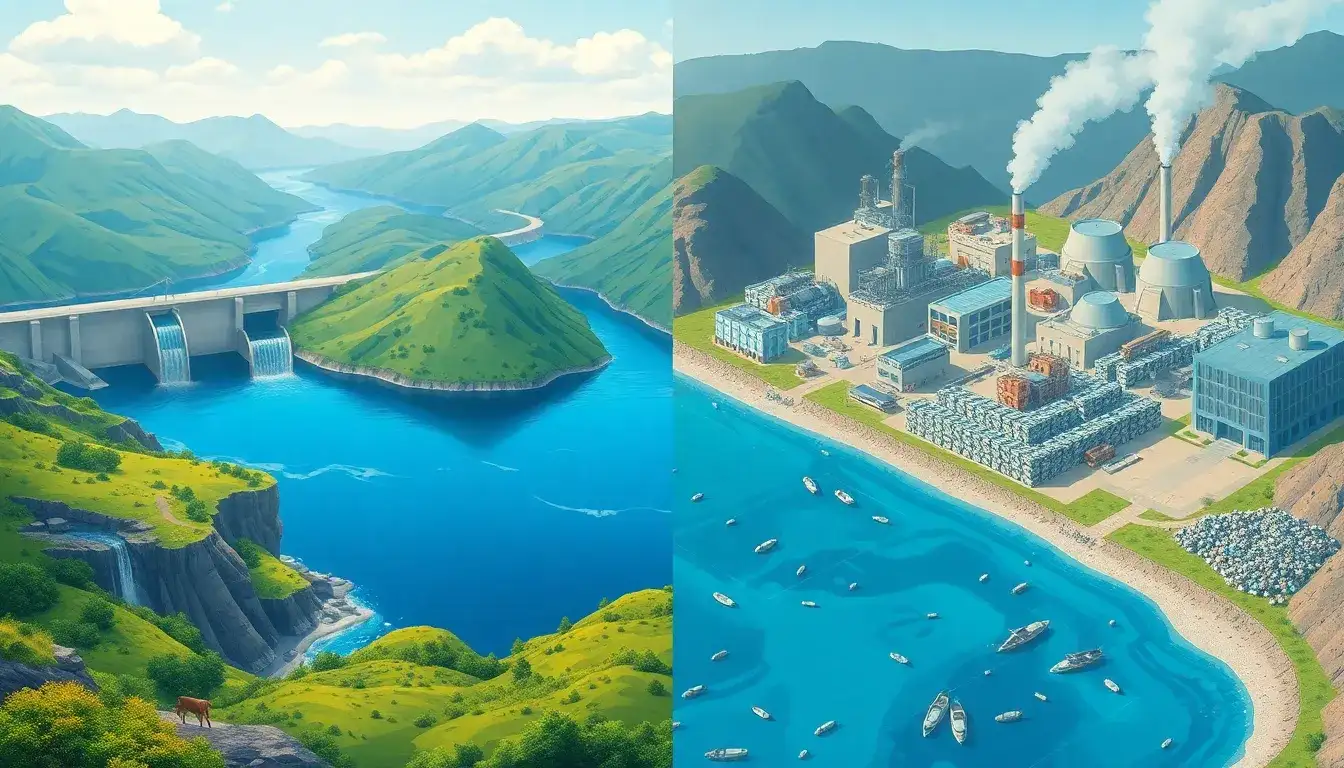
Pumped Hydroelectric Energy Storage (PHES)
Environmental Benefits:
- PHES has among the lowest life cycle greenhouse gas (GHG) emissions compared to other energy storage technologies, including lithium-ion batteries.
- It is a mature technology that can support grid stability with large-scale energy storage, contributing to integrating intermittent renewables.
Environmental Impacts:
- Construction of PHES facilities is highly resource-intensive, involving substantial use of concrete, steel, and cement, leading to significant environmental burdens during the build phase.
- It often requires large-scale landscape alterations such as dam construction, reservoir creation, and sometimes diversion of rivers, which can negatively impact local ecosystems and biodiversity.
- Water sourcing and management for closed-loop systems can be complex due to water rights issues and potential impacts on aquatic life.
- There is also a risk of flooding during or after construction, posing environmental hazards.
- The environmental impacts during operation are mainly from electricity losses during the charging and discharging cycles, which depend on the grid’s electricity mix (fossil or renewable).
- As the share of renewable energy in the electricity grid increases, the environmental impact of PHES operation decreases.
Lithium-Ion Batteries
Environmental Benefits:
- Lithium-ion batteries can be installed on brownfield or already disturbed sites, avoiding some of the landscape and habitat disruptions associated with PHES.
- They support decentralized energy systems and rapid deployment, which aids in flexible grid balancing.
Environmental Impacts:
- The production phase of lithium-ion batteries is resource-intensive, involving the extraction and processing of limited natural resources such as lithium, cobalt, and nickel, which have significant environmental and social concerns.
- Mining for battery materials can cause habitat destruction, pollution, and large carbon footprints.
- Battery manufacturing processes also contribute to GHG emissions.
- End-of-life battery disposal or recycling poses additional environmental challenges if not managed properly.
Comparative Summary
| Aspect | Pumped Hydroelectric Storage | Lithium-Ion Batteries |
|---|---|---|
| GHG Emissions | Lowest life cycle GHG emissions among storage options | Higher life cycle emissions due to mining and manufacturing |
| Land and Ecosystem Impact | Large-scale ecological disruption from dam/reservoir construction, river diversion, habitat loss | Smaller land footprint, can be sited on disturbed lands |
| Material Resource Use | Mostly concrete, steel, and cement with local resource consumption | Heavy reliance on scarce minerals like lithium, cobalt, nickel |
| Water Use | Potential issues with water sourcing and aquatic impact in closed-loop systems | Minimal water use in operation and construction |
| Operational Efficiency & Losses | Electricity losses in charging/discharging, influenced by grid mix | High round-trip efficiency, but capacity degrades over time |
| End-of-Life Concerns | Infrastructure has long lifespan; decommissioning has low environmental hazard | Battery recycling and disposal challenges |
In conclusion, pumped hydroelectric storage is generally more environmentally friendly in terms of lifetime greenhouse gas emissions and large-scale energy capacity but has significant ecological and landscape impacts due to infrastructure construction. Lithium-ion batteries offer flexibility and lower landscape disruption but entail significant environmental impacts from resource extraction and manufacturing. The choice between these technologies depends on local ecological conditions, grid requirements, and sustainability priorities.
Original article by NenPower, If reposted, please credit the source: https://nenpower.com/blog/what-are-the-environmental-impacts-of-pumped-hydroelectric-energy-storage-versus-lithium-ion-batteries/

