

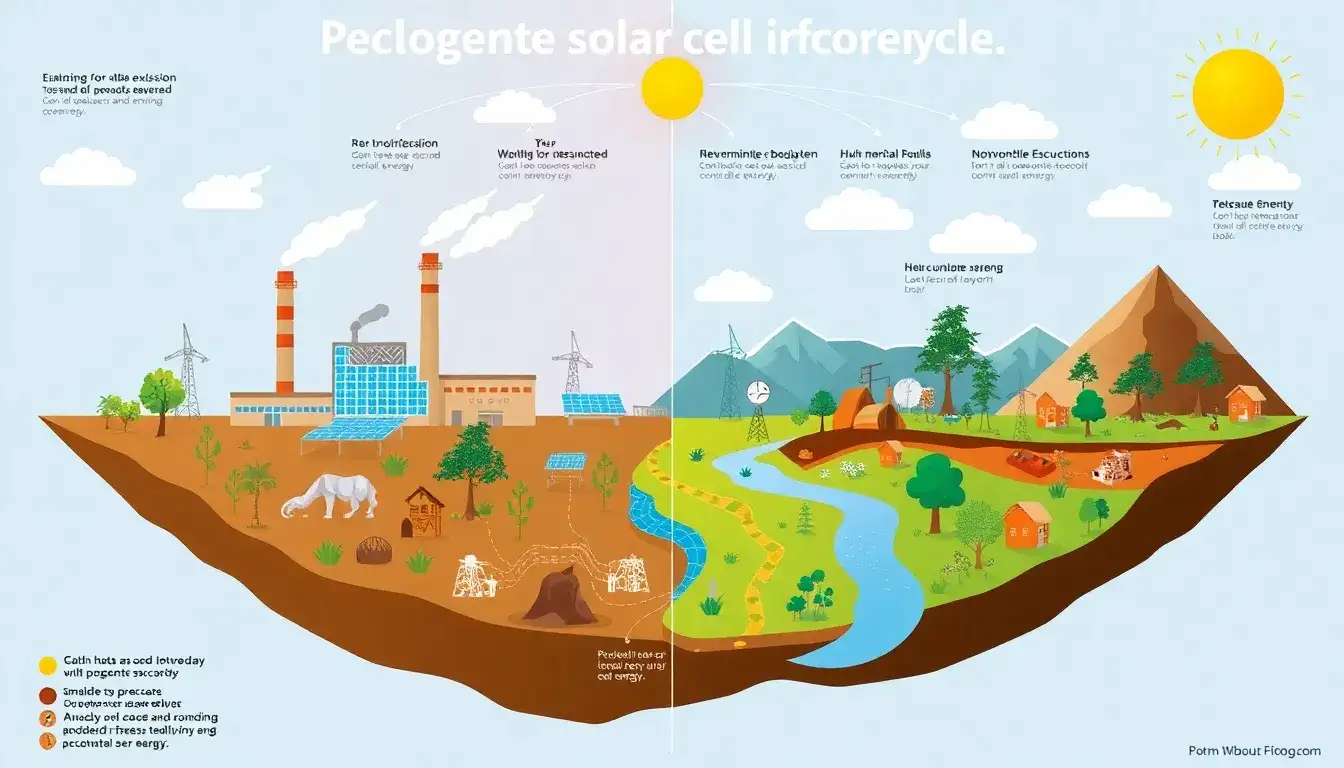
The production and lifecycle of perovskite solar cells (PSCs) present both promising environmental benefits and notable challenges primarily related to material toxicity and manufacturing processes.
Environmental Impacts of Perovskite Solar Cell Production
1. Lead Toxicity and Environmental Risks
- Most high-performance PSCs contain lead, typically in the form of lead iodide within the perovskite layer. Lead is a significant environmental and health hazard, especially when it leaches into soil or water through degradation or damage of the modules. For example, the perovskite layer can contain about 0.4 g/m² of lead, which, if released, could raise soil lead concentration substantially.
- The lead in PSCs is often water-soluble, increasing the risk of environmental contamination, particularly under conditions of module breakage, disposal, or fire.
- Efforts are underway to reduce these risks by developing absorbing materials to prevent lead leakage, alternative lead-free perovskite formulations, and recycling programs to recover lead and other valuable materials from end-of-life PSCs.
2. Manufacturing Impacts and Solvent Use
- Perovskite solar cells can be manufactured using low-cost, fast solution-processing methods (roll-to-roll printing or spray coating) requiring solvents such as dimethylformamide (DMF), which are toxic to human health, particularly affecting reproductive systems.
- Research indicates that while the use of hazardous solvents like DMF poses some health risks, the overall exposure and environmental risk from solvents in large-scale production is considered low, especially if solvent recovery and recycling processes are implemented.
- Among solvents used, dimethylsulfoxide (DMSO) has the lowest environmental and health risk, although it currently yields less efficient cells compared to others like DMF.
- Improving solvent management and developing greener processing techniques are key to minimizing environmental impacts from production.
3. Comparative Life-Cycle Environmental Impacts
- Life-cycle assessments show that despite the additional processing steps in tandem perovskite-silicon cells, these modules have 6% to 18% less overall environmental impact than pure silicon modules over a 25-year lifespan, mainly because the higher efficiency of PSCs allows them to generate more energy over their lifetime, offsetting the embodied impacts.
- The largest environmental impacts in PSC tandem modules arise from silicon wafer manufacture, copper cabling, aluminum frames, and glass rather than the perovskite layer or lead content itself, which surprisingly contributes little to ecotoxicity scores in these assessments.
- Continuous improvements in PSC efficiency and lifespan are expected to further reduce their environmental footprint.
4. Stability and End-of-Life Management
- PSCs are sensitive to environmental degradation factors like moisture, oxygen, and heat, which not only affect operational stability but also increase the risk of toxic lead release.
- Advanced encapsulation and interfacial layer technologies are being developed to improve stability and reduce environmental risks during operation and disposal.
- Recycling methods are being explored to recover toxic and valuable materials (e.g., lead, silver) from PSC waste streams, promoting circular economy principles and minimizing landfill contamination.
5. Overall Assessment and Recommendations
- The main environmental concern with PSC production and use stems from lead toxicity, particularly if modules break or degrade improperly.
- Environmental impacts from manufacturing solvents are manageable with proper recovery and substitution strategies.
- When considering the full lifecycle, perovskite solar modules, especially as tandems with silicon, offer lower greenhouse gas emissions and resource depletion impacts compared to conventional silicon solar cells, reinforcing their potential as sustainable energy solutions.
- Development of standardized testing, regulatory frameworks, and recycling programs is crucial for minimizing environmental and health risks associated with PSCs.
In summary, while perovskite solar cell production introduces some environmental risks principally related to lead toxicity and solvent use, ongoing technological advances in stability, encapsulation, recycling, and greener manufacturing processes are actively addressing these challenges. Additionally, life-cycle analyses demonstrate that PSCs can offer significant environmental benefits over traditional solar technologies when managed responsibly.
Original article by NenPower, If reposted, please credit the source: https://nenpower.com/blog/what-are-the-environmental-impacts-of-perovskite-solar-cell-production/

