

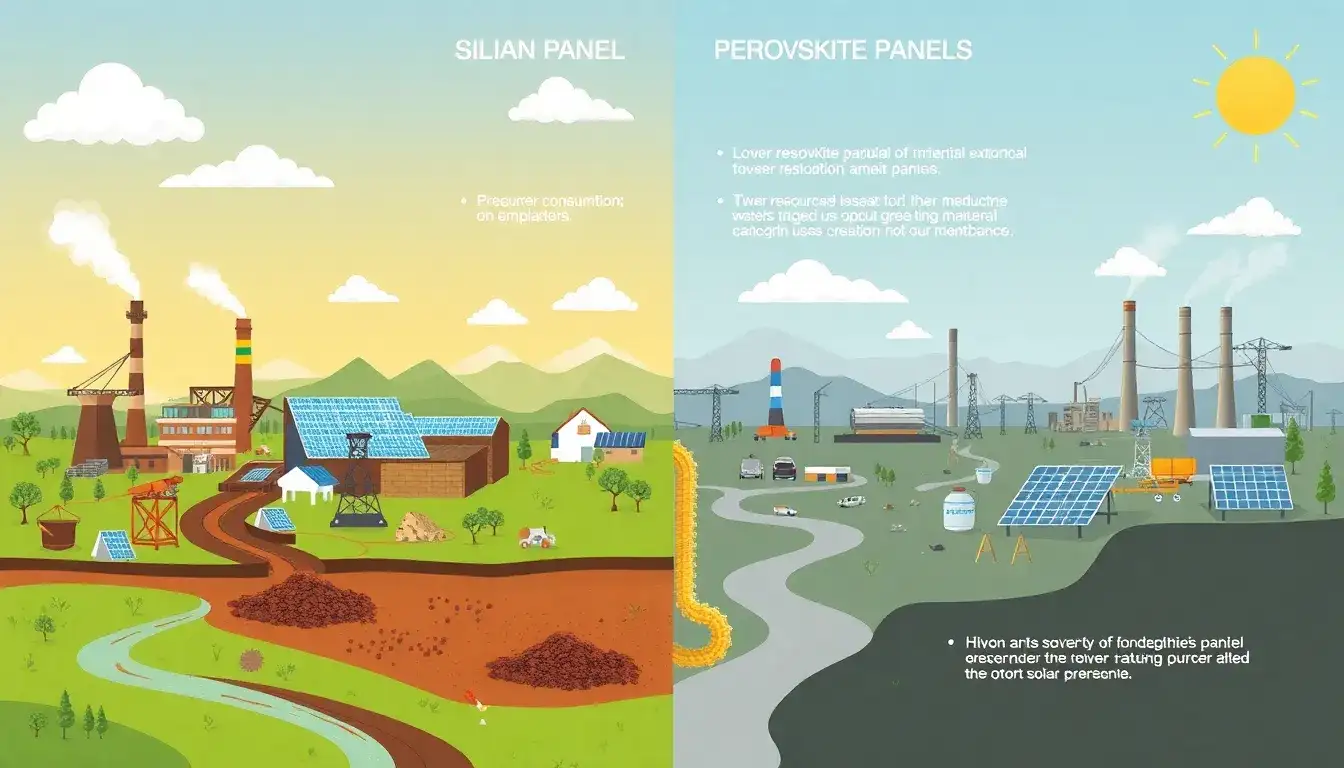
The environmental impacts of manufacturing perovskite solar panels compared to silicon-based ones show key differences in carbon footprint, energy consumption, material toxicity, and lifecycle impacts.
Carbon Footprint and Energy Use
- Perovskite solar cells generally have a lower carbon footprint and shorter energy payback periods than silicon solar cells. This is primarily because silicon purification requires very high temperatures and energy-intensive processes, leading to more CO2 emissions during manufacturing. Perovskite manufacturing uses less energy-intensive processes, resulting in lower emissions overall.
Material Toxicity and Environmental Risks
- Perovskite solar panels typically contain lead in the perovskite layer (approximately 0.4 g/m²). If released into the environment, this lead can significantly increase soil contamination (~70 ppm increase in the top 1 cm of soil), posing health and ecological risks. Lead management and containment are key challenges for perovskite panel environmental safety.
- Silicon-based panels do not have this specific lead-related toxicity issue; however, their manufacturing processes involve other environmental burdens such as fossil fuel depletion and water usage.
Lifecycle Environmental Impact
- Studies on perovskite-silicon tandem modules (where a perovskite layer is added atop silicon cells) show that while the tandem module’s manufacturing impacts (global warming potential, freshwater use, fossil fuel depletion) are up to 7% higher than traditional silicon modules alone, these extra impacts can be offset by the increased electricity generation efficiency over the module’s lifetime. The tandem module generates the equivalent electricity in about 22 years compared to 25 years for silicon-only modules, thus balancing out the environmental cost over time.
- The largest single stage environmental impact in solar panel manufacturing often comes from the silicon wafer production, which shows the highest impact in carbon emissions, water consumption, and fossil fuel use.
Summary Comparison
| Environmental Aspect | Perovskite Solar Panels | Silicon Solar Panels |
|---|---|---|
| Carbon footprint | Lower due to less energy-intensive manufacturing | Higher due to high-temperature silicon purification processes |
| Energy payback period | Shorter | Longer |
| Toxic material concerns | Lead content poses environmental and health risks if not managed | No lead, but other chemicals involved |
| Water and fossil fuel use | Lower to moderate | Higher, especially during wafer production |
| Lifecycle electricity output | Potentially higher for tandems offsets manufacturing impacts | Slightly lower, longer lifespan needed to offset impacts |
In conclusion, perovskite solar panels offer environmental benefits in terms of lower carbon emissions and energy use during manufacturing but face challenges due to lead toxicity. Silicon solar panels have higher manufacturing impacts but fewer toxicity concerns and established long-term performance. Tandem perovskite-silicon panels balance these factors, providing enhanced energy output that can offset their higher production impacts over time.
Original article by NenPower, If reposted, please credit the source: https://nenpower.com/blog/what-are-the-environmental-impacts-of-manufacturing-perovskite-solar-panels-versus-silicon-based-ones/

