

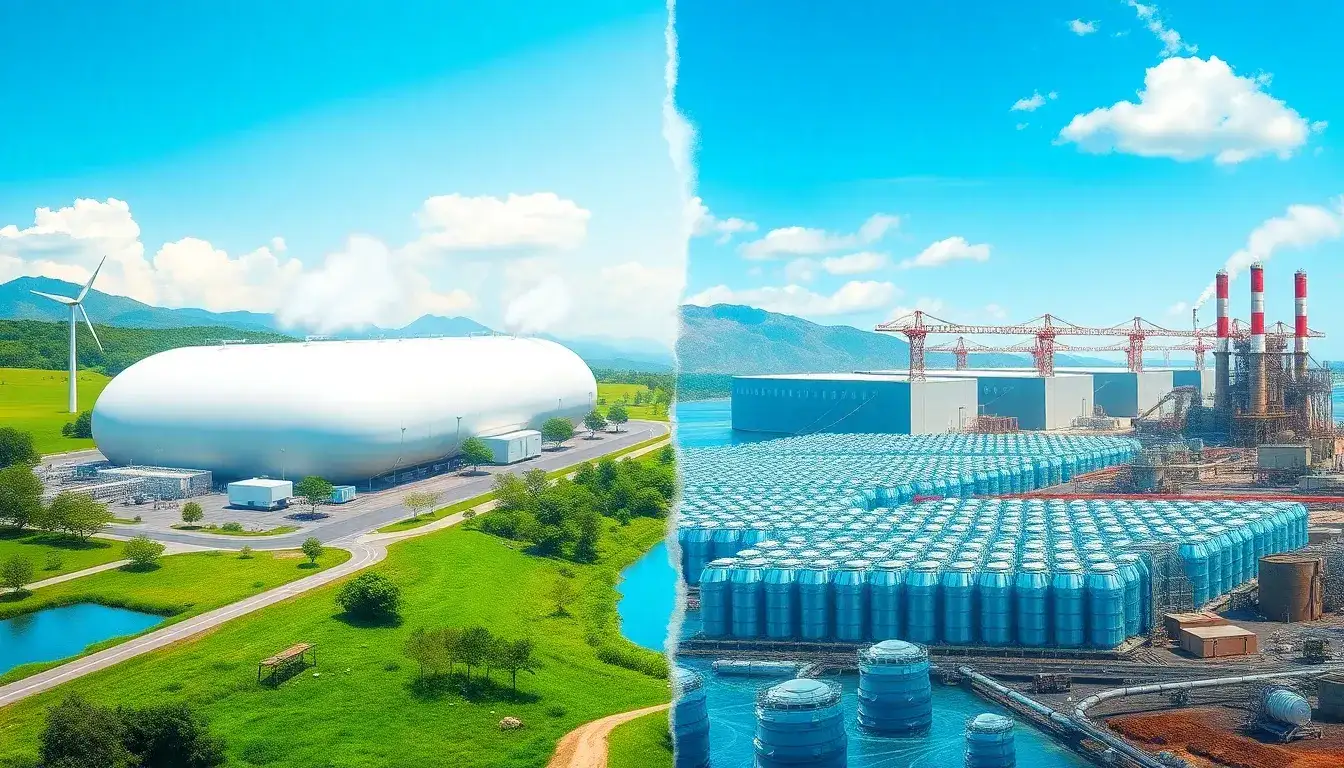
The environmental impacts of Liquid Air Energy Storage (LAES) and lithium-ion (Li-ion) batteries differ significantly, as shown by recent research and life cycle assessments.
Environmental Impacts of Liquid Air Energy Storage (LAES)
- LAES uses air as its storage medium, which is abundant, non-toxic, and results in minimal direct environmental impact during operation.
- LAES systems produce zero emissions during energy storage and discharge, relying on cryogenic processes and often integrating waste heat recycling to improve efficiency and reduce environmental footprint.
- LAES has no geographic or size constraints and can scale to multiple gigawatt-hours, making it flexible and durable with no capacity degradation issues typical of batteries.
- However, the manufacturing and disposal phases of LAES have environmental impacts predominantly due to the use of diathermic oil, which accounts for about 92% of the environmental impact in these phases, according to a life cycle assessment study.
Environmental Impacts of Lithium-Ion Batteries
- Li-ion batteries have a higher round-trip energy efficiency compared to LAES, which contributes to better environmental performance during the usage phase.
- Nevertheless, Li-ion batteries involve significant environmental impacts related to mining, material processing, and end-of-life disposal or recycling of critical metals like lithium, cobalt, and nickel.
- Overall, life cycle assessments indicate that Li-ion batteries currently outperform LAES environmentally when considering full electric storage cycles, largely due to LAES’s lower efficiency and the impact of materials used in its system.
Summary Comparison
| Aspect | Liquid Air Energy Storage (LAES) | Lithium-Ion Batteries |
|---|---|---|
| Storage medium | Air (abundant, non-toxic) | Chemical materials (lithium, cobalt, nickel, etc.) |
| Operational emissions | Zero emissions | No direct emissions but lifecycle emissions exist |
| Size/geographical constraints | None, scalable to multiple GWh | Limited scalability and geographic dependency |
| Efficiency | Lower round-trip efficiency | Higher round-trip efficiency |
| Manufacturing impact | High impact mainly due to diathermic oil | High impact from mining and material processing |
| Durability and degradation | Durable, no capacity degradation | Subject to capacity degradation over time |
| Environmental impact (LCA) | Higher impact mainly in manufacturing/disposal phases | Lower impact overall in electric storage use case |
In conclusion, while LAES offers a flexible, scalable, and low operational emission solution by using air and cryogenic techniques, its current environmental drawbacks lie in material use and lower efficiency leading to higher overall lifecycle impacts. Li-ion batteries tend to have better environmental performance in full electric cycles due to higher efficiency, though they have their own challenges related to resource extraction and recycling.
This suggests that LAES may be more suitable for large-scale, long-duration storage with additional innovation to reduce manufacturing impacts, while Li-ion batteries remain advantageous for higher efficiency, smaller scale applications.
Original article by NenPower, If reposted, please credit the source: https://nenpower.com/blog/what-are-the-environmental-impacts-of-liquid-air-energy-storage-versus-lithium-ion-batteries/

