

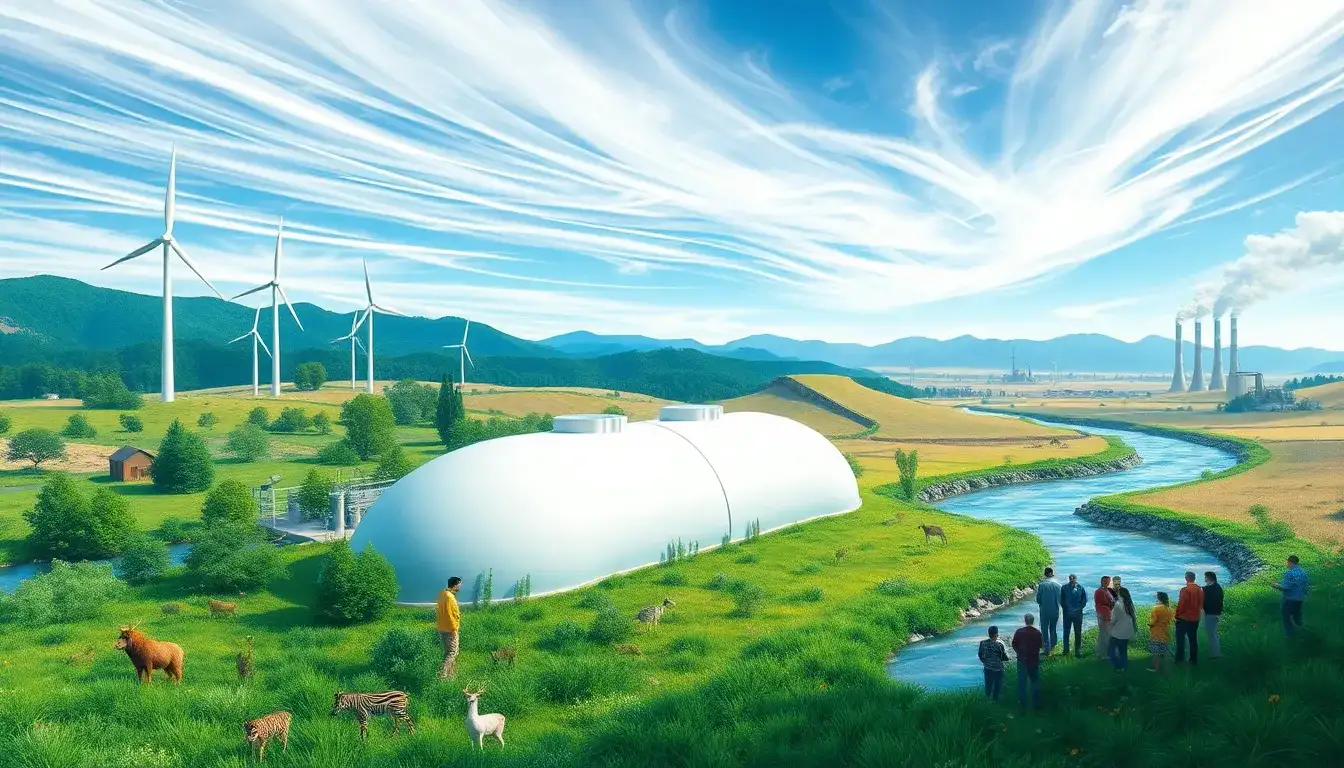
Liquid Air Energy Storage (LAES) has several notable environmental impacts, most of which are positive compared to other energy storage technologies:
- Minimal Environmental Impact and No Geographic Constraints: LAES uses air, an abundant and non-toxic resource, as its storage medium, leading to minimal direct environmental impact. It requires no specific geographic conditions, unlike some other storage technologies, which reduces land-use conflicts and environmental disruption.
- Reduction in CO2 Emissions: LAES systems can significantly decrease carbon dioxide emissions by improving the utilization of renewable energy sources and reducing dependence on fossil fuel-based power generation. Studies show CO2 emission reductions of up to 21% overall, and in certain scenarios (e.g., Spain) reductions as high as 78% compared to systems without LAES.
- Energy Efficiency and Waste Heat Utilization: Modern LAES designs often incorporate waste heat recovery, which increases system efficiency and reduces environmental impact by recycling heat that would otherwise be lost.
- Life Cycle Environmental Considerations: While LAES is generally eco-friendly, some life cycle assessments highlight environmental impacts related to the materials used in the system, particularly the diathermic oil used in the thermal management process, which accounts for a substantial portion of manufacturing and disposal environmental costs. Compared to lithium-ion batteries, LAES currently has lower round-trip efficiency and higher environmental impact in manufacturing phases due to this oil.
Summary Table of Environmental Impacts
| Aspect | Environmental Impact | Notes |
|---|---|---|
| Storage Medium | Minimal impact | Air is abundant, non-toxic, and freely available. |
| CO2 Emissions Reduction | Up to 21-78% reduction | Due to better renewable energy utilization and less fossil fuel use. |
| Geographic and Land Use | No geographic constraints | Avoids location-based environmental conflicts. |
| Waste Heat Utilization | Reduces environmental impact | Increases efficiency and sustainability. |
| Life Cycle Impact | Some environmental concerns | Diathermic oil manufacturing and disposal increase impact relative to Li-ion batteries. |
| Energy Efficiency | Lower than Li-ion batteries | Impacts overall environmental performance. |
In conclusion, Liquid Air Energy Storage presents a highly sustainable and environmentally friendly large-scale energy storage solution with significant potential to reduce carbon emissions and support renewable energy integration. Its main environmental drawbacks relate to thermal oil use and lower efficiency compared to batteries, which are areas for further technological improvement. Overall, it offers a scalable, flexible, and low-impact energy storage method.
Original article by NenPower, If reposted, please credit the source: https://nenpower.com/blog/what-are-the-environmental-impacts-of-liquid-air-energy-storage/

