

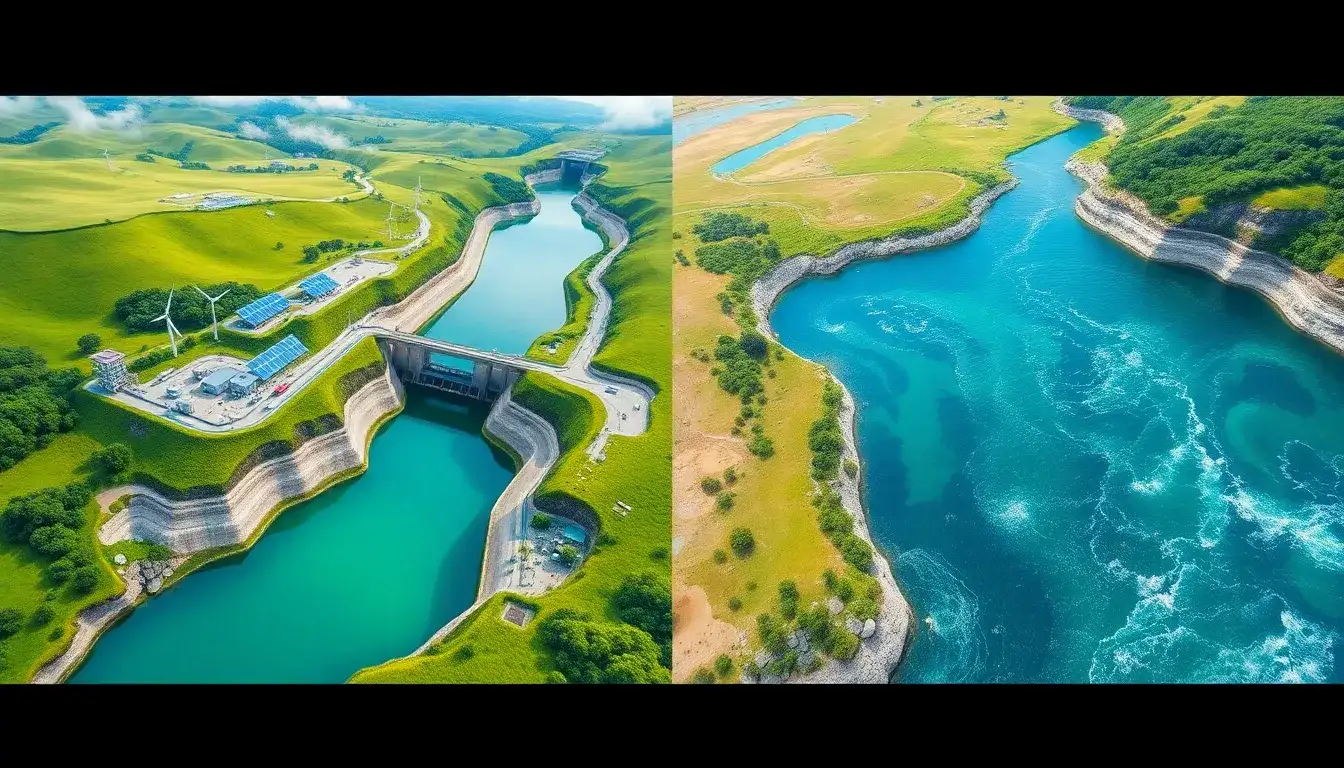
Differences in Environmental Impacts
Water Source and Aquatic Ecosystem Impacts
- Open-loop systems use existing natural water sources such as rivers or lakes. This can lead to significant ecological disturbances including altered flow regimes, impacts on aquatic habitats and species, and issues with water rights and availability. Construction often requires diverting rivers or altering natural waterways, which can disrupt local ecosystems and pose risks such as flooding.
- Closed-loop systems use isolated reservoirs that do not interact continuously with natural water bodies. Water is cycled between two artificial reservoirs, minimizing direct impact on rivers or lakes and aquatic life. However, water sourcing to fill the reservoirs initially can still cause delays and complications related to water rights and aquatic resource impacts, though these are generally less severe and more controllable than in open-loop systems.
Greenhouse Gas Emissions
- Closed-loop PHES generally exhibit lower life cycle greenhouse gas emissions compared to open-loop systems and other energy storage technologies. This is because closed-loop systems reduce methane emissions that can arise from organic matter decomposition in natural reservoirs connected to open-loop systems.
- Open-loop systems can contribute to greenhouse gas emissions from flooded terrestrial areas and ongoing interaction with natural water bodies, including potential methane emissions from submerged organic matter.
Construction and Material Use Impacts
- Both types of PHES involve construction impacts primarily related to concrete, steel, and cement use, which dominate environmental burdens during the building phase. These impacts are similar between closed- and open-loop systems but can be higher in open-loop systems if river diversions or larger-scale dams are required.
- Closed-loop systems, often built in isolated or less ecologically sensitive locations, might reduce the extent of ecosystem disruption during construction.
Operational Environmental Burdens
- Energy losses during pumping and generation constitute a significant portion of the environmental impact for both systems because of the electricity used, which may remain a function of the grid’s overall cleanliness. As renewable energy penetration in the grid increases, these impacts will decrease for both system types.
Summary Table of Environmental Impact Differences
| Aspect | Closed-Loop PHES | Open-Loop PHES |
|---|---|---|
| Water Source | Isolated reservoirs, limited natural water contact | Utilizes natural water bodies (rivers/lakes) |
| Aquatic Ecosystems | Minimal direct impact, initial water sourcing required | Potentially significant disruption and habitat alteration |
| Greenhouse Gas Emissions | Lower lifecycle emissions, less methane release | Higher risks of methane and other GHG emissions |
| Construction Impact | Material use similar, less ecosystem disturbance | Possibly greater due to dams/diversions |
| Flooding and Ecological Risk | Lower risk due to isolated reservoirs | Higher risk due to river alteration and flooding potential |
| Operational Impact | Energy loss impacts related to grid electricity mix | Same as closed-loop but potentially higher if natural interactions cause additional losses |
In conclusion, closed-loop pumped hydroelectric energy storage systems typically offer reduced environmental risks related to aquatic ecosystems, water rights, and greenhouse gas emissions compared to open-loop systems, primarily due to their isolated water cycling design. However, both systems share impacts from construction materials and operational electricity losses.
Original article by NenPower, If reposted, please credit the source: https://nenpower.com/blog/what-are-the-differences-in-environmental-impacts-between-closed-loop-and-open-loop-pumped-hydroelectric-energy-storage-systems/

