

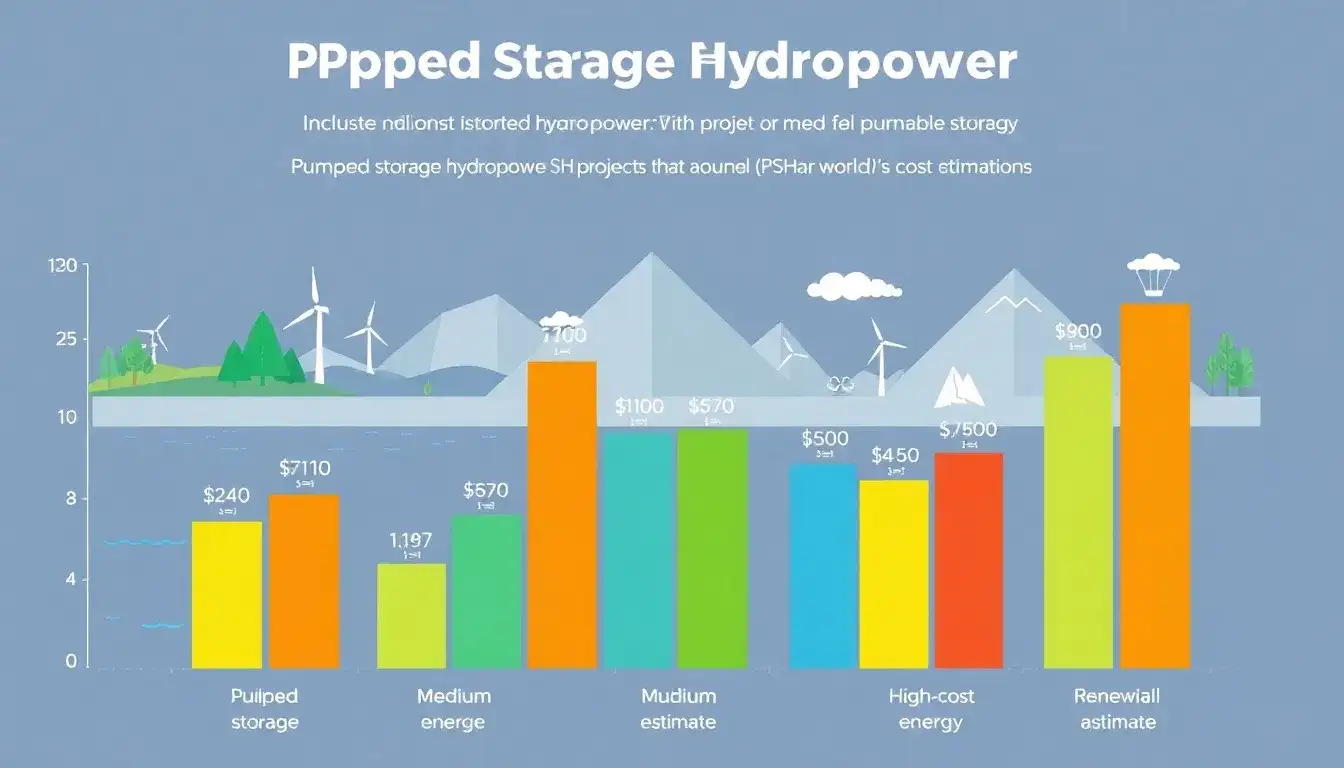
Cost Range Estimates for PSH Projects
- NREL PSH Cost Model:
NREL provides a bottom-up, open-source cost model for PSH projects that estimates costs based on site-specific factors such as geography, terrain, reservoir volume, and construction materials. This model allows developers to estimate costs tailored to a particular site, but exact numerical ranges are site-dependent and not given directly in the summary. - General Cost Estimates from Literature:
- Total project costs for PSH plants typically range from about $1,700/kW to $3,300/kW, depending on project size, duration, and other factors.
- For example, a feasible 1,000 MW project site might estimate costs in the range of $1,700/kW to $2,500/kW.
- Other analyses provide somewhat higher ranges, like $2,300 to $2,637/kW for projects with 8-11 hour storage duration, excluding transmission and substation costs.
- Earlier studies reported ranges up to $3,217/kW when including some transmission line costs.
- Project-Specific Validation:
Using the Eagle Mountain PSH plant in California as a reference, NREL’s model estimated total costs about 26% higher than the Federal Energy Regulatory Commission (FERC) license application cost, but the direct construction cost was actually estimated 15% lower. This reflects significant uncertainty and variability in indirect versus direct cost components. - Sensitivity to Site and Design Parameters:
Costs are more sensitive to parameters such as the hydraulic head (vertical elevation difference) and storage duration than to geology type or penstock type. Higher heads can reduce reservoir volume (and cost), while longer storage durations benefit from cost scaling effects where equipment procurement and planning costs are spread across more stored energy.
Summary Table of PSH Cost Estimates
| Source/Study | Estimated Cost Range ($/kW) | Notes |
|---|---|---|
| NREL PSH Cost Model | Site-dependent; detailed bottom-up | Allows cost estimation based on specific site |
| Feasible 1,000 MW project (NHA 2021) | $1,700 – $2,500 | Typical range for large-scale projects |
| 8-11 hour storage projects (PNNL 2020) | $2,300 – $2,637 | Excludes transmission/substation; duration impacts cost |
| HDR 2010 analysis | $2,915 – $3,217 | Includes 5-mile transmission line |
| Black & Veatch analysis (2016) | $2,844 – $2,954 | Tight cost range for similar project sites |
| Eagle Mountain project (NREL vs FERC) | NREL 26% higher total cost vs FERC | Reflects uncertainty and conservative indirect cost assumptions |
Key Cost Drivers and Differences Among Projects
- Hydraulic Head: Higher head reduces reservoir size and cost per kW by storing more energy per unit volume.
- Storage Duration: Longer durations increase reservoir size but benefit from economies of scale in equipment and planning.
- Indirect vs Direct Costs: Indirect costs such as permitting, engineering, and contingencies vary widely and can cause large differences in overall estimates.
- Site Conditions: Terrain, geology, and availability of water affect construction complexity and cost.
- Project Scale: Larger projects benefit from scale efficiencies reducing cost per kW.
Overall, while pumped storage hydropower projects share a common technology base, their cost estimates differ considerably based on site characteristics, design choices, and modeling assumptions. The typical range for PSH capital costs spans approximately $1,700 to $3,300 per kW, with most modern estimates clustering around $2,300 to $3,000 per kW excluding transmission infrastructure.
These differences underscore the importance of using detailed, site-specific cost models like NREL’s tool when evaluating new PSH projects to obtain accurate and project-relevant cost projections.
Original article by NenPower, If reposted, please credit the source: https://nenpower.com/blog/what-are-the-differences-in-cost-estimates-between-various-psh-projects/

