

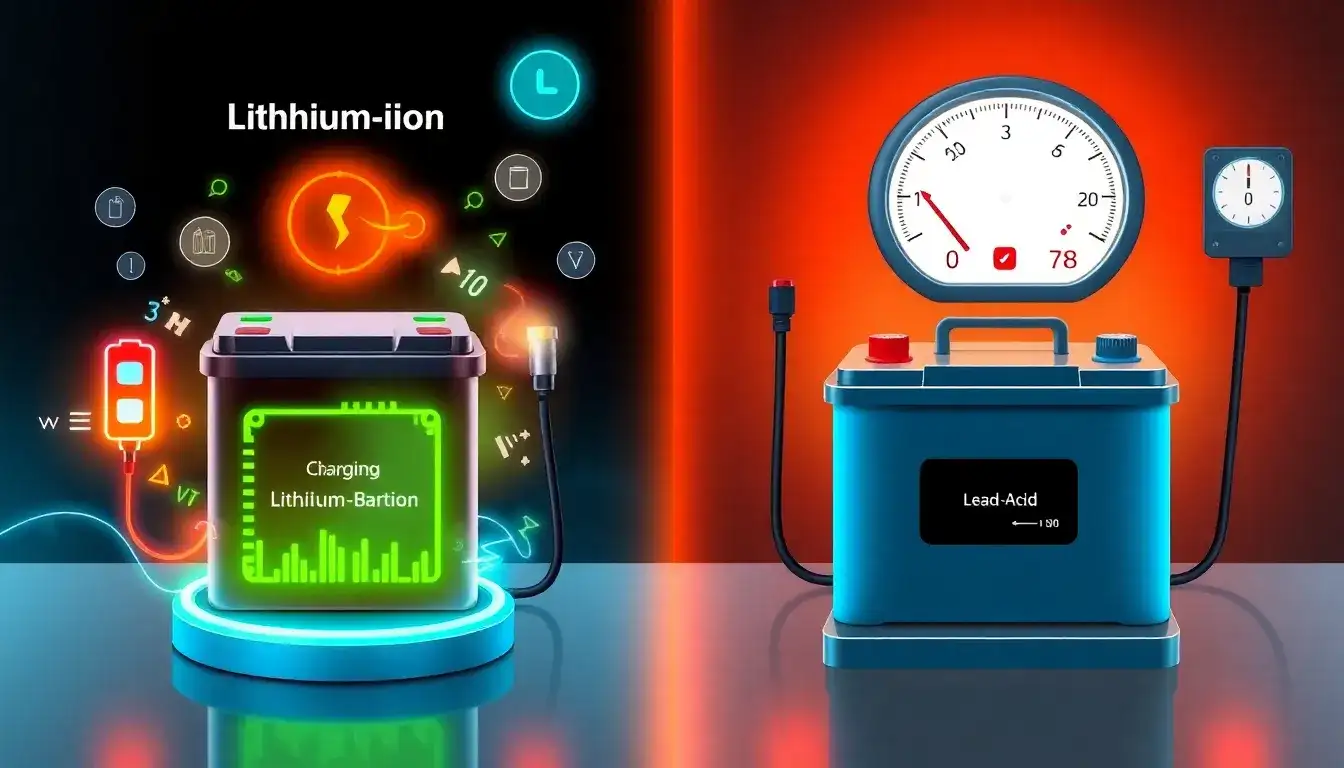
The differences in charging habits between lithium-ion and lead-acid batteries can be summarized as follows:
Charging Method
- Lead-Acid Batteries: Typically charged using a constant voltage method, often employing a three-stage method: bulk charge (initial stage), absorption (saturation topping charge), and float charge to maintain battery health at the end.
- Lithium-Ion Batteries: Charged using a combination of constant current and constant voltage. The charger adjusts between these modes to efficiently charge the battery without overcharging. Lithium-ion chargers often have built-in protection against overcharging and overheating.
Charging Speed and Efficiency
- Lead-Acid Batteries: Charging is slower compared to lithium-ion batteries, requiring more time to reach full capacity.
- Lithium-Ion Batteries: Charge faster than lead-acid batteries, which means they can spend more time in use and require less downtime for charging.
Charging Profile and Voltage Requirements
- Lead-Acid Batteries: Require a lower voltage profile and typically do not reach 100% state of charge (SOC) when charged with standard lead-acid chargers. They restart charging when the voltage drops significantly.
- Lithium-Ion Batteries: Need a slightly higher charge voltage to reach full SOC and have a more precise voltage control at the end of the charge cycle. The charger continuously monitors the battery’s state and adjusts accordingly.
Safety Features
- Lead-Acid Battery Chargers: Often equipped with thermal sensors to prevent overheating.
- Lithium-Ion Battery Chargers: Typically include more advanced safety features, such as overcharge protection, and are often UL listed, ensuring higher safety standards.
Charger Design and Cost
- Lead-Acid Battery Chargers: Generally larger and heavier than lithium-ion chargers, with a lower cost.
- Lithium-Ion Battery Chargers: Smaller, lighter, and often more expensive upfront but may offer lower overall cost of ownership due to efficiency and longevity.
Original article by NenPower, If reposted, please credit the source: https://nenpower.com/blog/what-are-the-differences-in-charging-habits-between-lithium-ion-and-lead-acid-batteries/

