

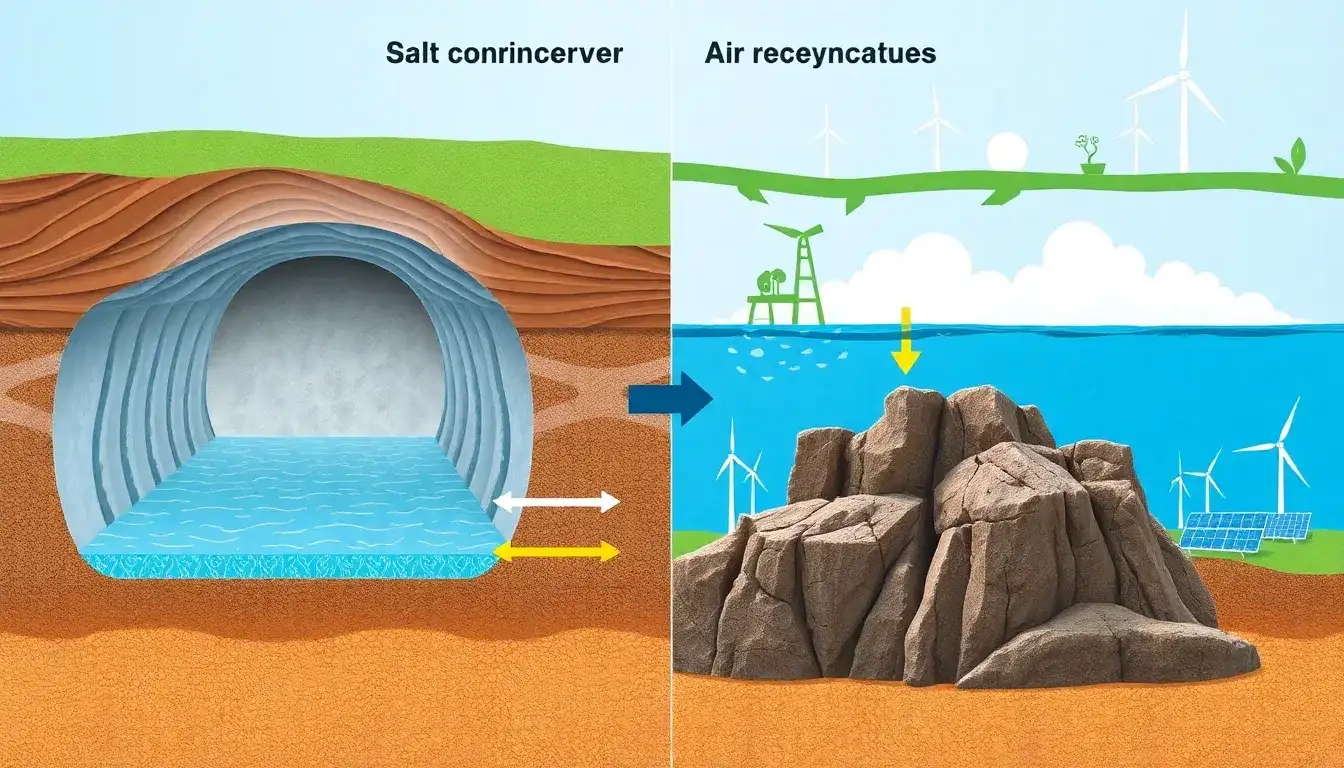
The main differences between using salt caverns and depleted natural gas reservoirs for compressed air energy storage (CAES) lie in their physical characteristics, operational capabilities, construction costs, and suitability for energy storage cycles.
Salt Caverns vs. Depleted Natural Gas Reservoirs for CAES
| Feature | Salt Caverns | Depleted Natural Gas Reservoirs |
|---|---|---|
| Storage Size | Much smaller working gas capacity | Much larger working gas capacity |
| Withdrawal and Injection Rates | Very high rates relative to capacity, enabling multiple cycles per year | Lower injection and withdrawal rates compared to salt caverns |
| Base/Cushion Gas Requirements | Relatively low base gas requirements | Depleted reservoirs can use unproduced residual gas as cushion gas |
| Construction/Development Cost | More costly to develop per unit of storage | Lower development cost, often converted from existing gas fields |
| Formation Type | Created in salt dome or bedded salt formations via solution mining | Natural porous rock formations previously holding gas |
| Operational Flexibility | Allows several cycles of injection and withdrawal annually due to high permeability | More limited cycling, better suited for seasonal or long-term storage |
| Infrastructure Linkage | Usually requires standalone infrastructure | Often linked to existing gas infrastructure, reducing upfront cost |
| Technical Complexity | Requires leaching to create cavern, which is specialized and expensive | Existing reservoirs have known subsurface data and infrastructure |
| Examples of Use | Proven CAES storage sites like McIntosh (AL, USA) and Huntorf (Germany) | Potential for CAES; less proven but promising for large-scale storage |
Explanation
- Storage capacity and facility size: Salt caverns tend to be much smaller in volume compared to depleted natural gas reservoirs, which can span large underground formations and thus hold significantly more working gas.
- Injection and withdrawal dynamics: Salt caverns have very high permeability and structural integrity, allowing for rapid injection and extraction of air, which supports multiple cycles per year—ideal for applications requiring frequent charge-discharge cycles. Depleted gas reservoirs have slower permeability and cycling capability, making them better suited for seasonal or less frequent cycling.
- Cost and construction: The creation of salt caverns through solution mining is more expensive on a per-unit basis than converting a depleted gas reservoir, which leverages existing geological formations and infrastructure.
- Base gas requirements: Salt caverns require a relatively low amount of base gas to maintain the cavern, whereas in depleted reservoirs, the remaining unproduced natural gas can serve as cushion gas, stabilizing pressure and reducing additional gas needs.
- Operational suitability: Salt caverns are often preferred for utility-scale CAES installations requiring high flexibility and fast response, and they have been proven in operational facilities. Depleted natural gas reservoirs hold potential for CAES with large capacity but less operational experience and lower cycling performance.
In summary, salt caverns provide high injection and withdrawal rates with smaller storage volumes and higher costs, ideal for applications needing rapid cycling. Depleted natural gas reservoirs offer larger storage capacity with lower costs but have slower operational dynamics, making them more suited to long-term or seasonal storage in CAES systems.
Original article by NenPower, If reposted, please credit the source: https://nenpower.com/blog/what-are-the-differences-between-using-salt-caverns-and-depleted-natural-gas-reservoirs-for-compressed-air-energy-storage/

