

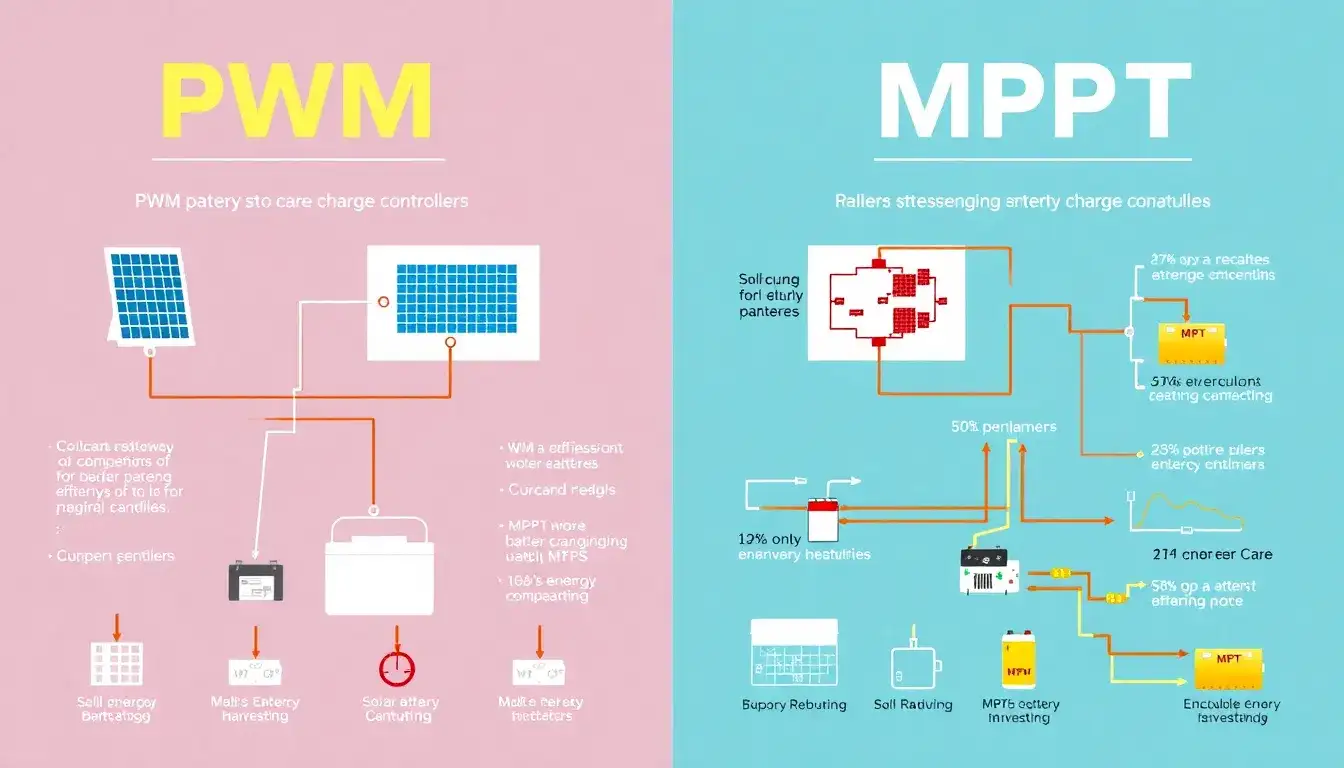
Differences Between PWM and MPPT Charge Controllers
PWM (Pulse Width Modulation) and MPPT (Maximum Power Point Tracking) charge controllers are two distinct types used in solar power systems to manage the flow of energy from solar panels to batteries. Understanding their differences is crucial for selecting the appropriate controller for your system.
Key Differences
- Operating Principle:
- PWM Controllers: Operate by rapidly switching the connection between the solar panel and the battery to maintain a constant battery voltage. Essentially, the array voltage is pulled down to match the battery voltage, which can result in efficiency losses.
- MPPT Controllers: Use advanced technology to track and adjust to the maximum power point of the solar panel’s voltage-current curve, ensuring that the panels operate at their optimal efficiency. This maximizes power output under varying conditions like temperature and shading.
- Efficiency and Performance:
- PWM Controllers: Are less efficient compared to MPPT controllers, with efficiency generally constant across different system sizes. However, they are simpler and more cost-effective, making them suitable for small systems or warm climates where efficiency differences are minimal.
- MPPT Controllers: Offer higher efficiency, especially in cooler conditions or when using high-voltage panels. They can increase energy harvest by 5 to 30% compared to PWM controllers, depending on the environmental conditions.
- System Size and Scalability:
- PWM Controllers: Best suited for small-scale applications with fewer panels, where the cost is a significant factor. They require that the solar panel and battery voltages match.
- MPPT Controllers: Ideal for larger solar systems due to their ability to handle higher voltages and optimize energy output across different configurations.
- Cost and Complexity:
- PWM Controllers: Generally cheaper and less complex, with fewer components that might fail.
- MPPT Controllers: More expensive due to their advanced technology but offer superior performance and flexibility.
- Environmental Performance:
- PWM Controllers: Perform well in warm and sunny conditions where voltage differences between the array and battery are minimal.
- MPPT Controllers: Excel in colder conditions or shaded environments, as they can capture and utilize excess voltage more effectively.
Choosing Between PWM and MPPT Controllers
- PWM is suitable for smaller systems where cost is a priority, and efficiency is less critical (e.g., small off-grid setups, RVs).
- MPPT is ideal for larger systems or those requiring higher efficiency and flexibility in varying environmental conditions (e.g., commercial solar installations, cold climates).
Ultimately, the choice depends on your system’s size, budget, and specific requirements.
Original article by NenPower, If reposted, please credit the source: https://nenpower.com/blog/what-are-the-differences-between-pwm-and-mppt-charge-controllers/

