

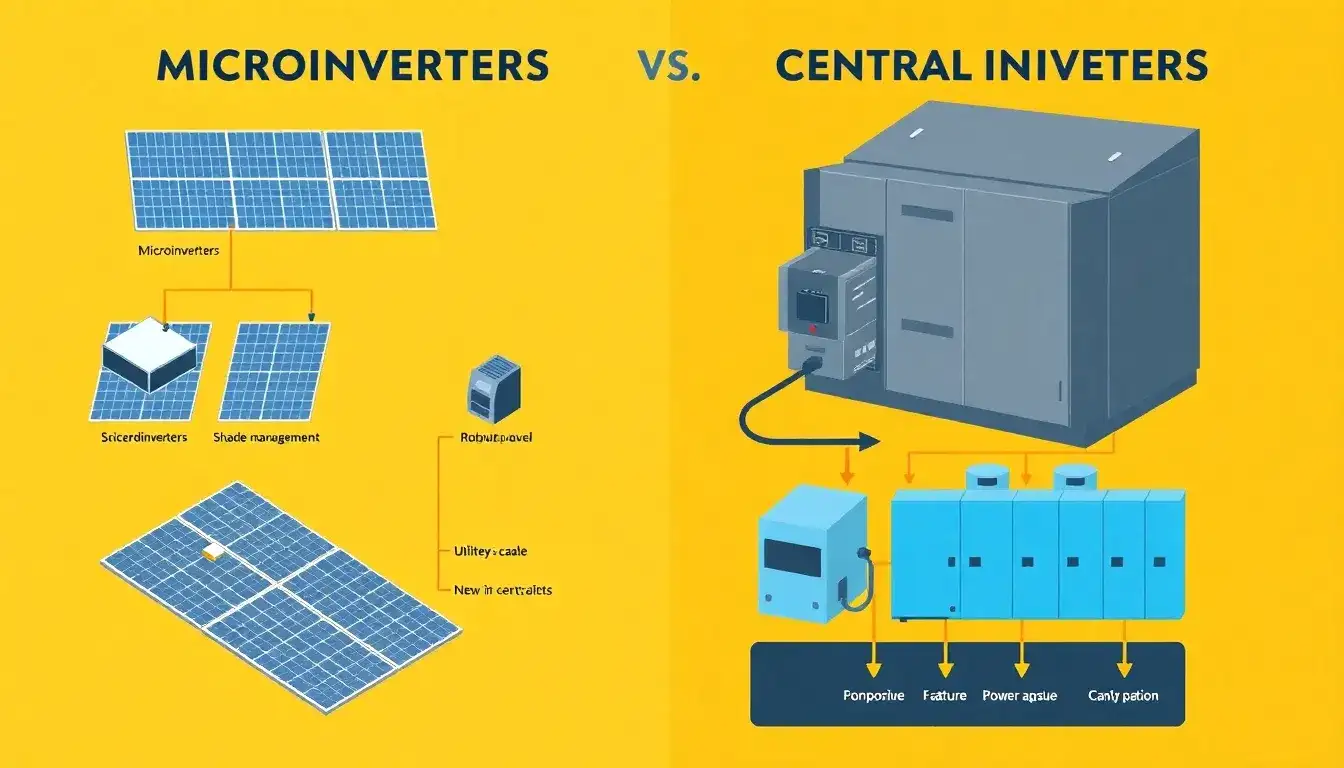
Key Differences Between Microinverters and Central (String) Inverters
| Feature | Microinverters | Central (String) Inverters |
|---|---|---|
| Location & Operation | Attached individually to the back of each solar panel; convert DC to AC right at the panel | One central inverter converts DC from all panels connected in series (a “string”) at once, typically installed on a wall or indoors |
| System Design | Panels operate independently in parallel wiring | Panels connected in series; the whole string affected by weakest panel |
| Performance Impact | A shaded or faulty panel affects only itself; other panels continue at full output | Shading or failure in one panel reduces output of the entire string |
| Monitoring | Allows panel-level performance monitoring | Provides system-level monitoring only; harder to identify which panel is underperforming |
| Durability & Location | Subject to weather conditions on the roof, which can reduce lifespan | Housed in temperature-controlled environments, generally more durable |
| Efficiency | Typically boosts energy production by 5-15%, especially in shading or complex roof scenarios | Efficiency limited by the lowest-performing panel in the string |
| System Uptime | Single microinverter failure affects only one panel | Inverter failure stops entire solar system |
| Expandability | Easier to expand by adding panels with corresponding microinverters | Adding more panels usually requires additional string inverter, more complex and costly |
| Safety | Converts to low-voltage AC at panel, reducing DC wiring hazards | High-voltage DC runs across the roof, increasing fire risk potential |
| Warranty | Longer warranties, often 25 years (matching panel warranties) | Shorter warranties, typically around 10-12 years |
| Cost | Higher upfront cost due to multiple inverters and installation complexity | Lower initial cost with one inverter but potential for higher long-term costs |
| Solar Clipping | Microinverter capacity limits can cause power clipping if undersized relative to panel output | Central inverters match panel wattage better, reducing power clipping risks |
| Best Use Cases | Complex roofs with multiple orientations, shading issues, future expansion plans | Simple, unshaded roofs with panels mostly in one orientation |
Detailed Explanation
1. Operation and Placement
Microinverters are installed on each panel, converting DC to AC electricity right at the panel, allowing each panel to function independently. Central inverters convert electricity from all panels connected in series at one central location, usually mounted indoors or in a protected area.
2. Performance and Efficiency
Because microinverters allow each panel to operate at its optimal performance independently, they can provide a 5-15% increase in overall energy production, particularly when shading or dirt affects some panels. In contrast, central inverters’ output is limited by the lowest performing panel in the string, and shading or damage to one panel affects the entire string’s output.
3. Monitoring Capabilities
Microinverters permit panel-level monitoring, making it easier to detect underperforming panels and perform targeted maintenance. Central inverters typically only monitor the entire system, requiring a process of elimination to find issues.
4. Durability and Environment
Central inverters are typically located in temperature-controlled environments, making them less susceptible to weather-related failures. Microinverters endure the same weather conditions as the panels they attach to, which can reduce their durability over time.
5. Safety Considerations
Microinverters reduce fire risk by converting DC to low-voltage AC on the roof, minimizing the amount of high-voltage DC wiring on the property. Central inverters involve high-voltage DC wiring across the roof, which carries higher risk in case of electrical faults.
6. Expandability and Maintenance
Microinverter systems are easier to expand by adding panels with their respective microinverters, without major rewiring or new inverters. In contrast, expanding a system with central inverters usually requires a separate inverter or complex rewiring.
7. Cost and Warranty
Microinverters have higher upfront costs because each panel needs an inverter, and repair can be more complex due to multiple points of failure. However, their warranties are longer (up to 25 years), matching the lifespan of solar panels. Central inverters are less expensive initially but have shorter warranties (around 10-12 years), often leading to replacement costs within the system’s lifespan.
8. Solar Clipping
Microinverters sometimes limit output if not properly sized to the solar panel wattage, causing power clipping and loss of potential energy. Central inverters typically have higher capacity to handle peak generation from panels without clipping.
Summary
- Microinverters are ideal for solar systems with shading issues, complex roof layouts, or plans for future expansion. They provide higher efficiency, panel-level monitoring, increased safety, and longer warranties at the cost of higher initial investment and potentially more complex maintenance.
- Central (String) Inverters suit simple, unshaded roofs where panels are oriented similarly. They offer a lower upfront cost, centralized durability, easier maintenance location, but are less efficient in partial shading conditions and more vulnerable to system-wide downtime if one inverter fails.
Choosing between microinverters and central inverters depends on your roof characteristics, shading, budget, and future system plans.
Original article by NenPower, If reposted, please credit the source: https://nenpower.com/blog/what-are-the-differences-between-microinverters-and-central-inverters/

