

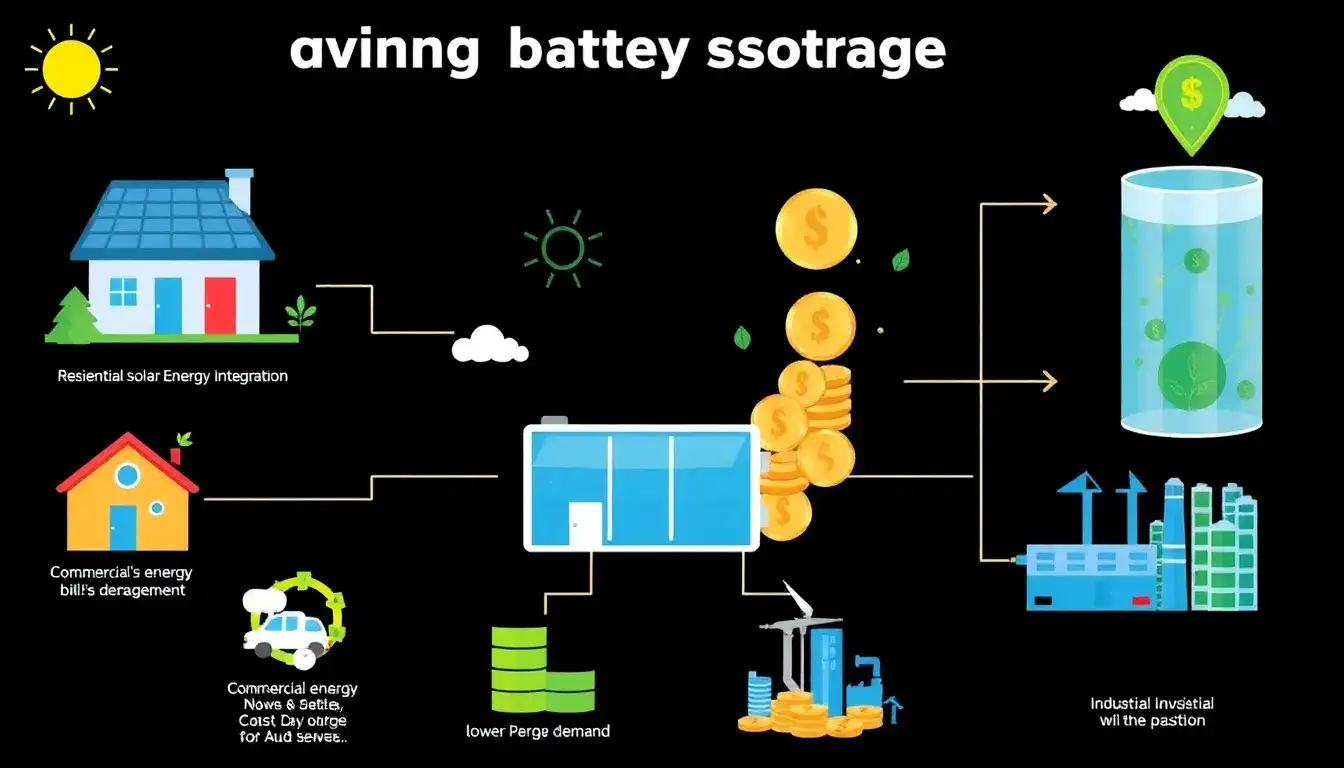
Battery storage systems offer significant cost savings through several mechanisms linked to declining costs, operational benefits, and enhanced renewable energy use.
Cost Reductions in Battery Storage
- Battery storage costs, especially for lithium-ion batteries, have dropped dramatically over the last decade—around a 90% decline from approximately $1,100 per kWh in 2010 to about $137 per kWh in 2022.
- Continued technological advancements, manufacturing optimizations, economies of scale, and increased demand for renewables are expected to further reduce total installed costs by 50-60% by 2030, with even greater reductions in battery cell costs.
- These cost trends have shifted batteries from being seen as prohibitively expensive to economical solutions for residential and commercial energy storage.
Direct Electricity Cost Savings
- Battery storage allows users to store electricity when prices are low and discharge it during peak demand when prices are higher, leading to substantial utility bill reductions for consumers, businesses, and utilities.
- For residential consumers using solar panels combined with battery storage, annual electricity bill savings can reach 70-85%, compared to approximately 50% savings without battery storage.
- Utility-scale deployments have demonstrated large-scale savings; for example, in Texas, energy storage helped consumers save $750 million in energy costs during the summer of 2024 alone.
Additional Economic and System Benefits
- Battery storage reduces reliance on fossil fuels by enabling greater use of renewable energy, facilitating cost-sharing benefits when co-located with solar projects, and improving system efficiency.
- It also mitigates the risk and costs associated with power outages and volatile fuel prices for the grid.
- Beyond direct cost savings, battery storage projects contribute economically by creating jobs (over 75,000 nationally) and generating over $580 million annually in tax revenue and land lease payments to local communities.
Summary Table
| Aspect | Cost Savings / Benefits |
|---|---|
| Battery price decline | ~90% reduction over last 10 years (to ~$137/kWh) |
| Projected cost decline | 50-60% further total installed cost reduction by 2030 |
| Residential savings | 70-85% reduction in electricity bills with solar+battery |
| Utility savings example | $750 million saved in Texas energy costs summer 2024 |
| Grid & system benefits | Reduced outage costs, improved renewables utilization |
| Economic impact | 75,000+ jobs and $580 million+ in annual community revenue |
In sum, battery storage systems provide substantial cost savings by lowering energy bills, enabling more efficient renewable energy use, reducing grid costs, and supporting local economies through job creation and tax revenues. These savings continue to increase as battery prices and system costs drop rapidly and technology improves.
Original article by NenPower, If reposted, please credit the source: https://nenpower.com/blog/what-are-the-cost-savings-associated-with-battery-storage-systems/

