

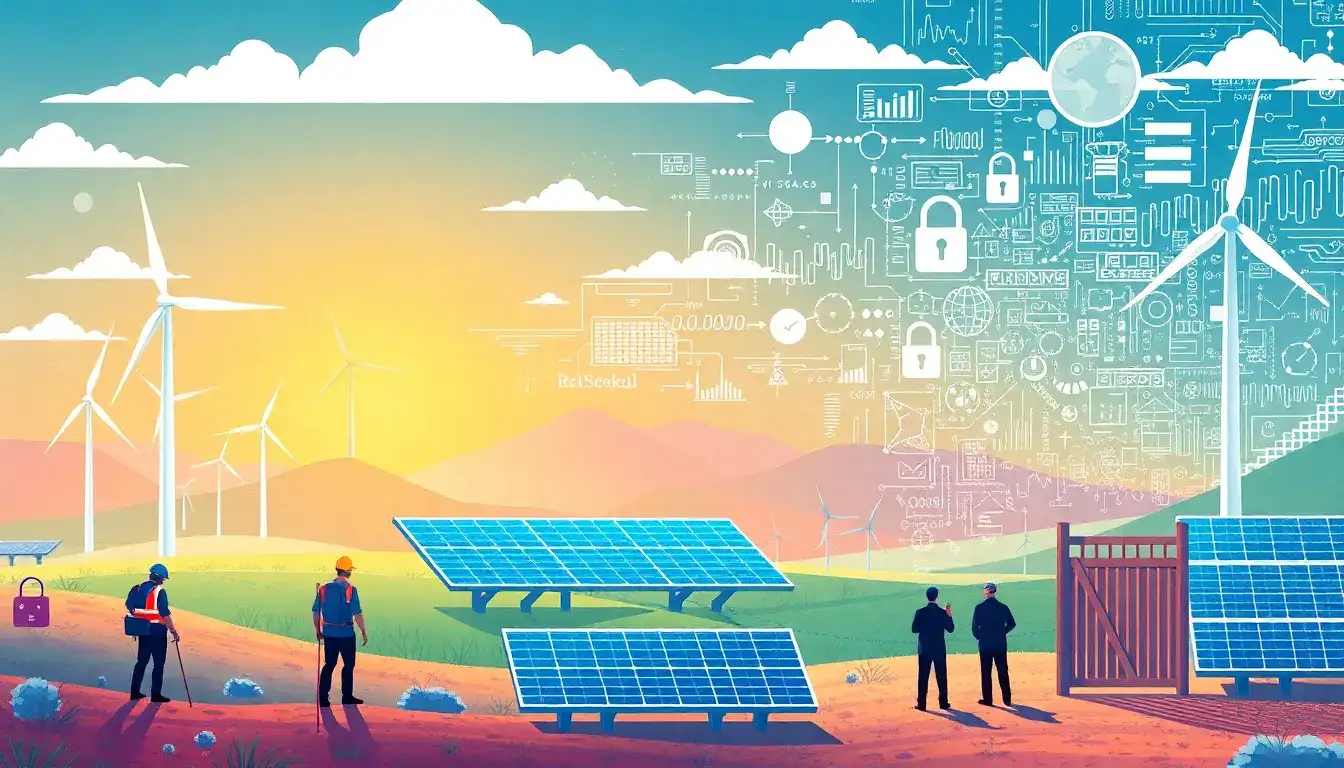
Implementing AI in Predictive Maintenance for Renewable Energy Faces Several Significant Challenges:
Data Quality and Availability
- Predictive maintenance relies heavily on high-quality, comprehensive data to train AI models. Often, data collected from renewable energy systems can be incomplete, noisy, or biased, which reduces prediction accuracy. Ensuring data cleanliness, completeness, and relevance is critical but difficult to achieve consistently.
Integration with Existing Infrastructure
- Many renewable energy installations, especially older ones, lack the necessary sensors and monitoring hardware required for real-time data collection and AI analytics. Upgrading or retrofitting these systems to enable predictive maintenance is expensive and labor-intensive.
- Integrating AI-based predictive maintenance tools with legacy energy infrastructure also presents technical challenges related to compatibility and system interoperability.
Organizational and Workforce Adaptation
- There is often resistance within maintenance teams to adopt AI-driven approaches, as they necessitate new skill sets, changes in workflows, and trust in automated decision-making. This cultural and human factor can slow down implementation.
Complexity of Renewable Energy Systems
- Renewable energy assets such as wind turbines and solar panels operate under highly variable environmental conditions, including fluctuating weather patterns. Modeling these complex, dynamic factors accurately requires sophisticated AI techniques, such as deep learning and digital twins, which still face development and deployment challenges.
Cost Considerations
- The initial investment to implement AI predictive maintenance—including sensor installation, data infrastructure, and AI model development—can be substantial. This upfront cost may deter some operators, especially smaller or less capitalized projects.
Scalability and Generalization
- AI models trained on one set of equipment or location may not easily generalize to different types of renewable energy assets or geographic conditions without re-training or customization, complicating widespread adoption.
In summary, while AI-powered predictive maintenance offers benefits like reduced downtime, lower maintenance costs, and extended equipment lifespan in renewable energy, challenges around data quality, infrastructure integration, workforce readiness, system complexity, and costs must be overcome for successful implementation.
Original article by NenPower, If reposted, please credit the source: https://nenpower.com/blog/what-are-the-challenges-of-implementing-ai-in-predictive-maintenance-for-renewable-energy/

