

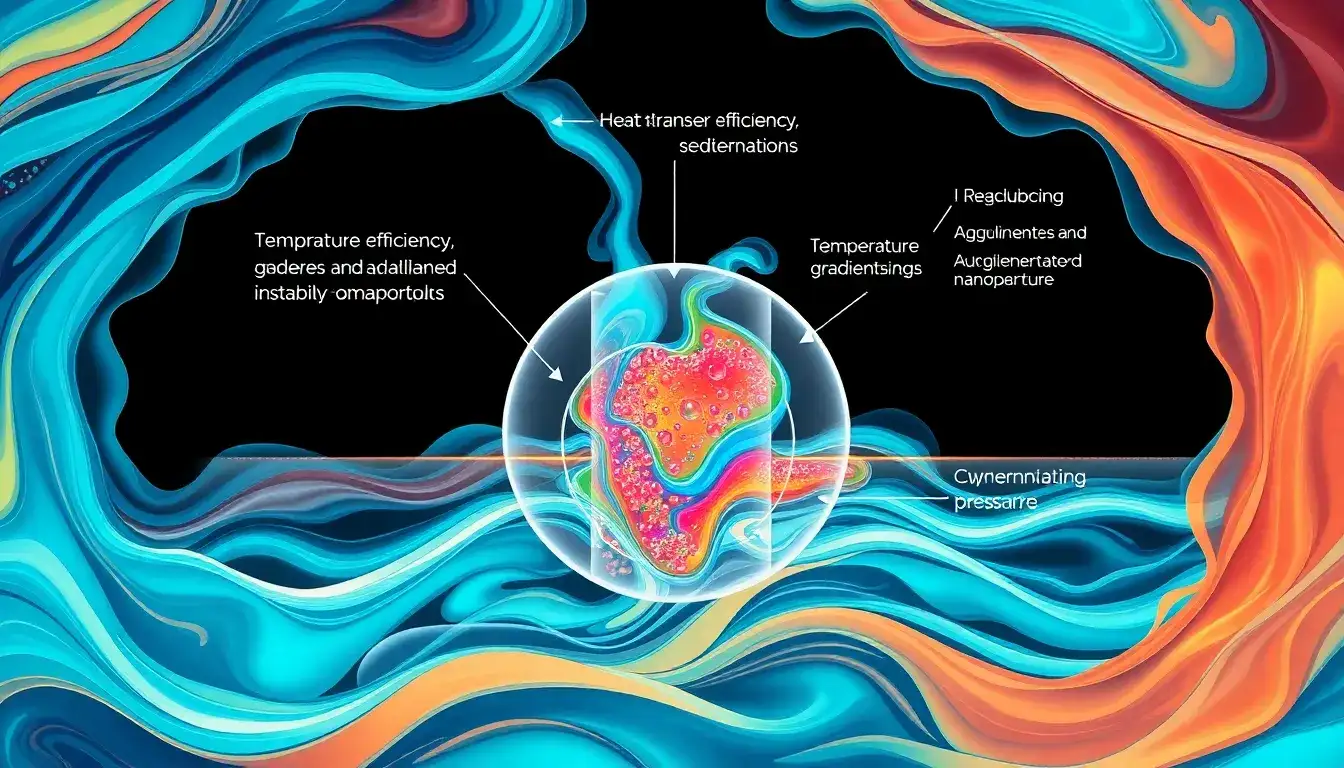
The use of nanofluids in thermal energy storage (TES) systems presents several challenges despite their potential to enhance thermal conductivity and heat transfer. These challenges include:
- Agglomeration of Nanoparticles: Nanoparticles in nanofluids tend to agglomerate or cluster together, which can significantly reduce the thermal conductivity benefits and degrade the overall performance of the TES system. This agglomeration makes stable long-term use problematic.
- Reduction in Specific Heat Capacity (SHC): While nanoparticles generally improve thermal conductivity, they may decrease the specific heat capacity of the nanofluid. This reduction can hinder the energy storage capacity and efficiency of the system, complicating the balance between enhancing heat transfer and maintaining energy storage.
- Stability and Longevity: Maintaining the stability of nanofluids over prolonged periods is difficult. Issues such as sedimentation or settling of nanoparticles affect the reliability and operational lifespan of TES systems. Ensuring stable dispersion without frequent maintenance or replacement remains a critical hurdle.
- Phase Change Material (PCM) Interaction: In systems combining nanofluids with PCMs for latent heat storage, challenges include PCM leakage during phase transitions and the proper encapsulation of PCMs. Nanoparticles can help improve PCM stability, but selecting appropriate PCMs and ensuring compatibility with nanoparticles add complexity to system design.
- Cost and Scalability: Producing nanofluids at scale with precise nanoparticle concentration and dispersion control can be expensive. The cost-effectiveness and feasibility of implementing nanofluid-enhanced TES in commercial or large-scale renewable energy systems require further development and optimization.
- Design and Optimization Complexity: The concentration of nanoparticles must be carefully controlled, as it directly influences the heat transfer rate and system performance. Achieving the optimal balance requires sophisticated modeling and experimental validation, adding to the design complexity.
In summary, while nanofluids offer promising improvements in thermal conductivity and energy storage efficiency, challenges related to nanoparticle agglomeration, reduced specific heat capacity, stability, PCM integration, cost, and system design complexity must be addressed to realize their full potential in thermal energy storage applications.
Original article by NenPower, If reposted, please credit the source: https://nenpower.com/blog/what-are-the-challenges-associated-with-using-nanofluids-in-thermal-energy-storage/

