

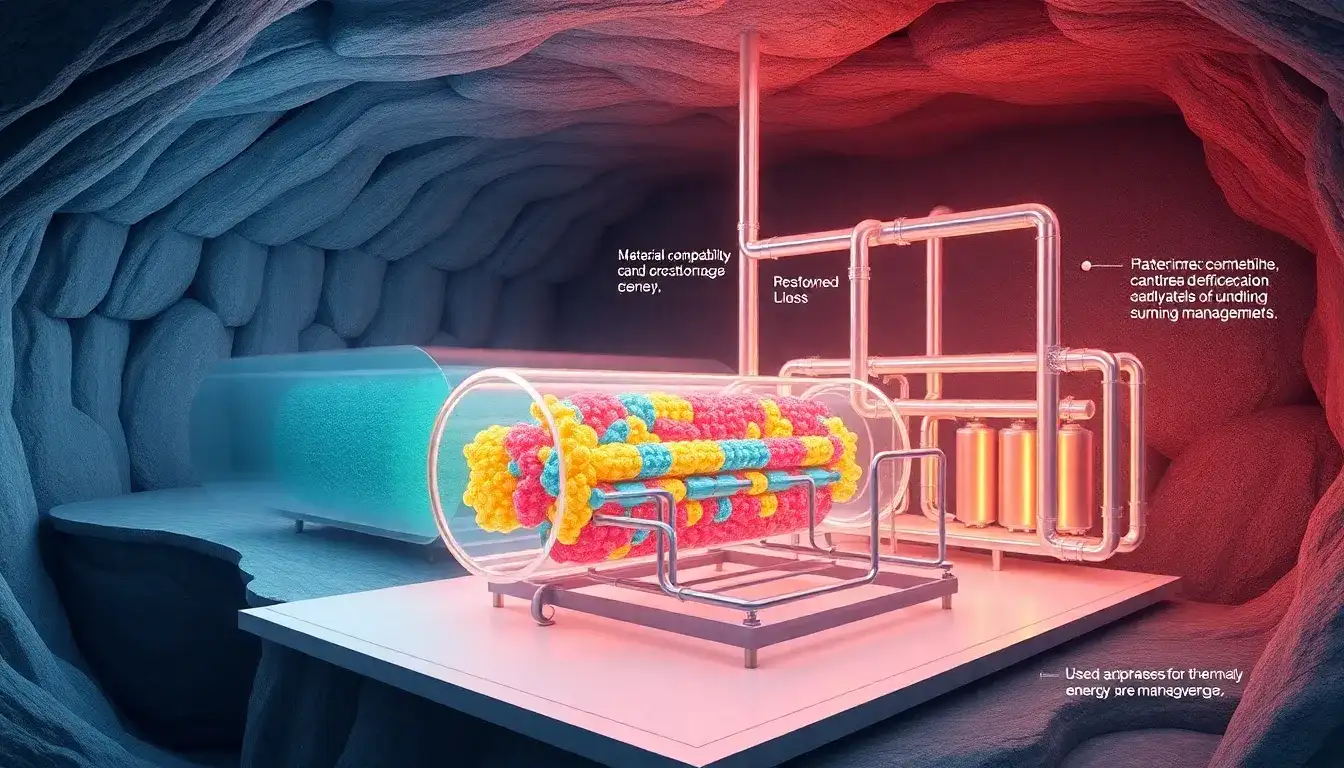
Integrating phase change materials (PCMs) into Compressed Air Energy Storage (CAES) systems presents several technical and practical challenges:
1. Low Thermal Conductivity of PCMs
PCMs typically have low thermal conductivity, which hampers the rate of heat absorption and release during phase transitions. This results in slower charging and discharging cycles for thermal energy storage, reducing system efficiency in dynamic CAES operations where rapid thermal exchange may be required.
2. Durability and Material Stability
Organic PCMs can degrade over time, impacting their thermal performance and reliability in long-term storage applications. This degradation can lead to diminished energy storage capacity and reduced lifecycle of the integrated system.
3. Cost Considerations
High-quality PCMs tend to be expensive, which can increase the overall capital costs of CAES systems. The need for customized PCMs tailored to specific temperature ranges or performance criteria may exacerbate these cost challenges.
4. Temperature Range Limitations
PCMs are effective only within narrow temperature ranges corresponding to their phase change points. CAES systems may require PCMs that operate efficiently across broader temperature spectra, especially in varying climatic conditions, which complicates material selection and system integration.
5. Integration Complexity and Scalability
Incorporating PCMs into CAES involves complex design considerations to ensure effective thermal management without excessive spatial or material requirements. The scalability of PCM integration can pose challenges in terms of materials customization, cost, and system footprint.
6. Trade-offs with Mechanical Properties (Specific to Structural Applications)
While more pertinent to concrete applications, the integration of PCMs can affect the mechanical strength and structural integrity if used in CAES infrastructure. This necessitates advanced material engineering to balance thermal storage benefits with mechanical durability.
Summary Table of Challenges
| Challenge | Description |
|---|---|
| Low Thermal Conductivity | Limits heat transfer rates, reducing charge/discharge efficiency |
| Durability | Organic PCMs degrade over time, impacting long-term performance |
| Cost | High-quality PCMs are expensive, increasing system costs |
| Temperature Range Limitation | Narrow operational temperature ranges constrain effectiveness in variable climates |
| Integration and Scalability | Material customization and system design complexity increase with scale |
| Mechanical Property Trade-offs | Possible reduction in mechanical strength when used in structural elements |
Overall, further research and development are needed to improve the thermal conductivity, durability, and cost-effectiveness of PCMs to make their integration into CAES systems practical and efficient. Enhancements such as adding conductive additives (e.g., copper nanoparticles or carbon-based materials) show promise but are still in early research stages. Addressing these challenges will be crucial for maximizing the potential of PCMs in enhancing CAES thermal management and energy storage efficiency.
Original article by NenPower, If reposted, please credit the source: https://nenpower.com/blog/what-are-the-challenges-associated-with-integrating-phase-change-materials-into-caes-systems/

