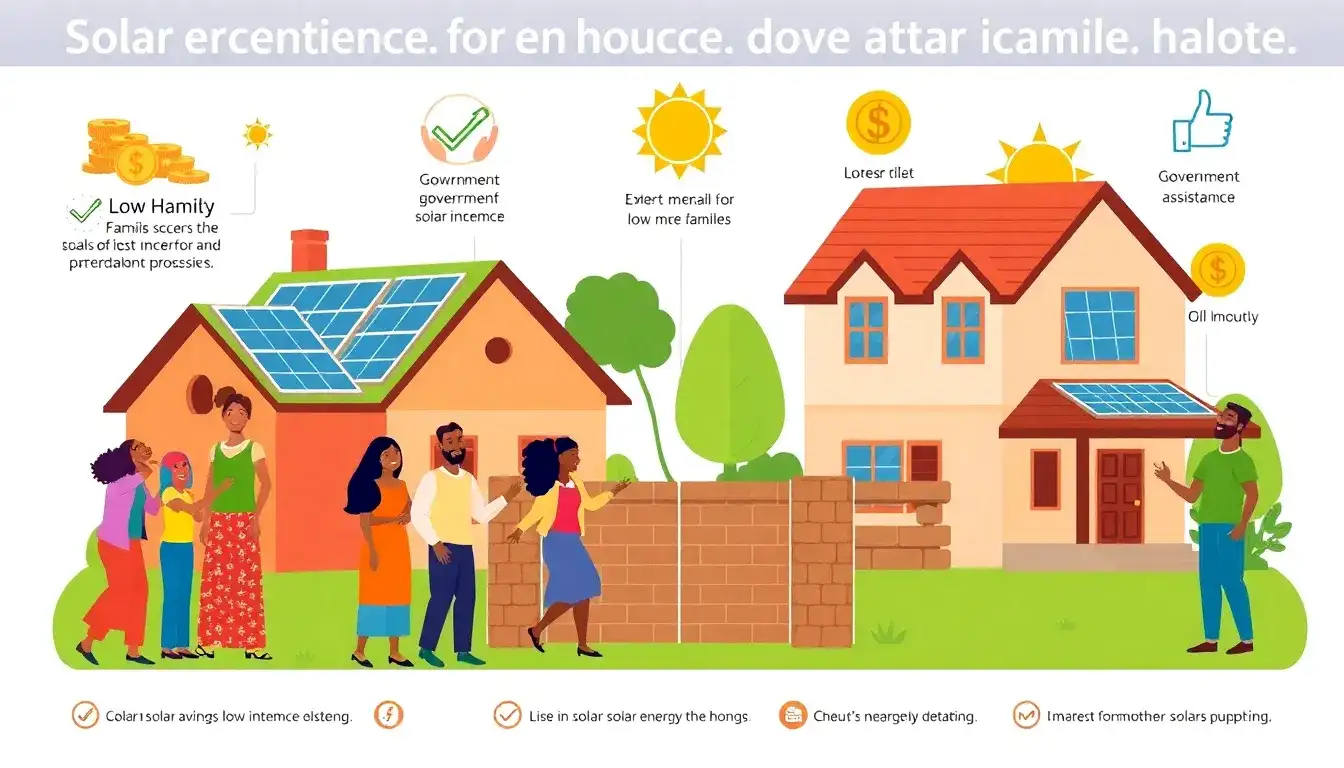
The best solar incentives for low-income families in 2025
in 2025 include a combination of federal, state, and local programs that offer grants, rebates, cash incentives, low-interest loans, and community solar options designed to reduce or eliminate the upfront cost of solar panel installations and energy storage. Key programs and incentives are:
Federal Programs
- Solar for All Program: Funded by the EPA, this program expands solar access to low-income and disadvantaged communities by offering grants that reduce energy costs and promote clean energy adoption nationwide.
- Low-Income Home Energy Assistance Program (LIHEAP): While primarily for utility bill assistance, some states allow LIHEAP funds to help cover solar energy improvements.
- Weatherization Assistance Program (WAP): Helps low-income households improve home energy efficiency, sometimes including solar installations.
- Federal Solar Investment Tax Credit (ITC): Enables homeowners to deduct a portion of solar installation costs from federal taxes. Though less directly beneficial to low-income families due to limited tax liability, it can be combined with state/local incentives to increase affordability.
Notable State and Local Low-Income Solar Incentive Programs
| Program / Location | Type of Incentive | Details |
|---|---|---|
| DAC-SASH (California) | Substantial cash incentives | For eligible low-income single-family households, lowers solar installation costs annually. |
| Solar For All (IL, NY, CO, D.C.) | Community and residential solar with bill assistance | Provides little-to-no cost solar installations and utility bill assistance via community solar. |
| SANAH (Nationwide focus on many states) | Grants and incentives | Financial assistance for single-family, multifamily, and community solar projects. |
| SMART Program (Massachusetts) | Incentive payments per kWh installed | For income-qualified property owners to reduce solar installation cost. |
| Oregon Solar Within Reach | Cash incentives per watt and per kWh storage installed | Up to $6,600 for solar, $11,700 for battery storage for income-qualified PGE or Pacific Power customers. Offers 40% rebate capped at $7,500 on solar panels and batteries. |
| Philadelphia Solar Rebate | Rebates with low/moderate-income set-aside | Solar rebate program with funds reserved for low- and moderate-income households, solar discounts via Solarize Philly group purchasing, and grants to reduce costs further. Low-interest loans (HEELP) also available at 1% APR for energy improvements. |
These programs often provide:
- Upfront incentives or grants that drastically reduce or eliminate the initial installation costs.
- Community solar projects allowing renters or those with unsuitable roofs to benefit.
- Cash rebates based on the size (watts) of solar systems installed.
- Assistance with battery storage to enhance energy independence and savings.
Summary of Best Solar Incentives for Low-Income Families in 2025
| Incentive Type | Benefit | Examples |
|---|---|---|
| Upfront cash incentives | Lowers initial installation costs | DAC-SASH (CA), Oregon Solar Within Reach |
| Utility bill assistance | Reduces monthly energy expenses | Solar For All programs (IL, NY, CO, D.C.) |
| Community solar access | Provides solar benefits without roof installation | Solar For All, SANAH |
| Rebate programs | Offers partial cost reimbursement | Philadelphia Solar Rebate, Oregon rebate (40%) |
| Low-interest loans | Affordable financing for energy upgrades | HEELP (Philadelphia) |
| Federal tax credits combined | Further reduces net cost via tax deductions | Federal ITC |
Together, these programs make solar energy more affordable and accessible for low-income families, helping them lower utility bills and gain energy independence while promoting environmental sustainability.
Original article by NenPower, If reposted, please credit the source: https://nenpower.com/blog/what-are-the-best-solar-incentives-for-low-income-families/