

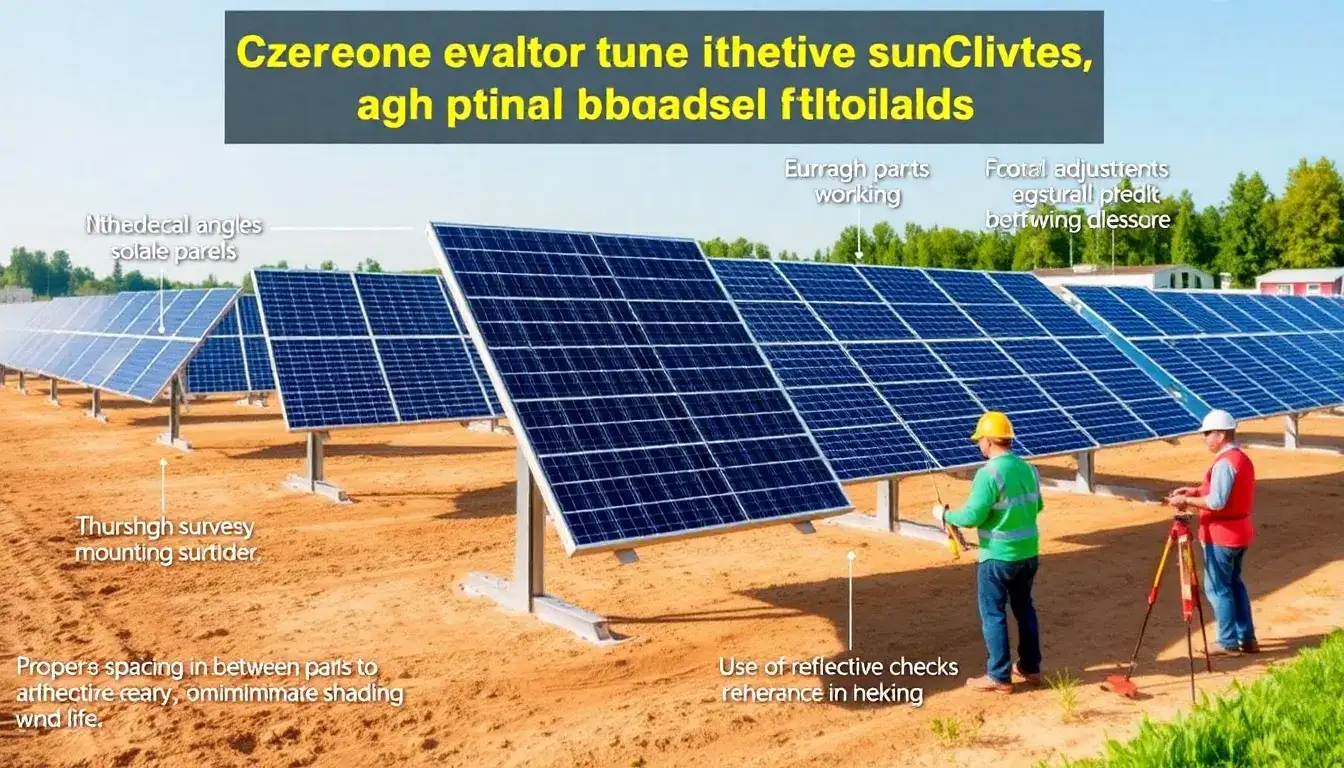
Best Practices for Alignment and Stability of Bifacial Solar Panels
1. Optimize Panel Height and Clearance
– Elevate bifacial panels higher than traditional monofacial panels, ideally at least 1 meter (3.3 feet) above the ground or roof to allow more reflected light to reach the rear side and improve airflow, reducing shading especially at the bottom edge. On sloped roofs, maintain at least 10-15 cm (4-6 inches) clearance behind panels.
– Recommended ground clearance for optimal irradiance uniformity and to avoid self-shading is about 42.5 inches (approximately 1.08 meters).
2. Implement Optimal Row Spacing
– Provide sufficient spacing between rows—starting at a minimum of 2.5 meters—to allow light to reach the ground and reflect back to the backside of the panels. Wider spacing can further enhance rear illumination.
– Design spacing with a ground coverage ratio (GCR) between 0.3 and 0.5 to balance land use and performance.
– Maintain row gaps of 3–5 inches between panels vertically to prevent snow buildup and shading effects in snowy climates.
3. Use Appropriate Mounting Systems
– Employ mounting systems designed specifically for bifacial panels that enable elevation and tilt optimization. Adjustable tilt mounts and tracking systems (single or dual-axis) can enhance sunlight exposure and energy yield by maintaining optimal panel angles throughout the day.
– Mounting structures should be securely fixed, level, and stable to withstand environmental forces such as wind and snow loads.
– Use light-colored or reflective materials for mounting rails and supports to increase reflected light onto the panel backsides and avoid opaque components that could cast shadows.
4. Optimize Panel Orientation and Tilt
– Align panels facing south in the Northern Hemisphere (or north in the Southern Hemisphere) with tilt angles typically between 20° and 30°, adjusted based on geographic location and seasonal solar angles to maximize direct and reflected sunlight.
5. Manage Shading and Site Conditions
– Select installation sites with high albedo surfaces such as white roofs, gravel, sand, concrete, or snow-covered ground to maximize rear-side reflected light.
– Avoid shaded areas near trees, buildings, or other obstructions that can block light on either panel side.
– Incorporate diffusers or scatterers, such as white paint on walls or fences, white gravel around mounts, or reflective film on barriers near the array to increase reflected light onto panel backs.
6. Cable and Component Placement
– Route electrical cables and connectors along the sides or back of panels using transparent or light-colored cable ties and conduits to minimize shading on the rear surfaces.
– Ensure all mounting and electrical components comply with safety and local building codes to guarantee long-term stability and performance.
7. Regular Maintenance and Testing
– Conduct periodic inspections and cleaning of both front and back surfaces of bifacial panels to remove dirt, dust, and snow that can reduce efficiency.
– Perform system tests after installation to verify proper electrical connections, mounting stability, and optimal power output.
Proper adherence to these guidelines helps maximize bifacial solar panel efficiency, improve energy yield by capturing sunlight from both sides, and maintain system durability and safety throughout the installation lifecycle. Elevated mounting, sufficient spacing, reflective surroundings, and careful mechanical and electrical installation are keys to ensuring proper alignment and stability.
Original article by NenPower, If reposted, please credit the source: https://nenpower.com/blog/what-are-the-best-practices-for-ensuring-proper-alignment-and-stability-of-bifacial-solar-panels/

