

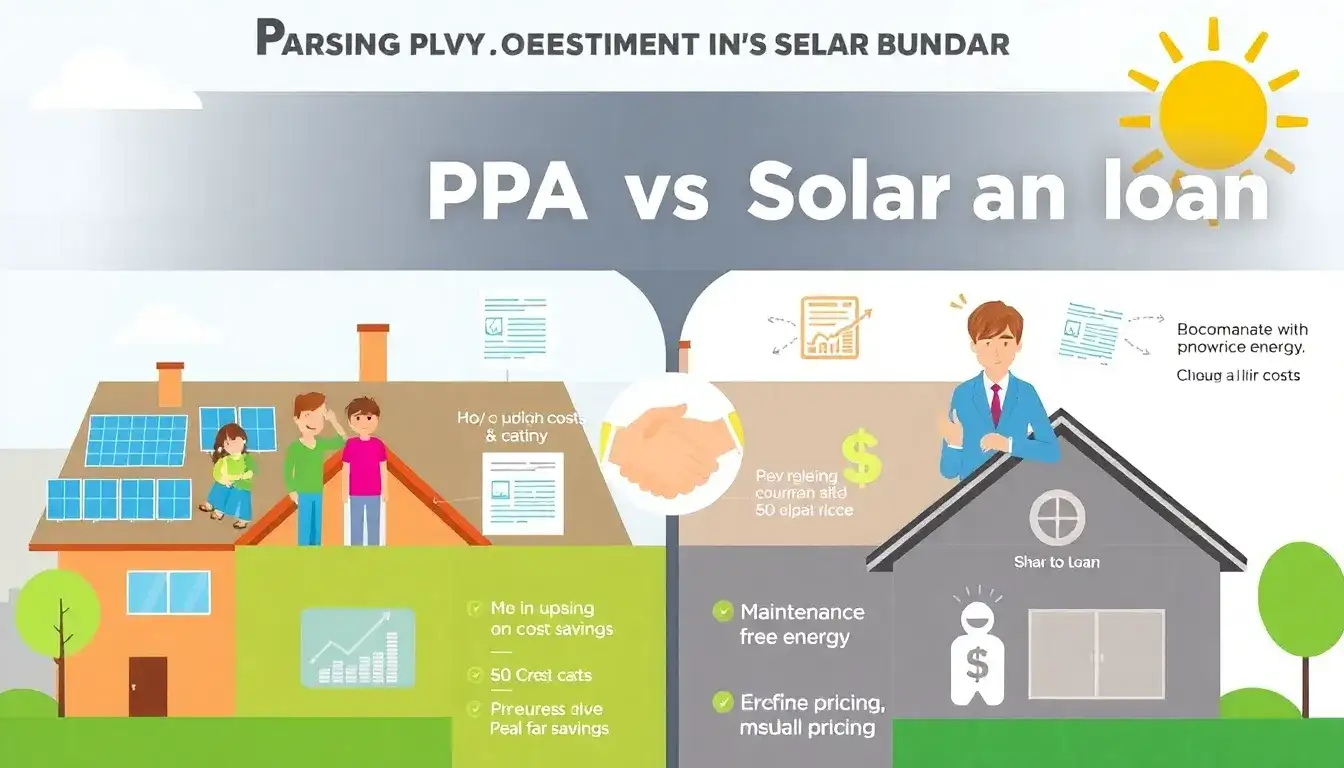
A power purchase agreement (PPA) offers several distinct advantages over a solar loan for customers interested in solar energy, especially for those who want to avoid upfront costs and maintenance responsibilities.
Key Benefits of a Power Purchase Agreement (PPA) over a Solar Loan
- No Upfront Costs
With a PPA, the solar developer finances, installs, and owns the solar system on your property, so you pay little to nothing upfront. In contrast, solar loans require either full or partial upfront payments or taking on debt from the start. - Immediate Energy Savings Without Debt
PPAs allow customers to start saving on electricity bills immediately because the electricity cost from the solar panels is typically lower than utility rates. These savings begin from the day the system is operational, without the burden of loan payments or interest. - No Maintenance or Operational Responsibilities
Since the solar developer or service provider owns the system under a PPA, they are responsible for all maintenance, repairs, monitoring, and system performance risks throughout the contract term. With a solar loan, the homeowner assumes these responsibilities. - Predictable and Stable Energy Rates
PPAs often feature fixed or pre-determined escalating electricity rates (typically 1-5% annual increases). This predictability helps customers avoid fluctuating utility prices and simplifies budgeting. - Lower Barriers to Access Solar Energy
PPAs enable homeowners who may not qualify for loans or lack the capital to still access solar energy benefits. This increases solar adoption among a broader segment of the population. - No Impact on Credit or Debt Load
Because a PPA doesn’t involve borrowing money, it won’t affect your credit score or increase your debt-to-income ratio, unlike a solar loan.
Tradeoffs to Consider (Compared to Solar Loans)
- No Ownership and Limited Incentives
With a PPA, the third party owns the system and typically keeps the federal tax credits and solar incentives, so you cannot claim these benefits yourself. Solar loans allow homeowners to own the system and claim these incentives directly. - No Increase in Property Value
Since you do not own the system under a PPA, it generally does not increase your home’s resale value, unlike a purchased or loan-financed solar system. - Contractual Obligations and Possible Escalators
PPAs often have long contract terms (10-25 years) during which you are obligated to pay fixed or escalating rates. This can sometimes lead to higher costs over the long term compared to owning panels outright.
Summary Table: PPA vs Solar Loan Benefits
| Feature | Power Purchase Agreement (PPA) | Solar Loan |
|---|---|---|
| Upfront Cost | $0 down; no upfront investment | Requires upfront payment or financing |
| Ownership | Owned by solar provider | Owned by homeowner |
| Maintenance & Repairs | Covered by provider | Owner responsible |
| Tax Incentives | Taken by provider, not homeowner | Claimed by homeowner |
| Immediate Savings | Yes, from day one | After loan payments start, savings can grow |
| Impact on Credit & Debt | None | May affect credit and debt load |
| Contract Length & Flexibility | Long-term contract with fixed/escalating rates | Loan term varies; ownership can be indefinite |
| Property Value Increase | No | Yes |
| Access for Low Credit/Capital | Easier to qualify | May require credit approval and down payment |
In conclusion, a solar PPA is best suited for customers seeking no upfront costs, predictable monthly payments, and no maintenance responsibilities, providing immediate energy savings without taking on debt. Solar loans, while requiring upfront investment and responsibility, offer greater long-term financial benefits through ownership, tax incentives, and property value appreciation.
Original article by NenPower, If reposted, please credit the source: https://nenpower.com/blog/what-are-the-benefits-of-a-power-purchase-agreement-ppa-over-a-solar-loan/

